




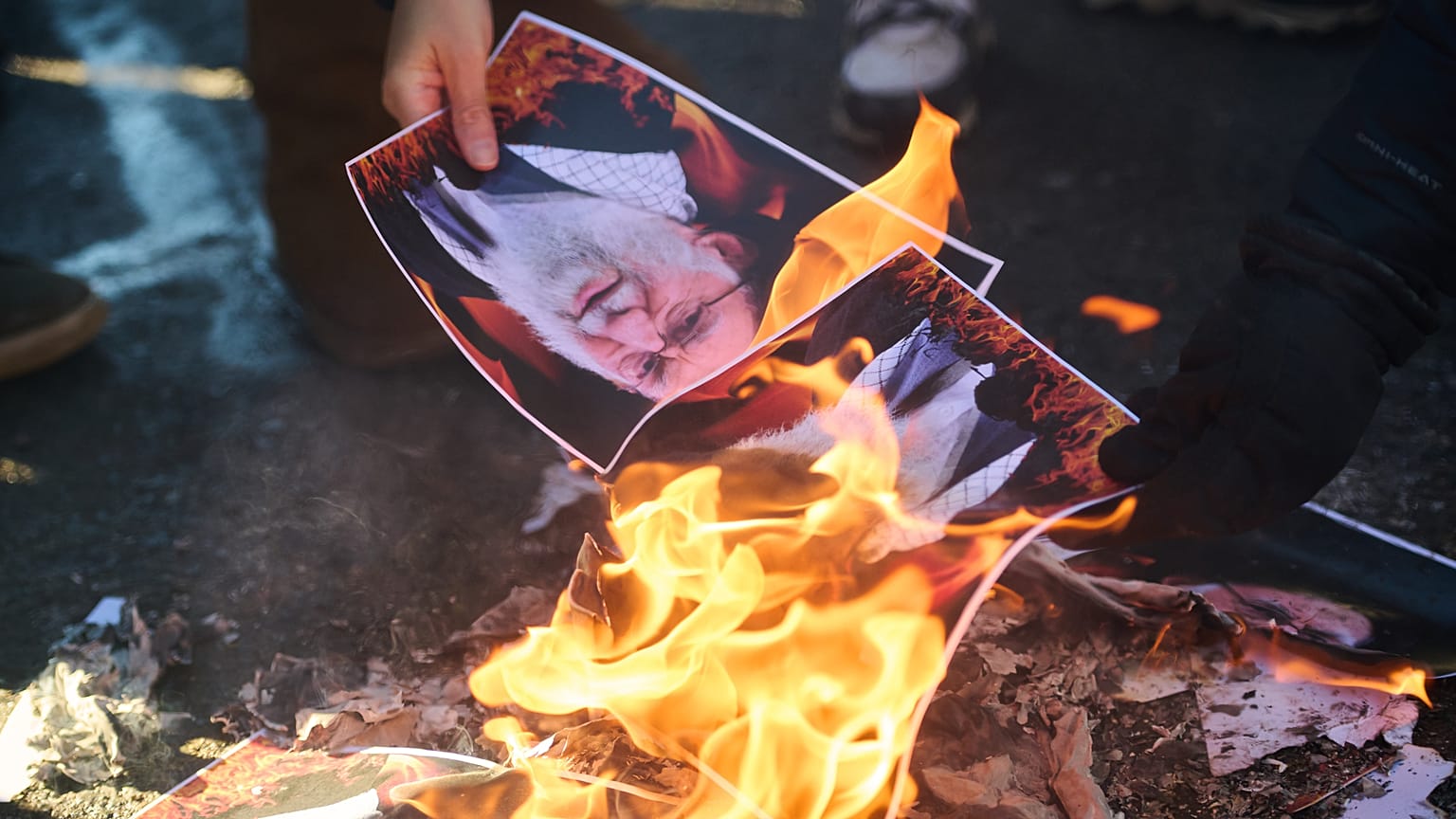













The US president is threatening strikes on Iran, this time in response to the Tehran's violent repression of protestors in recent weeks. Former Israeli Prime Minister Olmert says that if the endgame is regime change, only people can do that.
Any regime change in Iran should come "from within" and be led by "more moderate forces" than hardline Islamic fundamentalists, former Israeli Prime Minister Ehud Olmert told Euronews.
 ADVERTISEMENT
ADVERTISEMENT
ADVERTISEMENT
Olmert, who served as Israel’s premier between 2006 and 2009, spoke to Euronews just weeks after protests swept across Iran in early January.
According to the UN’s special rapporteur on Iran, Mai Soto, the unrest has resulted in at least 5,000 deaths, while insiders in Iran Euronews spoke to and human rights activists fear that the number might surpass 30,000.
Tensions between Iran and the United States have also been rising since President Donald Trump renewed pressure on Tehran, even threatening a “massive armada” if Iran refused to return to negotiations over its nuclear programme.
“In the end, the regime will be changed from within by the people of Iran — and I certainly hope so,” Olmert said. “But I hope it can happen without a massive number of Iranian citizens being killed by the country’s leadership.”
Olmert added that despite Trump’s warnings, he does not believe that even a major American military strike would bring about regime change. “With all due respect to President Trump and his threats, I don’t think that even a massive American attack will change the regime,” Olmert said.
'Same interests' in high-stakes negotiations
High-stakes talks between Iran and the US began on Friday morning in Oman, with Iran’s nuclear programme and the regime’s brutal repression of protesters high on the agenda.
Ahead of the discussions, White House press secretary Karoline Leavitt said Trump had been “quite clear” in his demands, including insisting on “zero nuclear capability.” Trump also warned that Iran’s Ayatollah Ali Khamenei “should be very worried.”
Regional powers are hoping the talks could lead to a broader easing of tensions, fearing any escalation would further destabilise the Middle East.
Olmert said he hoped for an agreement that would end Iran’s nuclear ambitions and also halt its ballistic missile programme, though he admitted he was not optimistic.
He argued that both Washington and Tehran have a shared interest in presenting Iran’s nuclear threat — long described by Israel as an attempt to develop nuclear weapons — as no longer urgent.
“I think both sides have the same interests, strangely enough,” Olmert said. “The Americans want to claim they have completely destroyed the nuclear programme because the president needs to show he is a great winner. The Iranians, meanwhile, want to convince the Americans they have already done enough.”
Others, including Anour Gargash, adviser to the UAE president, have urged Tehran to seize the opportunity for diplomacy, rebuild its economy, and avoid another regional confrontation.
US Secretary of State Marco Rubio insisted that meaningful progress would require broader discussions beyond nuclear issues, including Iran’s ballistic missile capabilities, its support for armed groups across the region, and its treatment of its own citizens.
While there are no clear signs the Iranian regime is on the verge of collapse, mounting pressures — including economic mismanagement, corruption, heavy sanctions, currency instability, and soaring inflation — have placed the leadership under unprecedented strain.
Trump has not clarified whether regime change is an objective of any potential strikes, and Olmert warned that further US interference could backfire by strengthening the regime while it remains vulnerable.
He also noted that Iran is still recovering from last summer’s Operation Midnight Hammer, which severely damaged nuclear facilities and exposed weaknesses in air defences and intelligence.
“I don’t think negotiations will change it,” Olmert concluded. “In fact, perhaps the opposite — negotiations may strengthen the Revolutionary Guards and the ayatollahs, allowing them to carry on.”