





























The deal was signed after nearly two decades of on-and-off negotiations between Brussels and New Delhi.
On Tuesday, 27 January, the European Union (EU) and India announced the signing of a landmark trade agreement, which Ursula von der Leyen described as the “mother of all deals.”
 ADVERTISEMENT
ADVERTISEMENT
ADVERTISEMENT
What does this pact mean for both countries? And why did the president of the European Commission’s outfit go viral?
To answer these and more questions, Euronews’ weekly podcast Brussels, My Love?talked to EU-India expert Stefania Benaglia, correspondent Teresa Küchler, and EU-India media commentator Rahul Venkit.



The free trade agreement
The Brussels–Delhi trade deal talks came to an end after almost two decades of on-and-off negotiations.
Under the free trade agreement, India will reduce or eliminate duties on 96.6% of EU goods exports, while the EU will reduce tariffs on 99.5% on goods imported from India over seven years.
Yet, as Benaglia explained, this is only the start of a much broader project. The EU–India bilateral summit, which took place in New Delhi at the beginning of the week, “is more than a symbol, it’s actually meaningful,” she told Euronews.
“The FTA [free trade agreement] is one part of it, and I would dare even say it is not the major one.”
Benaglia underlined that important discussions on security and defence also took place, making the summit particularly significant.
Venkit explained that in India, this deal was perceived as a big concession to the EU.
“This is exceptional for a very traditionally protectionist country like India,” he explained. “And now it’s time for Europe and European companies to put their money where their mouth is, come and invest in India.”
Von der Leyen’s outfit
European Commission’s chief Ursula von der Leyen caught the attention of the Indian media for the outfits she wore during her diplomatic visit to Delhi.
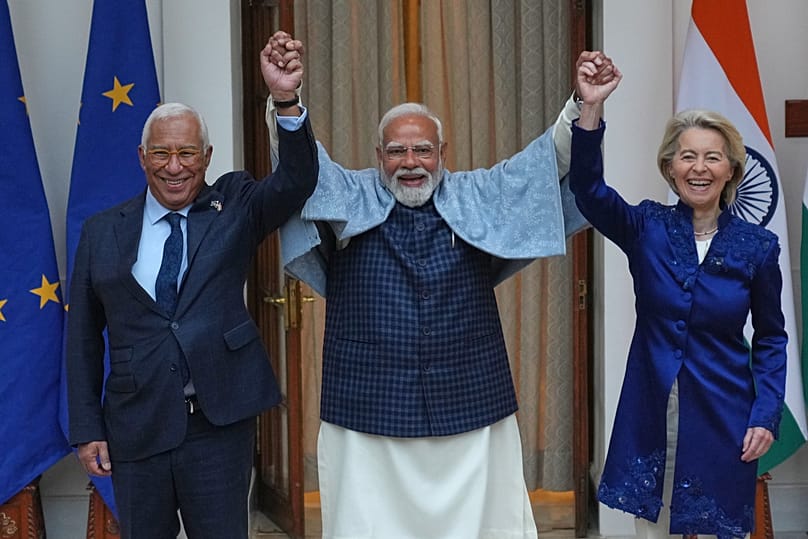
Von der Leyen wore traditional Indian dress that drew praise from Indian media and as Venkit noted, was viewed as an expression of cultural respect rather than appropriation.
Even Teresa Küchler ended up writing about this, something she would normally avoid, as writing about female politicians’ outfits is inappropriate.
She wrote about it because of the choice itself and its timing. “Everything about the dress, the timing of the deal, and the geopolitical moment was perfect for this meeting,” she said.
The deal comes at a crucial time for international relations and global trade, especially in light of the tariff policies of the United States administration.