




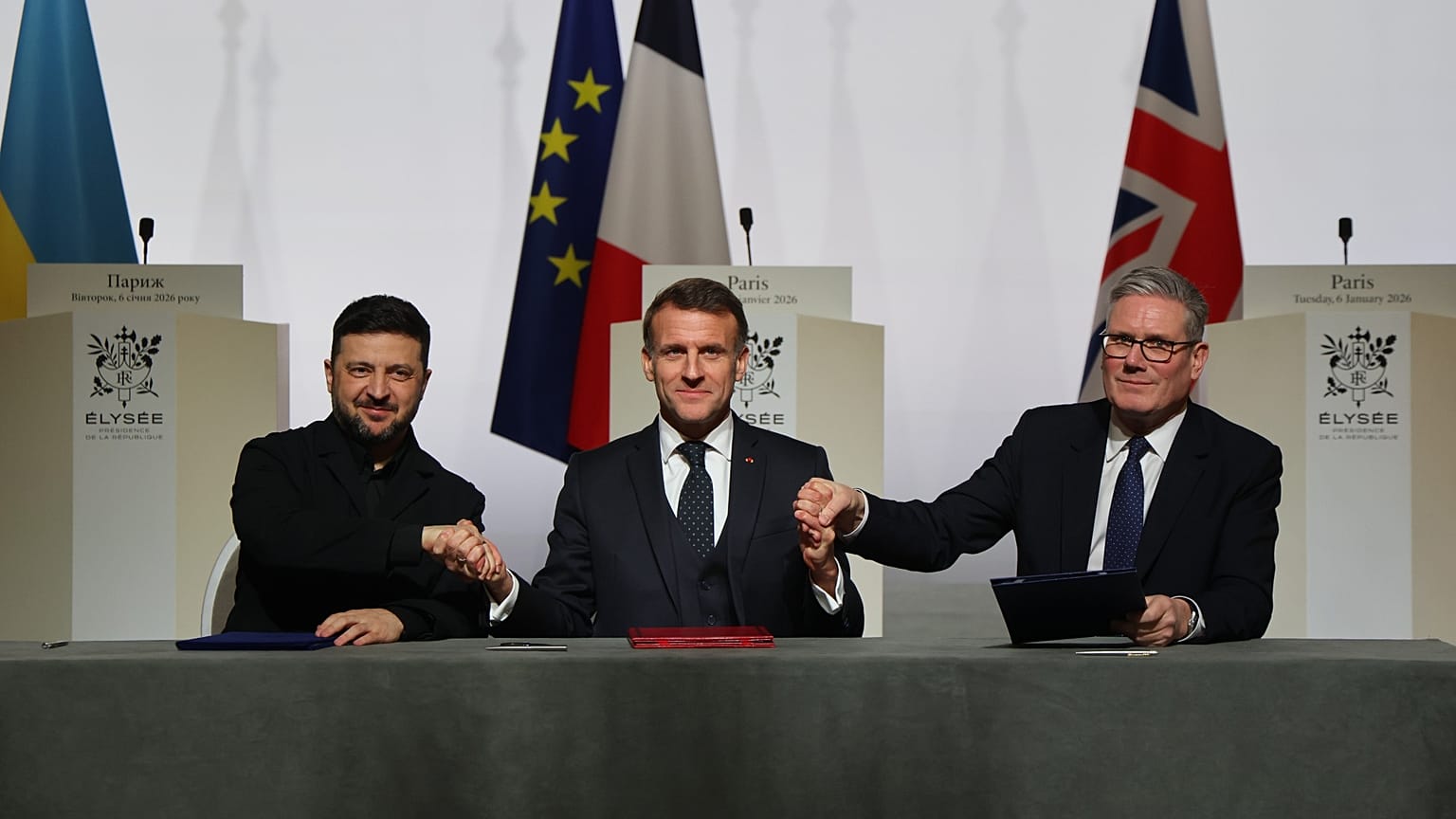














The security guarantees for Ukraine envisioned by the "Coalition of the Willing" and the United States include a high-tech mechanism to monitor a ceasefire, a multinational force led by France and the UK, and a legally binding obligation to assist Kyiv in case of a future Russian attack.
France and the United Kingdom have confirmed their intention to deploy their soldiers on Ukrainian soil after an eventual ceasefire as part of a broader package of security guarantees for Kyiv to avoid a repeat of Russia's full-scale invasion in the future.
 ADVERTISEMENT
ADVERTISEMENT
ADVERTISEMENT
The commitment was signed in a formal declaration by French President Emmanuel Macron, British Prime Minister Keir Starmer and Ukrainian President Volodymyr Zelenskyy at the end of a meeting of the "Coalition of the Willing" in Paris on Tuesday.
"I can say that following a ceasefire, the UK and France will establish military hubs across Ukraine and build protected facilities for weapons and military equipment to support Ukraine's defensive needs," Starmer said at the conclusion.
Macron said the multinational force would be deployed "away from the contact line" in the air, sea and land to provide the necessary "reassurance" so that Russia does not attack Ukraine again. Turkey, he said, would join in the operation with maritime support.
"The security guarantees are the key to ensuring that a peace agreement can never mean the surrender of Ukraine or a new threat to Ukraine," Macron said.
The guarantees discussed on Tuesday by allies would also involve a high-tech mechanism to monitor a ceasefire led by the United States and a legally binding obligation to assist Ukraine in the event of a renewed Russian attack.
The obligation, which appears to be modelled after NATO's Article 5 of collective defence, could mean military aid, but also logistical, economic and diplomatic.
Critically, it would require a ratification by national parliaments, a step that could prove difficult to pass in countries where support for Ukraine is fraying. In the case of the United States, it would go through the US Congress for approval.
It remains unclear how much each member of the coalition would contribute, both in the multinational force and the Article 5-like obligation.
After Tuesday's meeting, German Chancellor Friedrich Merz said his country's contribution would require the consent of the Bundestag and limited the deployment of military troops to countries neighbouring Ukraine.
But Merz also said: "We fundamentally don't rule anything out."
Spanish Prime Minister Pedro Sánchez announced he would launch talks with the main parties to discuss Spain's contribution, which, he said, could have a troops component.
"There's an open door for 2026 to become the year when the war ends. This is very good news," Sánchez said. "Europe never wanted this war."
'Huge step forward'
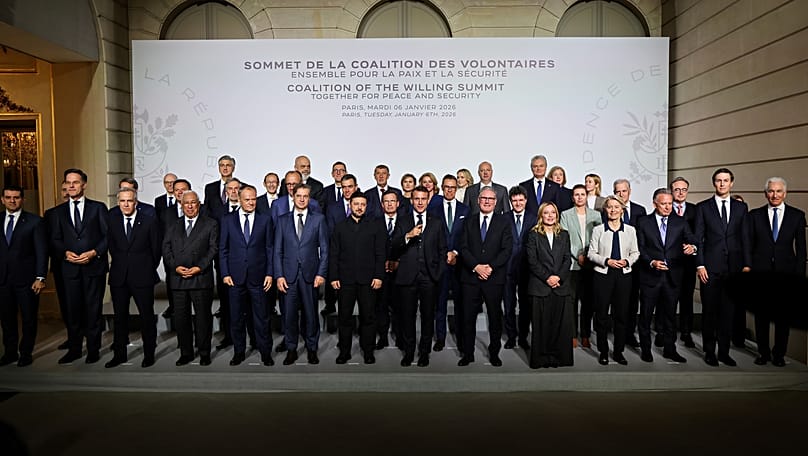
Tuesday's gathering saw leaders from almost 30 Western countries, alongside representatives from Turkey, Australia, Japan and New Zealand, come together.
The US delegation was led by Steve Witkoff and Jared Kushner, the two chief negotiators appointed by President Donald Trump, marking the first time they attended the format in person. Secretary of State Marco Rubio was originally planned to attend, but the recent events in Venezuela prompted a change in his schedule.
"President Trump's mandate is that he wants peace in Ukraine, and we're determined on his behalf to do everything possible," Witkoff said.
Also present in Paris were European Commission President Ursula von der Leyen, European Council António Costa, High Representative Kaja Kallas and NATO Secretary General Mark Rutte. Alexus Grynkewich, the Supreme Allied Commander Europe (SACEUR), who is the highest military authority in NATO, participated in the meeting too.
"We collectively stand by Ukraine, and a safe, secure prosperous future lies ahead," von der Leyen said, calling the meeting a "strong display of unity".
Leaders sought to flesh out and clarify the security guarantees structured along five main pillars: the US-led verification mechanism, military support for the Ukrainian army, the multinational force led by France and the UK, the legally binding obligation to assist in the event of a new attack and long-term defence cooperation with Ukraine.
The obligation to assist Ukraine was first pitched after a meeting in Berlin last month, where it drew comparisons with Article 5 of collective defence, the core foundation of the transatlantic alliance, even if leaders did not use that term publicly.
For Kyiv, a credible deterrent is an indispensable condition to abandon its constitutionally enshrined aspiration to join NATO, which Moscow firmly opposes and Washington does not support under President Donald Trump.
Still, the path for an Article 5-like guarantee is riddled with questions.
European governments would have to convince their parliaments, many of which are paralysed by political deadlock, to agree to an exceptionally consequential commitment.
The obligation to assist Ukraine in case of an attack would rely on a mechanism to monitor an eventual cessation of hostilities. This mechanism, envisioned as a system of high-tech sensors across the contact line, would be of critical importance because it would serve to verify potential breaches and allocate responsibility.
If allies were to conclude that Russia is to blame, the Article 5-like assistance would come into play. Triggering the provision would ultimately be a political, not automatic, decision, according to European officials briefed on the discussions.
Zelenskyy hailed Tuesday's meeting as a "huge step forward" but noted the efforts were still not enough. "It will be enough when the war in Ukraine will end," he said.
At this stage, Russia has not given indications that it is willing to compromise on a peace deal and end the war, maintaining the pace of drone and missile strikes against Ukrainian cities, killing scores of civilians and infrastructure.
"We can only get to a peace deal if Putin is ready to make compromises, "Starmer said. "For all Russia’s words, Putin is not showing he's ready for peace."