
















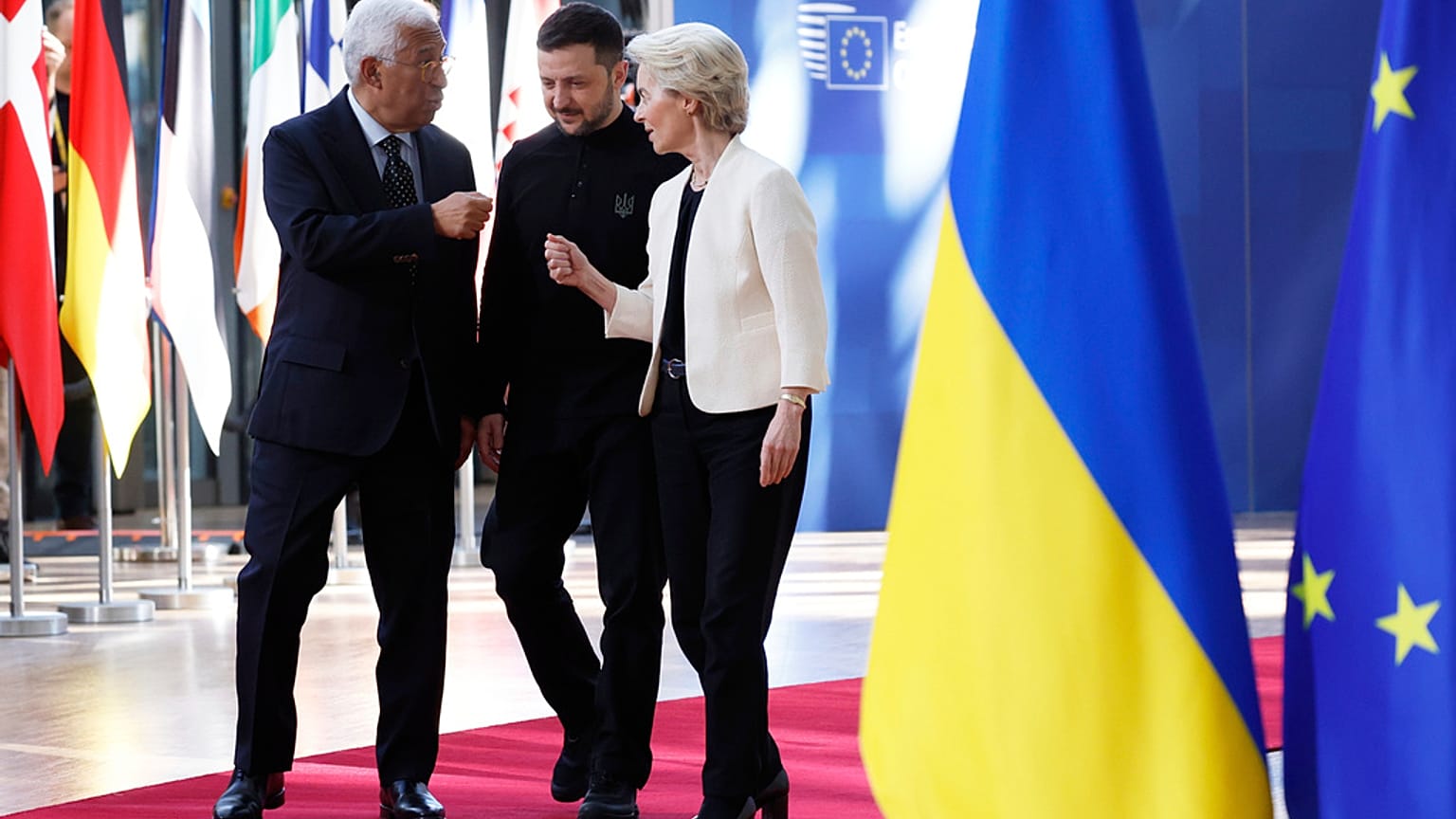













Under a reported US peace plan, Ukraine would join the EU as early as January 2027 as part of broader security guarantees. But Denmark's Minister for European Affairs told Euronews that this alone cannot shield Ukraine from future Russian aggression.
European Union membership alone is insufficient to guarantee Ukraine's future security as part of a peace settlement, although it's "undoubtedly" a key part of the answer, Danish European Affairs Minister Marie Bjerre has told Euronews' flagship interview programme, 12 Minutes With.
 ADVERTISEMENT
ADVERTISEMENT
ADVERTISEMENT
Ukraine would be slated to join the European Union as early as January 2027 as part of security guarantees reportedly put forward in peace negotiations mediated by the United States. However, the deadline has been met with scepticism by the EU, which repeatedly emphasises that accession is a "merit-based" process.
"I think it is fair that EU accession is a part of the talks when we're talking about peace with Ukraine, because the EU membership is undoubtedly a part of the long-term security and stability for Ukraine, having a more stable country," Bjerre told Euronews.
"But when we talk about security guarantees, the EU membership is not enough," she added.
The timeline proposed by the US in its plan for Ukraine has also been dismissed as unrealistic, as the EU accession process is complicated with Ukraine required to implement a raft of reforms, including to further clamp down on corruption and bolster the rule of law.
Members can only join when they meet the strict standards set by the bloc.
"I hear all of those rumours [about a timeline for Ukraine], and to be frank, we hear a lot of things from over the sea," Bjerre said, referencing the US.
"We have never put a timeline on either Ukraine or Moldova or on the countries in the Western Balkans, because it is a merit-based approach, and we stand with that."
In other words, the EU will not bow to the pressure imposed by the US. "Of course, we would like to see them joining the EU sooner rather than later, but they have to deliver, and they have to reform. We're not going to lower the bar. We will help them reach the bar," she said.
Side-stepping Hungarian veto
The Danish government has held the Presidency of the Council of the EU since 1 July 2025, setting the agenda in Brussels. At the start of the presidency, Bjerre said clearly that advancing Ukraine's application to join the EU would be a key focus. Nearing the end of this period, she said she was satisfied with the progress made.
"Advancing the EU enlargement process with Ukraine has been and is one of our top priorities, because we live in uncertain times. We need a stronger Europe, a Europe that is more secure, that can defend itself," she said. "We don't want any of the candidate countries to turn their gaze to Russia."
However, aside from being merit-based, entry to the EU also requires a unanimous vote from all 27 members. Here lies the crux of the matter, as Hungary has consistently voiced opposition to Ukraine joining.
For this purpose, the EU and Ukraine earlier this month drew up a to-do list that will allow Ukraine to informally proceed with the reforms it’s expected to implement, ensuring technical negotiations continue despite Budapest's entrenched opposition.
"I am extremely satisfied and proud that we actually managed to find a new approach where the enlargement procedure is not at a standstill, but is in fact very much alive, that we are moving with Ukraine and also Moldova, because we are now taking this new approach," Bjerre said.
"That approach will be continued during the next presidency," she said, referring to the Cypriot Presidency, which starts on 1 January 2026.
"So even though Hungary is blocking, we have moved on the enlargement agenda because we knew before we took over the presidency that it would be a problem with Hungary. They were also blocking during the Polish presidency. They are still blocking."
Asked whether this risks further entrenching Hungarian Prime Minister Viktor Orbán's opposition, Bjerre noted that Ukraine's ability to deliver increases pressure on Hungary.
"We need all countries on board. But I think that when Ukraine is making the reforms, is getting closer to the EU day by day, they can't keep blocking," she said.
"Ukraine in the EU will be a huge benefit, not just for Ukraine, but also for the EU. For instance, when it comes to our defence and security, having an integrated defence with Ukraine would really boost our security. So I think as long as Ukraine is moving that way, we are also able to increase the pressure on Hungary," she concluded.