




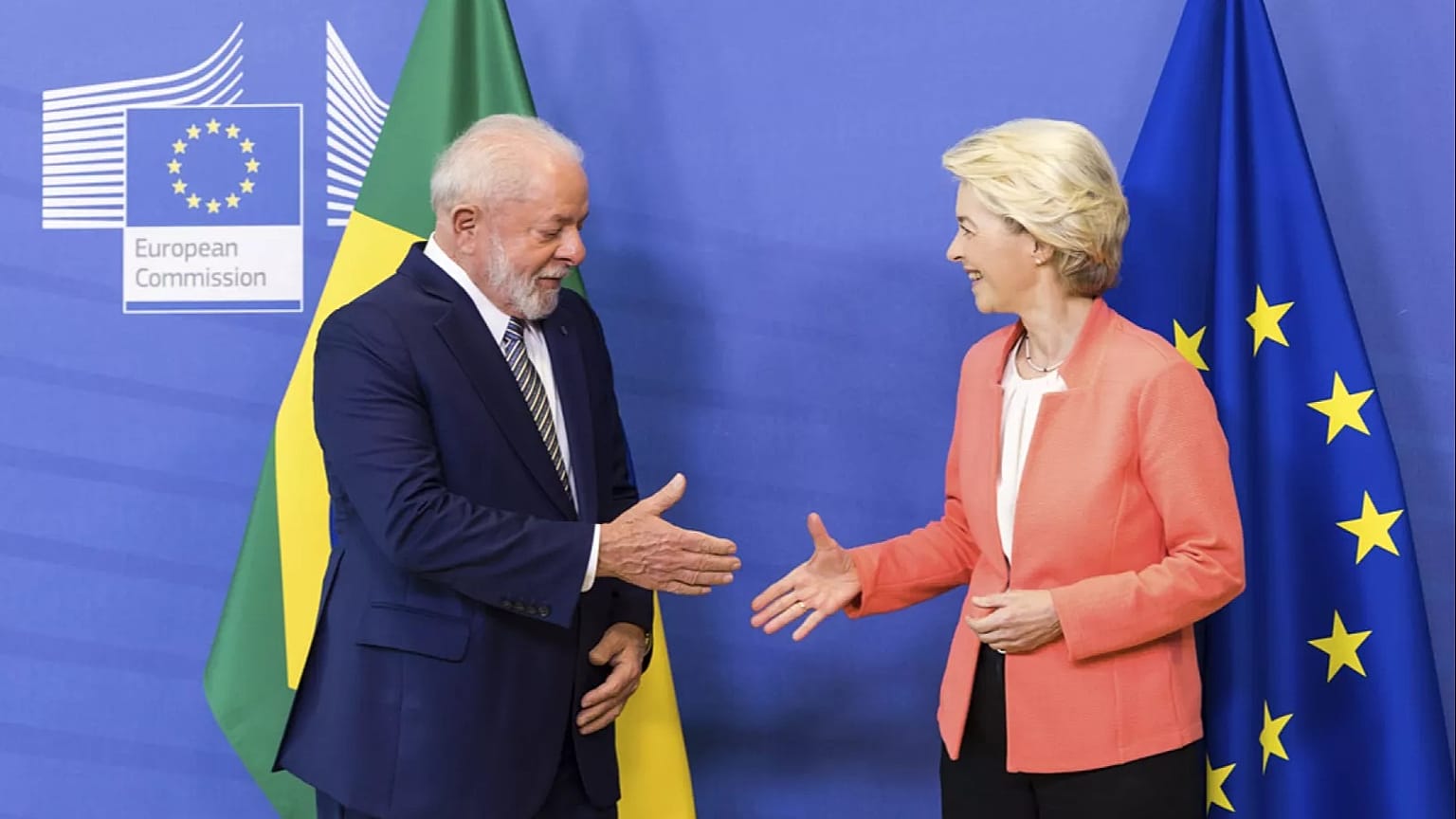













Twenty-five years after negotiations began, the fate of the free trade agreement between Mercosur and the EU is nearing its conclusion, but the struggle between backers and opponents remains tough.
EU Commission President Ursula von der Leyen and European Council President Antonio Costa plan to travel to Brazil on 20 December for the signing of the contentious agreement with the Mercosur trading bloc of South American countries.
 ADVERTISEMENT
ADVERTISEMENT
ADVERTISEMENT
The Commission, which has been negotiating the deal for 25 years, is confident a majority of EU member states will support it. But EU diplomats say the arithmetic remains uncertain, with the split between supporters and opponents still razor-thin.
The next ten days will be decisive.
The deal was concluded in December 2024 by Argentina, Brazil, Paraguay and Uruguay with the EU aims to create a transatlantic free-trade zone.
But the liberalisation it entails doesn’t make everyone happy.
Italy in the spotlight
France has led the opposition for years, arguing that Mercosur imports would create unfair competition for its farmers.
Paris is still campaigning against the pact, demanding strong safeguard clauses to protect the EU market from the disruption it claims would result from increase of Mercosur’s imports and reciprocity provisions to ensure Mercosur countries meet the same production standards as Europeans.
Poland has rallied its farmers against the deal, with Ireland and Hungary also opposed. The Dutch and Austrian governments, bound by earlier parliamentary positions, remain opposed. Belgium, meanwhile, will abstain.
Yet this group is still not big enough to block the deal, a move that would require at least four member states representing 35% of the EU population.
That puts the spotlight on Italy, whose Prime Minister Giorgia Meloni – an ally of Argentina’s President Javier Milei – has not taken a formal position. Italy is the EU’s second-largest exporter to Mercosur, and the market access on offer is highly valuable for its industry.
Meloni's agriculture minister and party colleague Francesco Lollobrigida defended Italian farmers in October and pushed for strong safeguards, but the guarantees presented by the Commission on 8 October to monitor the EU market may have swayed Rome toward supporting the pact.
Even countries opposing the deal have backed the Commission’s safeguards, arguing that if the agreement is approved, strong market protection will be essential.
The Parliament problem
The European Parliament, whose consent is required for the deal to enter into force, will vote on 16 December on tougher safeguards, including the reciprocity clause. Talks with the Council will follow to agree a common text. A special procedure could fast-track negotiations, allowing member states to take a final position in time for von der Leyen and Costa’s planned trip.
But even if member states approve the deal and it is signed in Latin America, the process will not be over. MEPs will still have to ratify it – and recent months have shown deep divisions.
Both the far right and far left are opposed to the deal, while other groups are split along similar lines as in the Council. So come 2026, Parliament could still derail the entire agreement.
In Brussels, diplomats from countries backing the deal are growing increasingly anxious about the fragile state of the negotiations, warning that failure would cost the EU strategic market access at a time when its relationship with its top trading partner, the US, is fraying.
They are particularly concerned about the dynamics of the European Parliament, which this year has moved away from the position of member states on many critical issues, fuelling institutional tensions.
Privately, they warn that if the Mercosur deal falls apart in the final stretch, it will be a vivid display of political incompetence, torpedoing Europe's much-vaunted ambition to diversify its trade partners and strengthen its geopolitical clout.
Meanwhile, on the Mercosur side, patience is running thin after decades of work.
As one senior diplomat from the South American side told Euronews: “If the deal isn’t backed, I’ll dig a hole, bury it and cover it with concrete.”