













Researchers say measures to extend school meal coverage from the current level of about one in five children to all children worldwide could reduce the overall prevalence of undernourishment by around 24 percent.
Healthy and environmentally friendly school meals can play a major role in tackling hunger, preventing disease and cutting climate pollution, according to new research.
 ADVERTISEMENT
ADVERTISEMENT
ADVERTISEMENT
Scientists at University College London (UCL) estimate that giving every child a healthy, sustainable school meal by 2030 would reduce global undernourishment by almost a quarter, prevent more than one million deaths a year from diet-related disease and halve the environmental impact of diets.
The modelling study suggests that universal school meals could cut the number of people who don't get enough vitamins by around 120 million.
“Our modelling shows that healthy and sustainable school meals can generate substantial health and environmental gains in every region of the world,” said Marco Springmann, the corresponding author of the study and a modelling lead for the Research Consortium at UCL’s Institute for Global Health, in a statement.
“The evidence is clear: investing in school meals is both effective and economically sound.”
Researchers used computer models to compare today’s school meal coverage with a future scenario in which all children receive at least one school meal a day.
They then estimated how changes in diet would affect nutrition, long-term health, greenhouse gas emissions, land use and water use, and compared the costs of providing meals with the savings from improved health and lower climate damage.
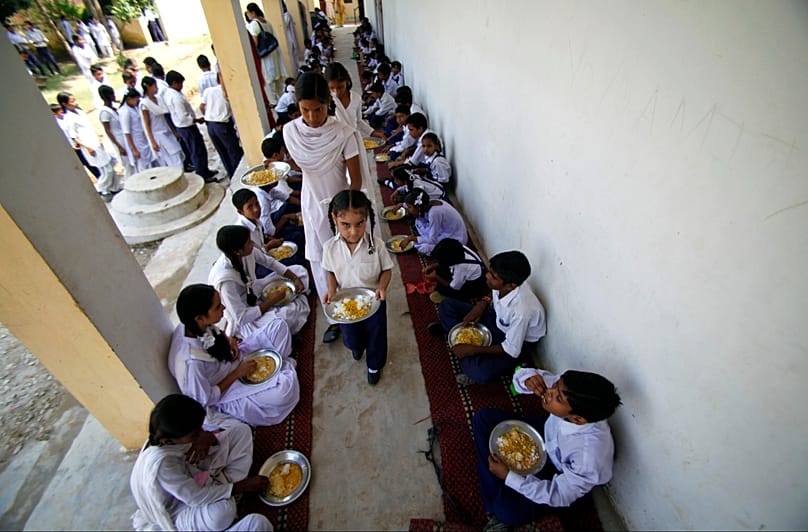
The study found that extending school meal coverage from the current level of about one in five children to all children worldwide could reduce the overall prevalence of undernourishment by around 24 percent.
Environmental gains depended on what was served. When school meals followed recommendations for healthy and sustainable diets, with more vegetables and less meat and dairy, and when food waste was reduced, food-related environmental impacts were cut by about half.
The study also examined costs. Increasing school meal coverage would require additional spending equal to about 0.1 percent of national income in high-income countries and up to 1 percent in low-income countries.
However, reductions in healthcare costs and climate-related damages were found to compensate for much of that investment.
Require political commitment
School meal programmes already feed about 466 million children every day, representing roughly 70 percent of the global public food system.
Authors of the study warn that achieving universal school meal coverage will require sustained political commitment and funding, particularly in low-income countries where fewer than one in ten children currently receive a school meal.
Researchers involved in the wider research collection argue that school meals should be seen as part of a broader food system strategy, supported by clean cooking, reduced food waste and food education that connects children with families and communities.
“School meals are not just a nutrition programme – they are a powerful lever for transforming food systems. When meals are healthy, sustainable and linked to food education, they improve children’s wellbeing today and foster long-term sustainable habits, while helping countries protect biodiversity, reduce emissions and build resilient communities,” said Silvia Pastorino, the diets & planetary health lead for the Research Consortium for School Health and Nutrition and a researcher the London School of Hygiene & Tropical Medicine (LSHTM).
According to a report from the 2024 Global Survey of School Meal Programs, 63 percent of primary school-age children in Europe were fed by school meals, while 27 percent of secondary school-age children in the continent were fed by school meals.
The study was conducted by the Research Consortium for School Health and Nutrition, an independent initiative linked to the School Meals Coalition, led by France and Finland.
The coalition was formed in 2021 after more than 100 countries pledged to provide a healthy school meal for every child by 2030.
The research consortium is now developing a “Planet-Friendly School Meals Toolkit” to help countries assess the costs, environmental impacts and health benefits of shifting to sustainable school meal models.
Co-created with partners in Kenya and Rwanda, the first results are expected in spring 2026, according to a statement from University College London.