




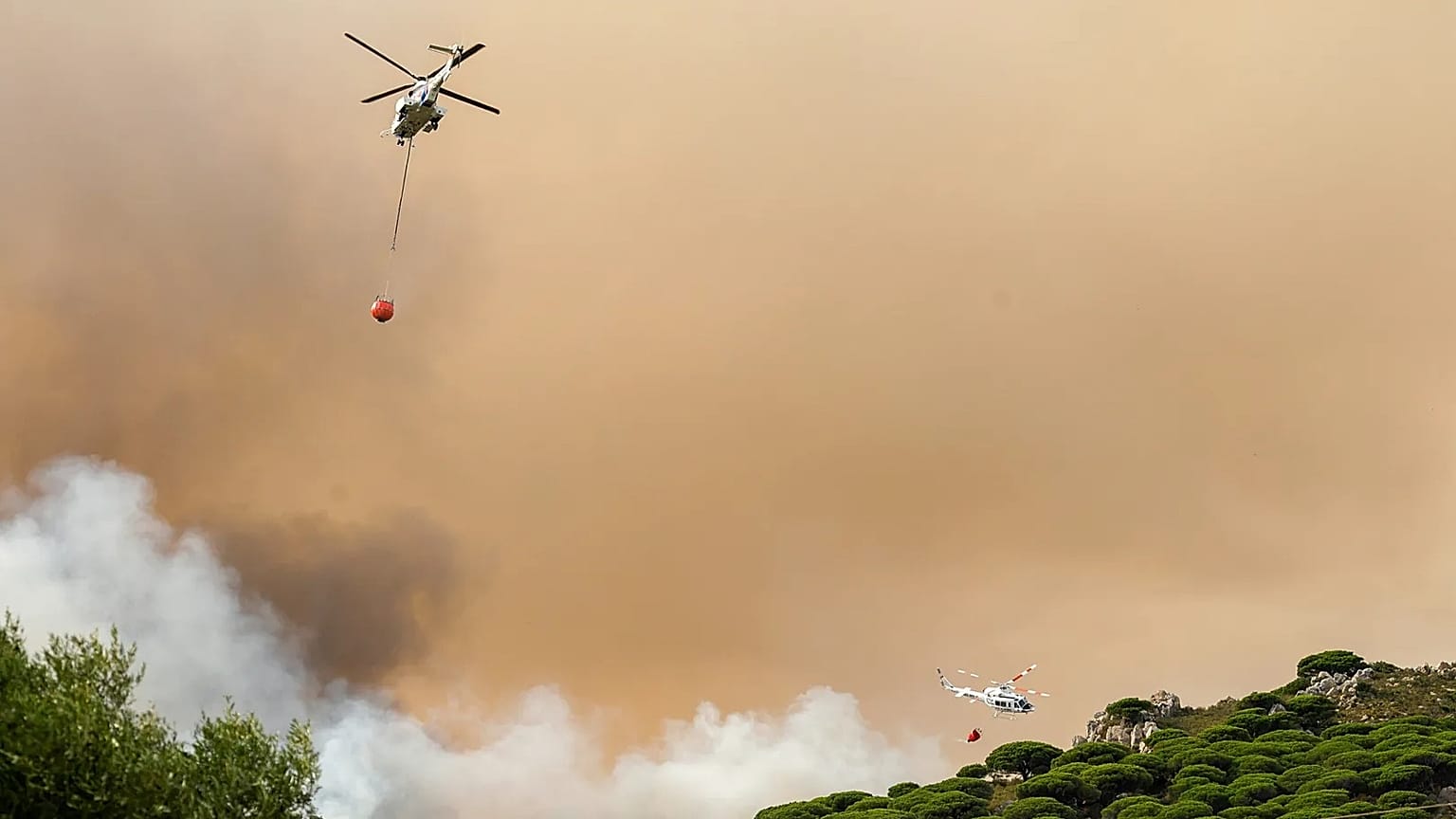













Climate policy is not discretionary spending but collective risk pooling, according to a Vienna University study, who argue that as natural disasters proliferate, it acts as a public insurance system that protects economies and societies.
The climate crisis is no longer measured only in degrees and carbon targets, but in hospital admissions, lost working hours, failing infrastructure and public money drained from already strained budgets, according to a new academic study.
 ADVERTISEMENT
ADVERTISEMENT
ADVERTISEMENT
Between 1980 and 2021, extreme weather and climate events caused economic losses of over €560 billion in the EU27, of which only 25–33% was insured, according to a study commissioned by MEP Lena Schilling (Greens/Austria) from the Vienna University of Economics and Business.
By 2050, production losses across the bloc are projected to exceed €5 trillion – and with 3°C of warming, GDP would decline by around 10%.
This “climate protection gap” means that most climate damage is not absorbed by private insurance markets but is transferred directly onto public budgets, according to the paper by Professor Sigrid Stagl, which argues that climate protection is not just an environmental necessity but an economic rationality.
Insurers of last resort
Presenting her findings at an event at the European Parliament in Brussels on Monday, Stagl said that governments are increasingly functioning as insurers of last resort, paying for disaster relief, infrastructure reconstruction, healthcare costs, social compensation and emergency recovery from public funds.
Stagl warned that unmitigated warming is eroding the foundations of private insurance, driving up premiums, shrinking coverage and making entire regions uninsurable. This scenario could trigger market collapse and force governments to deliver bailouts.
Climate damage, once treated as an external or future cost, is increasingly being internalised on state balance sheets and treated as a permanent fiscal liability rather than a temporary shock.
"Investing just 1–2% of global economic output can avert losses of 11–27% of GDP, with every dollar spent delivering savings of 5 to 14 dollars," reads the study, which seeks to encourage policymakers to invest more in climate adaptation.
It also explicitly describes climate action as “life insurance for the planet”, a systemic risk-management strategy in which the costs of mitigation and adaptation are small relative to the scale of potential losses.
Citing figures from the International Monetary Fund, Stagl told her audience in Brussels that early adaptation would reduce total losses by 65-70%, whereas delayed action would increase the annual burden to more than $100 billion (€840 billion).
“Every year of delay increases costs, deepens inequalities, and weakens Europe’s competitiveness. In political discourse, climate action is often framed as a cost. The data proves that inaction is the liability; climate action is the only solvent fiscal strategy,” said Stagl, noting that between 2 and 5 million jobs in the EU are at risk by 2040 if countermeasures are not taken.
EU countries to increase climate preparedness
Portugal recently announced it is developing a technical, economic, and regulatory framework to adapt the national electrical system to new climatic conditions and strengthen security as extreme events become more frequent and intense.
The proposal has two elements: the identification of critical areas most exposed to rural wildfires and storms, and the comparative evaluation of solutions such as the structural reinforcement of power lines, total or partial burial in critical areas, hybrid solutions and technologies to increase resilience.
"We are obliged to adapt the electrical system to avoid service disruptions and ensure security of supply," said Portuguese Energy Minister Maria da Graça Carvalho.
Portugal was recently hit by three powerful storms that triggered widespread flooding, landslides, and storm surges, leaving a number of people dead and causing billions in damage.
The decision to step up climate resilience also coincided with a damning report from the EU's climate advisory board, urging EU countries to step up action to mitigate the impacts of climate disasters, noting the continent is far from being prepared for the harsher scenarios expected to increase.
Climate-related health impacts have claimed up to 80,000 lives and cost €400 billion annually, according to the new study.
“The climate crisis is turning into a billion-euro graveyard for our economy," said Green lawmaker Schilling.
"Extreme weather has already caused unimaginable damage across Europe. And if we continue to hesitate, production losses will exceed five trillion euros by 2050. It is not just a large number. It is an absurd, preventable loss of prosperity,” the Austrian MEP added.