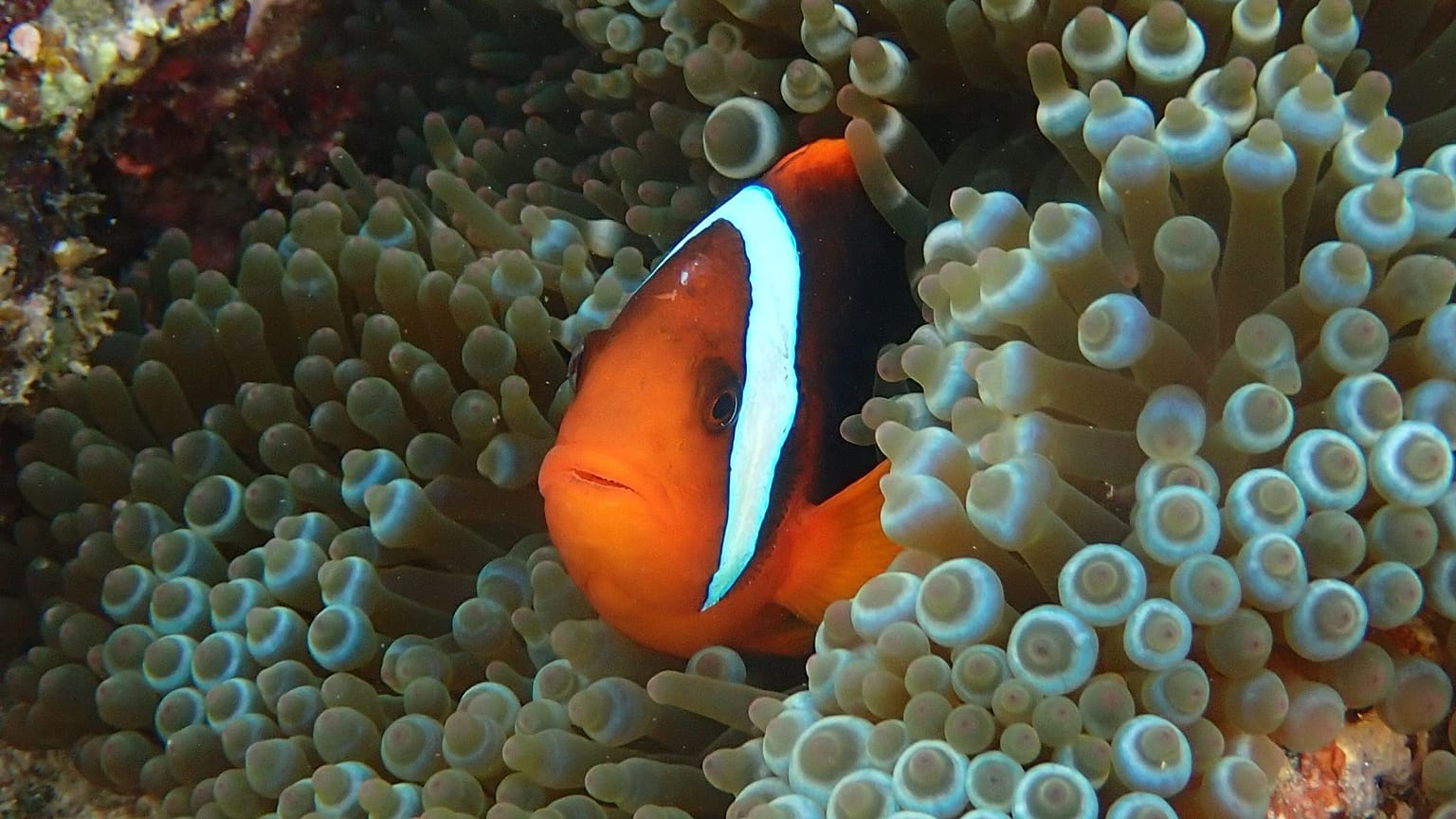













Highly territorial, clownfish use colour patterns and size as markers of their social rank.
Dressing to look more grown-up is a teenage rite of passage – but humans aren’t the only ones who do it.
 ADVERTISEMENT
ADVERTISEMENT
ADVERTISEMENT
Baby clownfish have been found to lose their additional white vertical stripe at a younger age when surrounded by older fish.
A new study from the Okinawa Institute of Science and Technology (OIST) reveals how young tomato anemonefish react to social influences within a strictly hierarchical world.
Clownfish stripes are markers of hierarchy
Within host anemones, the species typically allows just one breeding pair, with younger subordinate fish easily identified by their size and one or two additional white stripes.
“We’ve previously shown that anemonefish count bars to recognise each other. So, we know that bars, the white vertical stripes characteristic of clownfish, are essential in communication,” explains Dr Laurie Mitchell, first author on the study published in the journal PLOS Biology.
In around a third of anemonefish species, these bars are lost as they transition to adulthood. This is mainly the case in species that reside in smaller groups – possibly because more pronounced size differences within the hierarchy make fights more dangerous, so visual markers of status are important for survival.
To understand how and why this change happens, researchers used cameras to observe juveniles in anemones with adults versus empty, fake or no anemones.
They were surprised to find that bar loss accelerated with adults present, despite extra bars indicating a lower rank.
“This was very counterintuitive at first as we know that the extra bars are used to signal their subordinance,” says Dr Mitchell.
Why do clownfish lose their stripes?
After hatching, anemonefish spend a brief spell at sea before eventually finding an anemone to call home. Their ‘baby stripes’ could help them to appear unthreatening and avoid confrontation with occupying adult fish, the researchers theorise.
But before new rivals arrive, they may also be eager to cement their position in their new society. This, researchers suggest, could be the reason for losing their stripes early.
In unoccupied anemones, on the other hand, the fish were found to keep their extra bars for longer – possibly as an “insurance policy” against eviction from invading adults.
“This research helps us better understand how animal colour patterns have evolved to be developmentally flexible to suit unpredictable environmental conditions,” says Dr Mitchell.
“It gives another level of insight and appreciation for how and why fish colour patterns can form and change within a single lifetime.”
How do clownfish lose their stripes?
Clownfish white stripes are made of special light-reflecting cells called iridophores.
Examining these under a microscope, researchers observed mass cell death: “The cells shrink, their membranes wrinkle, and their nuclei fragment,” explains Dr Mitchell.
The white bars are then replaced by their characteristic orange skin.
“Pigmentation traits like these white bars are often treated as simple visual markers, but they in fact carry rich biological meaning,” says study co-author Professor Vincent Laudet.
“This study shows how by combining ecology, evolution, genomics and developmental biology, we can move beyond describing colour patterns to understanding what they actually do.”