












Greenpeace Italia has called out the Italian government for not investing enough in climate change mitigation.
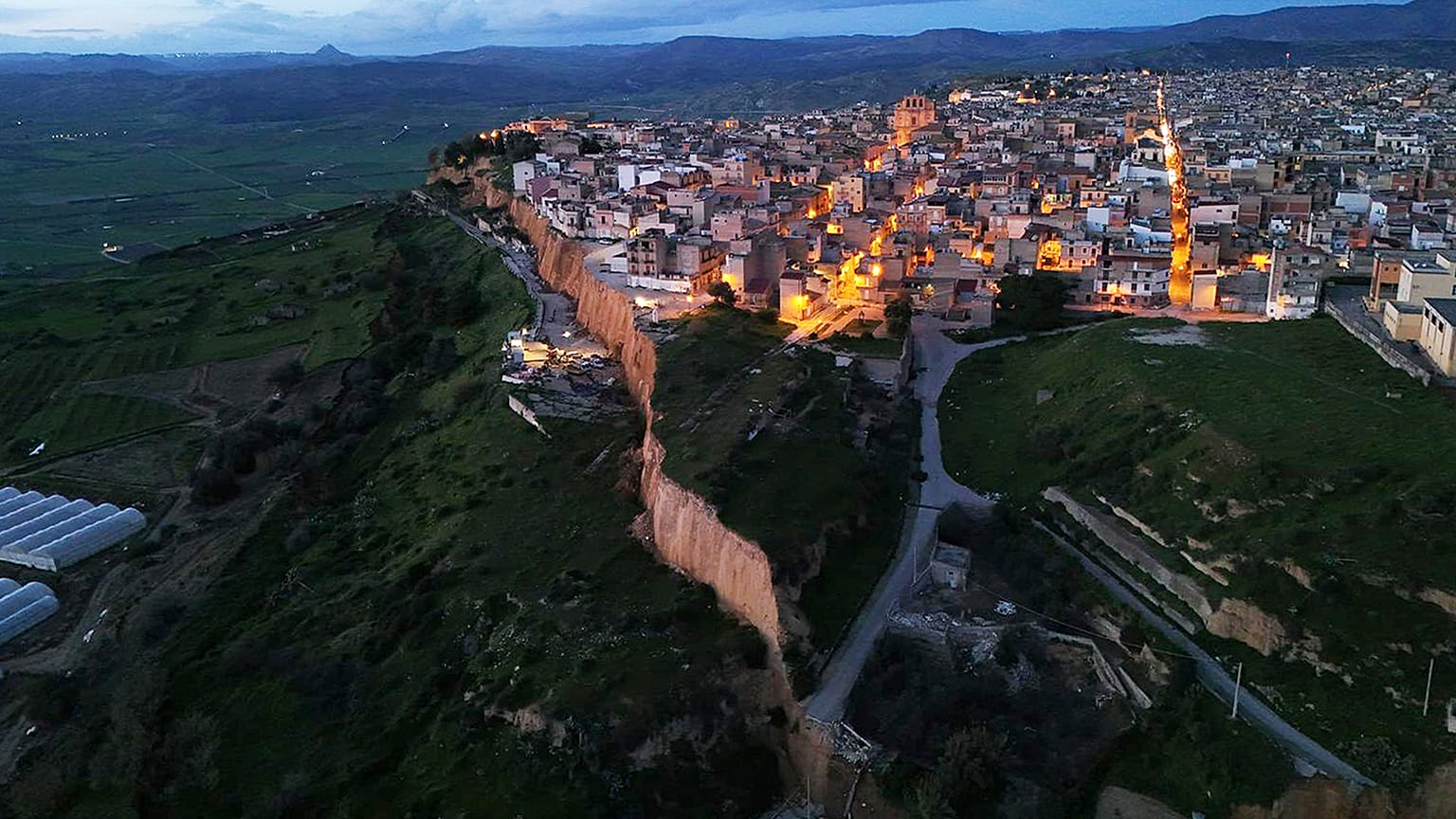
A town in Sicily has been left teetering on the edge of a cliff after days of heavy rains from a cyclone triggered a huge landslide and forced the evacuation of over 1,500 people.
 ADVERTISEMENT
ADVERTISEMENT
ADVERTISEMENT
The landslide in Niscemi, in the southwest of the Italian island, spanned 4 kilometres. Images showed cars and structures that had fallen 20 metres off the newly formed cliff, while many other homes remain perched perilously on the edge.
Greenpeace Italia has called out the Italian government for not investing enough in climate change mitigation.
“Instead of protecting us, it continues to make energy choices that risk worsening the situation, turning our country into a gas hub to please the fossil fuel industries,” the organisation said in a press statement.
"To avoid further disasters, we must invest structurally from north to south in the ecological transition, funding mitigation and adaptation measures to the climate crisis."
‘Houses can no longer be inhabited’
Civil protection crews have created a 150-metre-wide ‘no go zone’ in Niscemi, which is just inland from the coastal city of Gela.
“The entire hill is collapsing onto the plain of Gela,” civil protection chief Fabio Ciciliano says. “There are houses located on the edge of the landslide that obviously can no longer be inhabited, so we need to work with the mayor to find a permanent relocation for these families.”
Authorities have warned that residents with homes in the area will have to find long-term alternatives to moving back since the water-soaked ground was still shifting and too unstable to live on.
The federal government included Niscemi in a state of emergency declaration on Monday 26 January for three southern regions hard hit by Cyclone Harry and set aside an initial €100 million to be divided among them. Sicilian regional officials estimated on 28 January that the overall damage to Sicily stood at €2 billion.
Without climate investment, Italians face ‘incalculable damage’
Italian prime minister Georgia Meloni has vowed that the initial emergency funding was just the first step in addressing the immediate financial needs of displaced residents and that more was coming.
Niscemi was built on a hill on layers of sand and clay that become particularly permeable in heavy rain and have shifted before, most recently in a major 1997 landslide that forced the evacuation of 400 people, geologists say.
The latest collapse has revived political mud-slinging about why construction was allowed on land which, because of its geological makeup, had a known high risk of landslides.
The issue is more pertinent than ever given the increasing pressure of climate change on fragile landscapes like that of Niscemi, and Sicily as a whole.
Cyclone Harry, which has pummelled the island’s coastline, was fueled by an increasingly warm Mediterranean, Greenpeace emphasised.
“It is now scientifically proven that rising sea temperatures, caused by climate change, intensify the violence of these extreme events,” the organisation said.
Without a drastic reduction in greenhouse gas emissions, the expected rise in sea levels by 2100 will irreversibly alter the current morphology of Italy, with up to 5,500 km2 of coastal plain, where more than half of the Italian population is concentrated, predicted to be flooded.
“We're tired of counting damages and casualties, and of seeing the effects of the climate crisis once again dismissed as a generic 'weather-related damage', without the adequate media attention that events of this magnitude deserve,” Simona Abbate of Greenpeace Italia's Climate Campaign said in a press statement.
“The scientific data published daily is unequivocal: if Meloni and [deputy prime minister Matteo] Salvini continue to serve the interests of the fossil fuel industry and those who profit from it, they will condemn Italians to be among the European populations most affected by extreme events, with increasingly disastrous consequences and incalculable damage.”
Elly Schlein, secretary of Italy’s Democratic Party, has called on the government to redirect funds from the Messina Strait bridge project - which has sparked significant environmental concerns - towards extreme weather emergencies.
WWF Italia has also urged action. “After Cyclone Harry and yet another wave of extreme weather events, it's clear that the climate crisis and the impacts of land use are now the ‘new normal’,” the organisation said in a press release.
It added that there is an “urgent need to accelerate climate adaptation efforts, especially in areas most exposed to hydrogeological risk.”