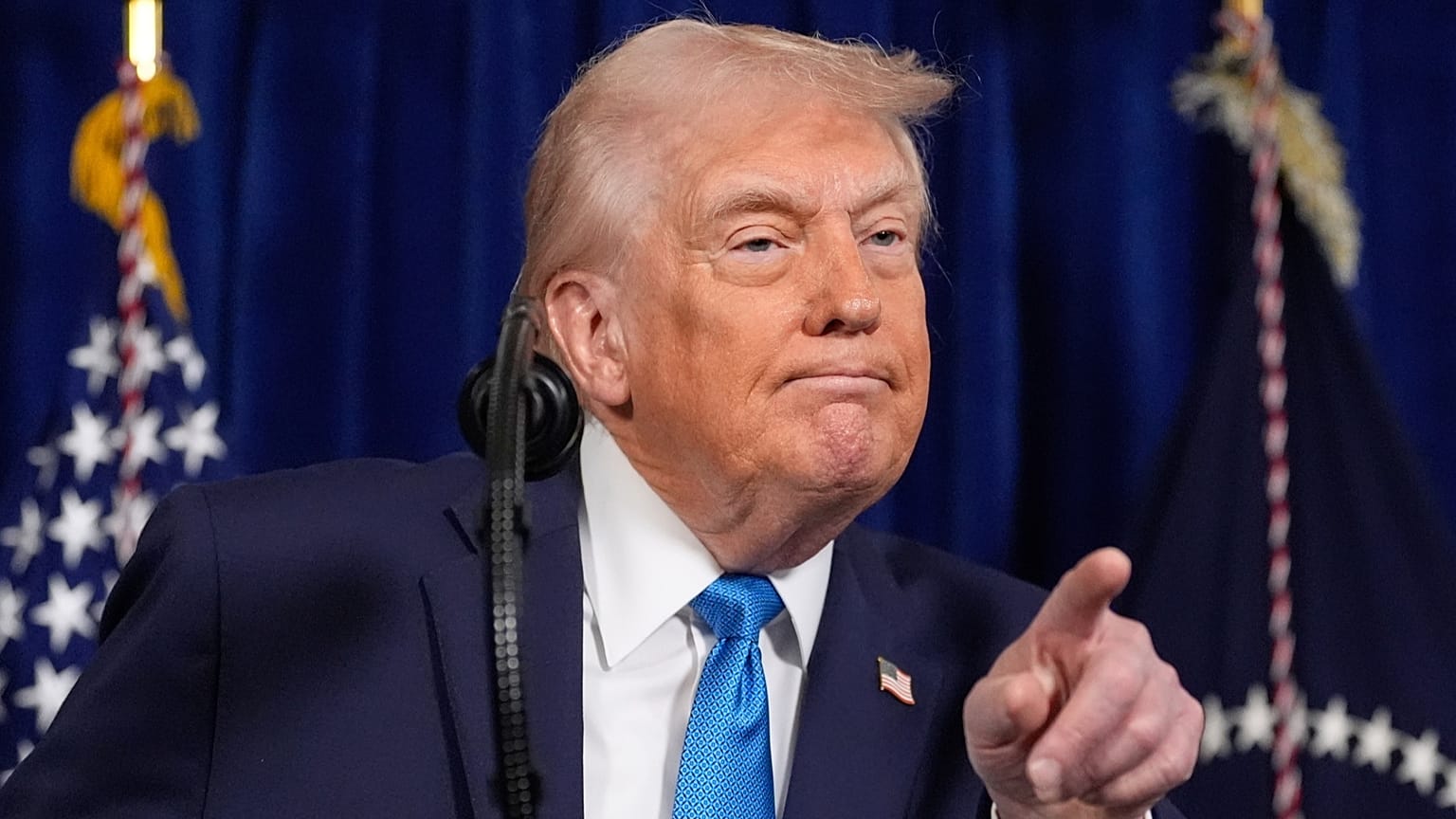













Experts warn that Trump could exploit Greenland for its critical mineral resources, which are seen as “essential” for green energy.
Trump’s growing interest in Greenland has highlighted the nation’s largely untapped mineral resources, which many experts argue are key to phasing out fossil fuels.
 ADVERTISEMENT
ADVERTISEMENT
ADVERTISEMENT
According to the International Energy Agency (IEA), critical minerals are “essential” for transitioning to a green energy future – used for technologies such as wind turbines and electric vehicles (EVs).
Acquiring Greenland may help the US reduce its dependency on China, but is Trump’s plan really that simple?
Greenland’s critical minerals
A 2023 survey found that 25 of the 34 minerals deemed “critical raw materials” by the European Commission were found in Greenland. The nation is estimated to hold between 36 and 42 million metric tons of rare earth oxides, making it the second-largest reserve after China.
The IEA says that lithium, nickel, cobalt, manganese and graphite are “crucial” for battery performance, while rare earth elements are used to make powerful magnets found in wind turbines and EV motors. Electricity networks also need huge amounts of aluminium and copper.
The global rare earth elements market is growing in tandem with the green energy boom and is expected to be worth over €6.5 billion this year. It makes the autonomous island particularly appealing to the US, which is 100 per cent reliant on imports for 12 minerals deemed critical for the economy and national security by the US Geological Survey.
Tapping into these resources could help the US reduce its dependency on China, which currently processes over 90 per cent of the world’s rare earth minerals, and empower the US as demand rises.
According to the Centre for Strategic and International Studies (CSIS), the US “cannot preserve” its leadership in national security, economic competitiveness or energy resilience while remaining dependent on foreign adversaries for critical minerals.
It’s a problem Trump has been trying to tackle since his first time in office. In March 2025, he signed an executive order to take “immediate measures” to increase American mineral production to the “maximum possible extent”.
The POTUS used the Defense Production Act to provide loans to boost the domestic mining industry and cut the red tape stalling projects. It also allowed federal agencies to prioritise federal lands for mining over other uses.
Last year, Trump also signed an executive order aimed at stepping up deep-sea mining within both US and international waters as his country races to become what it describes as a “global leader in responsible seabed mineral exploitation”.
Just last month, the US Department of State struck a deal with the Democratic Republic of the Congo, which holds more than 70 per cent of the world’s cobalt. The partnership will increase the level of US private sector investment in the mining sector while upholding “responsible stewardship” in the management of mineral resources.
Does Trump want to mine in Greenland?
Greenland currently lacks the infrastructure needed to support industrial-scale mining. Due to its harsh climate, it is also only mineable for six months out of the year.
Analysts estimate that extracting Greenland’s minerals would therefore cost “billions upon billions upon billions” and would be a logistical nightmare.
As Nick Bæk Heilmann, a senior associate at Kaya Partners, a business consultancy operating in Greenland, points out, Greenland isn’t the only nation sitting on critical minerals.
“I would strongly argue that minerals are not the driving force in the US quest for control and acquisition of Greenland,” he says. “That’s because Greenland is open for investments and mining. In Greenland there’s general social licence to mine, which is very important. The US does not need to acquire Greenland.”
Critical minerals also sell at “extremely low prices”, which Heilmann argues quashes the business case.
Are critical minerals needed to meet climate goals?
The demand for critical minerals has triggered concern from climate groups around the ethical and environmental impacts of mining, both on land and on the seabed.
Trump has also moved to accelerate deep-sea mining. In April 2025, he signed an executive order instructing the Secretary of Commerce to “expedite the process for reviewing and issuing seabed mineral exploration licences and commercial recovery permits in areas beyond national jurisdiction under the Deep Seabed Hard Mineral Resources Act”.
It means the US has side-stepped ongoing talks with the UN’s International Seabed Authority (ISA), which has agreed a moratorium on seabed mining pending negotiations.
Last month, Norway postponed its plans to dig up the seabed in search of critical minerals, after becoming the first country in the world to greenlight the practice.
Still, the country has allowed for around 280,000 square metres of its national waters – located between Svalbard, Greenland and Iceland – to eventually be opened to collect rocks containing cobalt and zinc.
Norway has long echoed the argument that these minerals are needed to lead a “green transition”. However, a 2024 report published by the Environmental Justice Foundation found that deep-sea mining isn’t necessary for a fossil fuel-free world.
It predicts that a combination of new technology, a circular economy and recycling could cut demand for minerals by 58 per cent between 2022 and 2050.
The foundation’s CEO and founder, Steve Trent, says deep-sea mining is a pursuit of minerals we don’t actually need that risks environmental damage “we can’t afford”.
“We know so little about the deep ocean, but we know enough to be sure that mining it will wipe out unique wildlife, disturb the world’s largest carbon store, and do nothing to speed the transition to clean economies,” he adds.
A smokescreen for other plans?
Experts caution against interpreting Trump’s interest in Greenland primarily through the lens of climate policy or the green transition.
They argue that, while these critical minerals have featured prominently in US rhetoric, they are not the key driver behind POTUS’s renewed focus on the country.
“This leaves the last, maybe most scary, important driver, which is the expansion of US territory, the idea of manifest destiny, which was also mentioned in Trump’s speech,” Heilmann says.
“We are increasingly convinced that this is the main driver, which is, for Greenland, Denmark, the EU - non-negotiable.”
Others stress that while climate policy may not motivate Trump personally, environmental change is reshaping the strategic context in which decisions are being made.
Jakob Dreyer, a researcher in climate and security politics at the University of Copenhagen, argues that global warming and the green transition are altering the economic logic of the Arctic.
“We cannot fully understand this dynamic without regarding global warming and the impact of the green transition on the global economy,” he explains. With the Arctic warming three to four times faster than the global average, rising temperatures could open new shipping routes and lower barriers to extraction as Greenland’s ice sheets melt.
Ultimately, this is, as Dreyer points out, “improving the business case” for both fossil fuel and critical raw material extraction.
“Trump is sceptical about climate change,” he adds, “but his advisers are not.”