















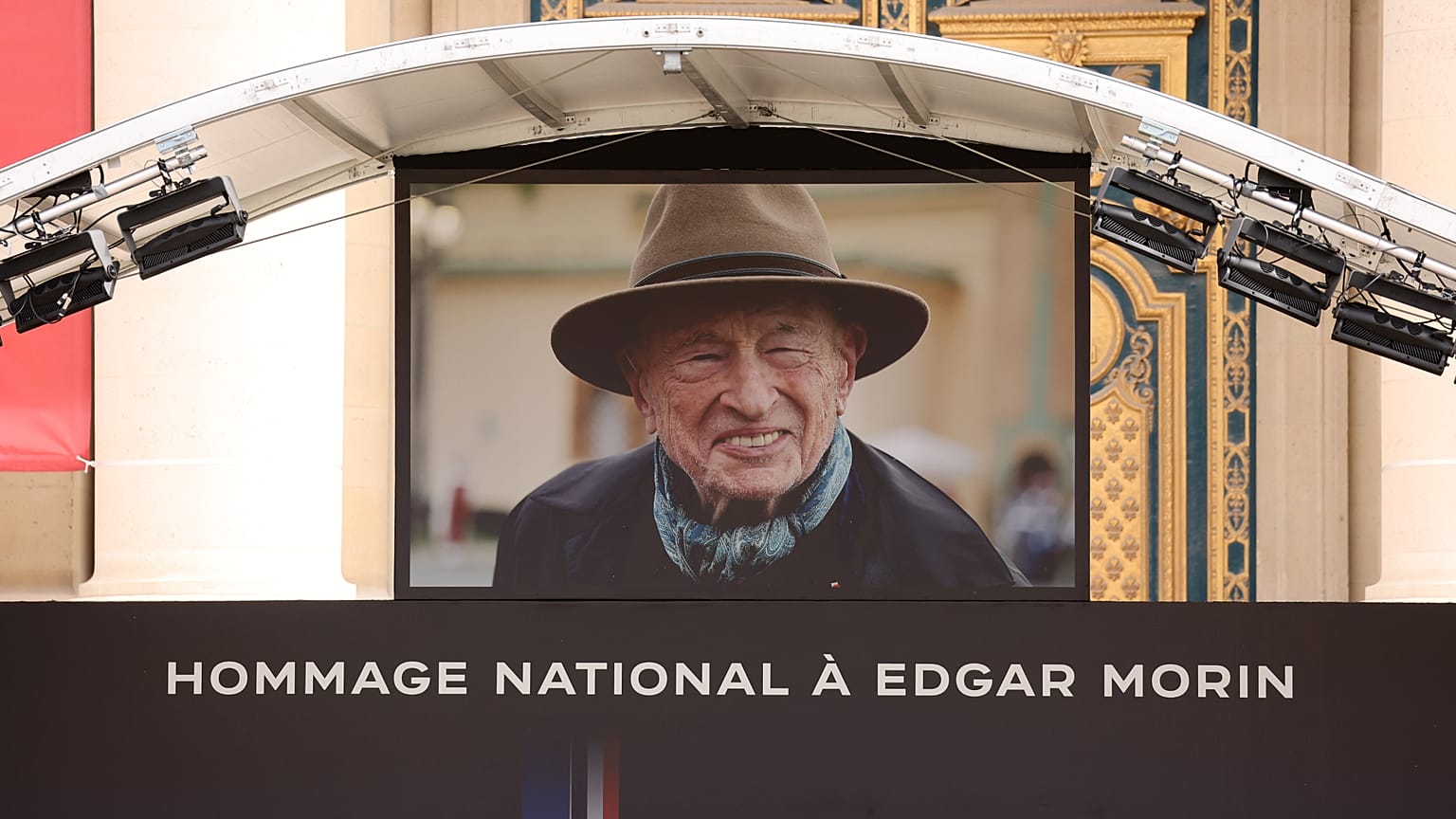













During a national tribute at Les Invalides on Wednesday, the French president honoured philosopher and sociologist Edgar Morin, who has died at 104, praising him as a man who never yielded to “the truth of a single camp, a single dogma”.
“His was an exceptional destiny in this century”, “a humanist with a global outlook, certainly, but irreducibly French in his battles for freedom, equality, emancipation and also fraternity with all peoples deprived of their rights”, said the head of state in front of a large smiling portrait of the philosopher.
 ADVERTISEMENT
ADVERTISEMENT
ADVERTISEMENT
“For him, truth never came from a single side, a single dogma. Commitment could not mean falling into line, and the future was destined for chaos if we gave in to despair or to inaction,” he added.
“That French energy, generous, ambitious, universal, will continue to be reborn,” Emmanuel Macron declared in a speech of about a quarter of an hour.
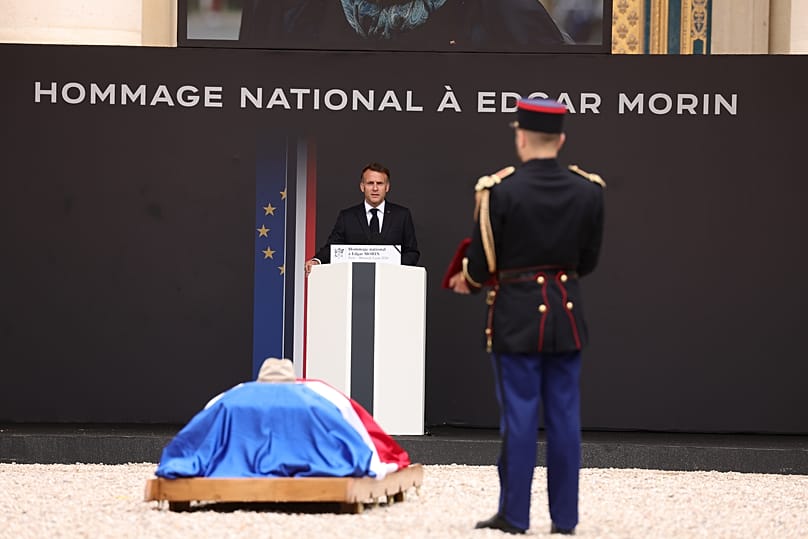
The ceremony was held in the south courtyard of the Dome at Les Invalides in the presence of his wife, the philosopher Sabah Abouessalam, and many figures from the political and intellectual worlds, including former president François Hollande, sociologist Jean Viard, historian Pascal Ory and the head of the Moroccan government, Aziz Akhannouch.
Edgar Morin was the author of a highly diverse body of work, known far beyond France and conceived as a reflection on humankind grounded in scientific knowledge. Despite his advanced age, the philosopher, who died on Friday, remained a constant and listened-to presence in intellectual debate.
His real name was Edgar Nahoum. He was born on 8 July 1921 in Paris, into a Jewish family originally from Salonika in Greece that had emigrated to Paris. In 1941 he joined the Communist Party and entered the Resistance under the pseudonym Morin.
In “Autocritique” (1959), the philosopher recounts his expulsion from the French Communist Party and his disillusionment with Stalinism. He was also one of the founders of the committee of intellectuals against the war in Algeria.
After becoming a researcher at the CNRS, he wrote dozens of books, including “La rumeur d'Orléans” (1969), about a surge of antisemitic fever, “La méthode” (1977–2004), a major six-volume work, as well as several books on ecology, a subject close to his heart.
After the fall of the Berlin Wall in 1989, he described the running out of steam of the Western political and economic model, the ecological crisis, the resurgence of religious fundamentalism, the crisis of the international order and the return of war to Europe.