














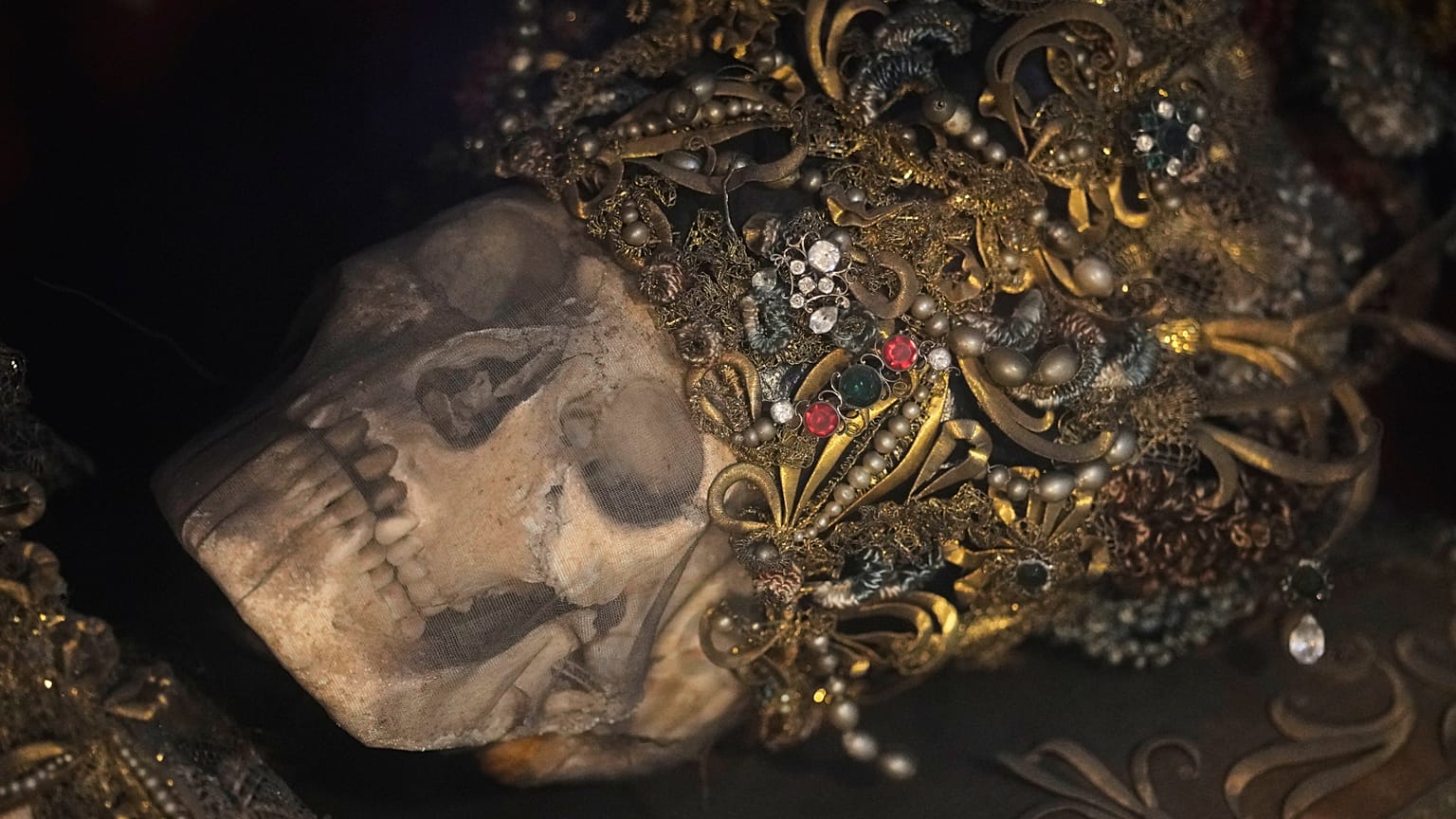














Known as Vincenzius, Valerius, Benedictus, and Felix Benedictus, these catacomb saints were brought to the Bavarian town of Bad Staffelstein from Rome during the late 17th and 18th centuries. The remains are believed to be those of early Christian martyrs.
Four full skeletons draped in silk, covered with gold jewellery, silver, lace and precious stones... A sight that has sent shivers down the spines of many visitors of the Catholic monastery church of Banz in southern Germany.
 ADVERTISEMENT
ADVERTISEMENT
ADVERTISEMENT
These eerie bodies - known as Vincenzius, Valerius, Benedictus, and Felix Benedictus -are the remains of so-called catacomb saints who were brought to the Benedictine monastery near the Bavarian town of Bad Staffelstein from Rome in the late 17th and 18th centuries.
The relics have since been on display as a reminder of finding hope in difficult times**.**
"It was at the end of the Thirty Years' War. It was a terrible time," priest Walter Ries explains. "Three-quarters of the German population simply perished. Wars, plagues, etc., were dreadful here as well. And through the Baroque, people tried to open the gate to heaven. That's why everything was designed so beautifully. It was simply an escape from the present, which was often so terrible. And that's why these eerie skeletons were beautifully draped and depicted as vividly as possible."
The church custodian, Anita Gottschlich, admits it's spooky but also points out to how memorable it is.
“It’s actually a little creepy,” she whispers, looking at one of the skeletons, which seems to be staring right back at her through its hollow eye sockets. "I notice that when older people come here who visited as children, they always look for the Holy Bodies, because they can still remember them,” she adds, noting the enduring fascination the skeletons hold for people of all ages.
While they may seem disturbing to some visitors, catacomb saints or 'Holy Bodies' can still be found in many Baroque Catholic churches and monasteries across Bavaria.
The skeletons, often presented in glass coffin-like cabinets, are also a familiar sight in churches in neighbouring Austria, Switzerland, Czechia, and Italy.
Holy Bodies are remains found in Roman catacombs. In the Middle Ages, legend has it that these relics are the remains of martyrs from the early days of Christianity in Rome, discovered in the 16th century in unmarked graves in the city's catacombs.
“At the time, the church simply designated them all as saints,” says Ries. "And, of course, in many countries, including Germany, people wanted to have such holy remains, such relics, simply because this enhanced the status of their own church or monastery and perhaps turned it into a place of pilgrimage.”
To ensure that viewing the Holy Bodies is an exceptional experience, they are kept out of sight for most of the year by wooden panels depicting the respective skeletons attached to the front of the display cases.
On special occasions, such as All Saints’ Day, the covers are removed, and the Holy Bodies are shown to believers.