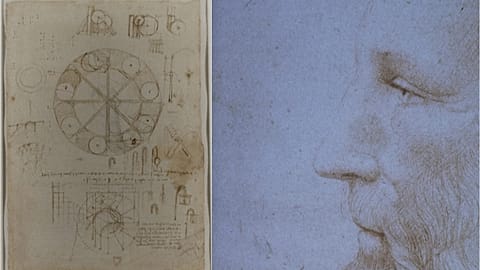

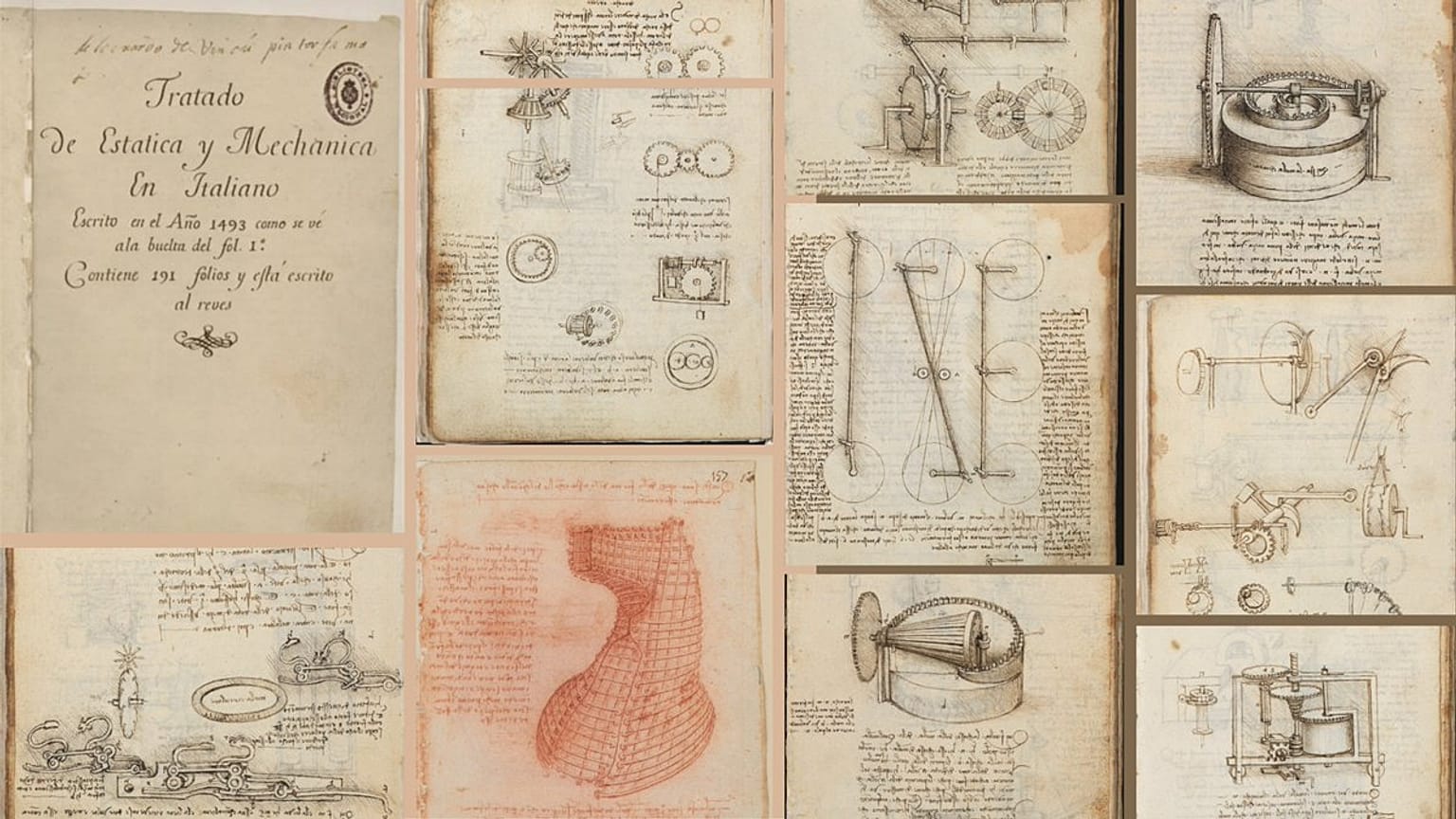













On 13 February 1967, the Spanish National Library announced the discovery of the Madrid I and II codices, two manuscripts by Leonardo da Vinci that had remained poorly catalogued for more than a century. But they are being digitised to make them accessible to the public.
Every year Spain celebrates one of the most significant discoveries of the 20th century for studies on Leonardo da Vinci.
 ADVERTISEMENT
ADVERTISEMENT
ADVERTISEMENT
On 13 February in 1967 the National Library of Spain conserved among its collections two original manuscripts of the Renaissance artist and engineer that had remained unnoticed for more than a century.
The so-called Madrid I and II codices (source in Spanish),identified as Mss. 8937 and Mss. 8936, are part of a set of scientific notebooks written by da Vinci between the end of the 15th and the start of the 16th century.
They were rediscovered when the American researcher Jules Piccus, who was working on the revision of the inventories of the institution's manuscripts, identified the relevance of some volumes that had not been correctly attributed.
According to official information from the National Library, the codices contain hundreds of pages of annotations and drawings devoted to statics, applied mechanics, gear systems, hydraulic machines, geometry and fortification studies.
Unlike his paintings, these manuscripts allow us to observe Leonardo's intellectual process:calculations, diagrams, hypotheses and corrections that show his experimental method.
Codex Madrid I, dated mainly in the 1490s, is considered one of the most important treatises on mechanics by Leonardo, with detailed studies on the transmission of motion and the functioning of mechanisms.
Codex Madrid II, dated slightly later, brings together research related to civil and military engineering, as well as topographical studies and hydraulic projects.
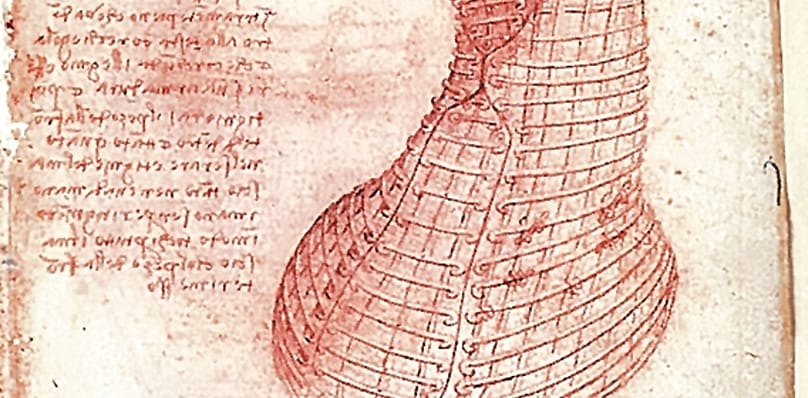
The manuscripts came to Spain in the 16th century via the sculptor Pompeo Leoni, who collected a series of Leonardo's documents after the artist's death. They subsequently became part of the royal collection and later entered the Biblioteca Nacional. Various internal reorganisations and cataloguing errors caused them to remain lost in the repositories for more than 100 years.
The Biblioteca Nacional de España has emphasised in its publications that the Madrid Codices are exceptional pieceswithin its documentary heritage, as they significantly extend the known corpus of Leonardo da Vinci's scientific writings. The announcement of their discovery in 1967 had international repercussions and changed the landscape of Leonardo da Vinci studies by providing previously unpublished material.
In 2012 (source in Spanish), the institution launched a digitisation project that made an interactive version of the codices available to the public. This initiative now facilitates worldwide access to the manuscriptsand reinforces the role of the Biblioteca Nacional as the custodian of one of the most important collections of Renaissance documents preserved in Spain.
More than half a century after their rediscovery, the Madrid I and II codices continue to remind us that behind the genius there was someone who observed, tested and dreamed of understanding how the world worked.