
















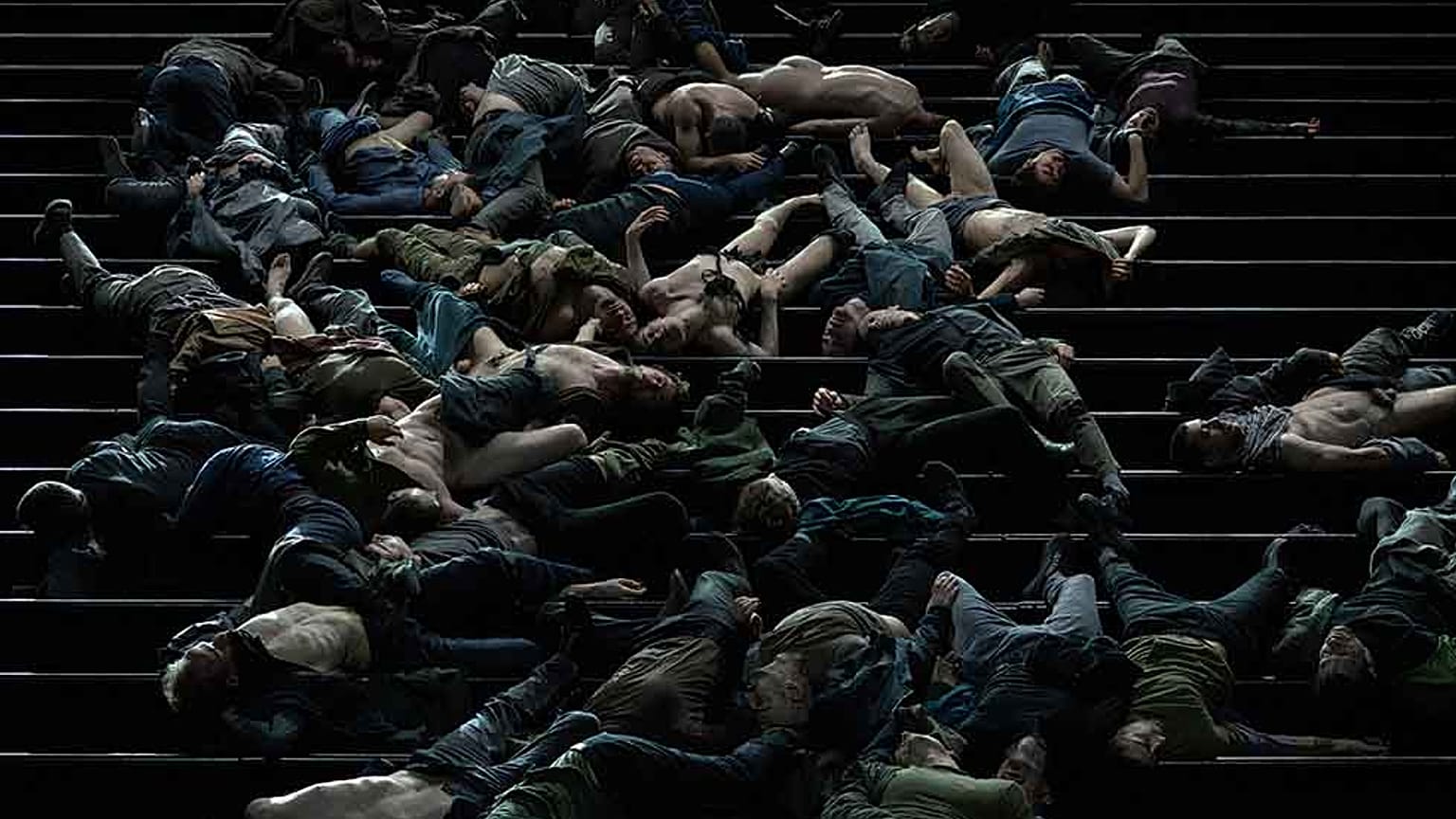














The work by Dimitris Papaioannou and Giorgos Koumentakis completed 12 performances in Athens, attracting large audiences. Created in 1995 in memory of those lost to AIDS, the production is now preparing to travel to Paris for a 2027 presentation.
Thirty one years after its first presentation, Requiem for the End of Love returned to a space where it could now stand without explanation: the main stage of the Greek National Opera. Not as a revival or anniversary gesture, but as a work that continues to engage with the present.
 ADVERTISEMENT
ADVERTISEMENT
ADVERTISEMENT
The performance installation was first created in 1995 by composer Giorgos Koumentakis and director/choreographer Dimitris Papaioannou inside a former power station in Neo Faliro, Athens. Conceived as a tribute to friends and a generation lost to AIDS, the work emerged at a time when the epidemic shaped both personal lives and artistic expression.
In its 2026 return, the core of the piece remained unchanged. What shifted was its scale and context. Over 12 performances, more than 16,000 people attended a production positioned between opera, visual installation and physical endurance. Tickets sold out within two hours, though the significance of the run lay less in demand than in the intensity and duration of the experience.
On stage, 48 performers were joined by 23 musicians from the Greek National Opera Orchestra, 25 singers of the MEIZON ensemble and two sopranos. Koumentakis’ score, based on the poem Lazarus by Dimitrios Kapetanakis, was performed with precision under the direction of conductor Theodor Currentzis, grounding the music’s austerity and emotional restraint.
The scenography functioned not as spectacle but as pressure. A monumental structure weighing up to 22 tonnes, dominated by a staircase of 36 steps, each rising 30 centimetres, imposing physical strain rather than visual comfort.
Movement unfolded through effort. Ascent and descent were not metaphors but conditions. Five trapdoors, from which performers emerged, reinforced a sense of constant exposure, without protective boundaries.
Reworking the piece on a large scale, Papaioannou did not pursue renewal through addition. Instead, he removed anything extraneous, concentrating on the relationship between the body, erosion, falling and silence. His direction resisted emotional coercion, opting for a strict, almost ascetic language that left the audience alone with what was taking place on stage.
Following the final performance in Athens, the production is now set to travel to Paris. Requiem for the End of Love will be presented at the Théâtre du Châtelet in November 2027, as part of a co production with the Greek National Opera, supported by the Stavros Niarchos Foundation, with PPC as major sponsor.
Internationally recognised for his cross disciplinary work across theatre, dance and visual art, Papaioannou is also known as the creative director of the opening and closing ceremonies of the Athens 2004 Olympic Games. Koumentakis, one of Greece’s leading contemporary composers, is currently the Artistic Director of the Greek National Opera, with a catalogue spanning opera, orchestral and vocal works.
Requiem for the End of Love no longer belongs to a specific moment in time. It remains a work that returns only when conditions allow, insisting not on remembrance alone, but on endurance.