
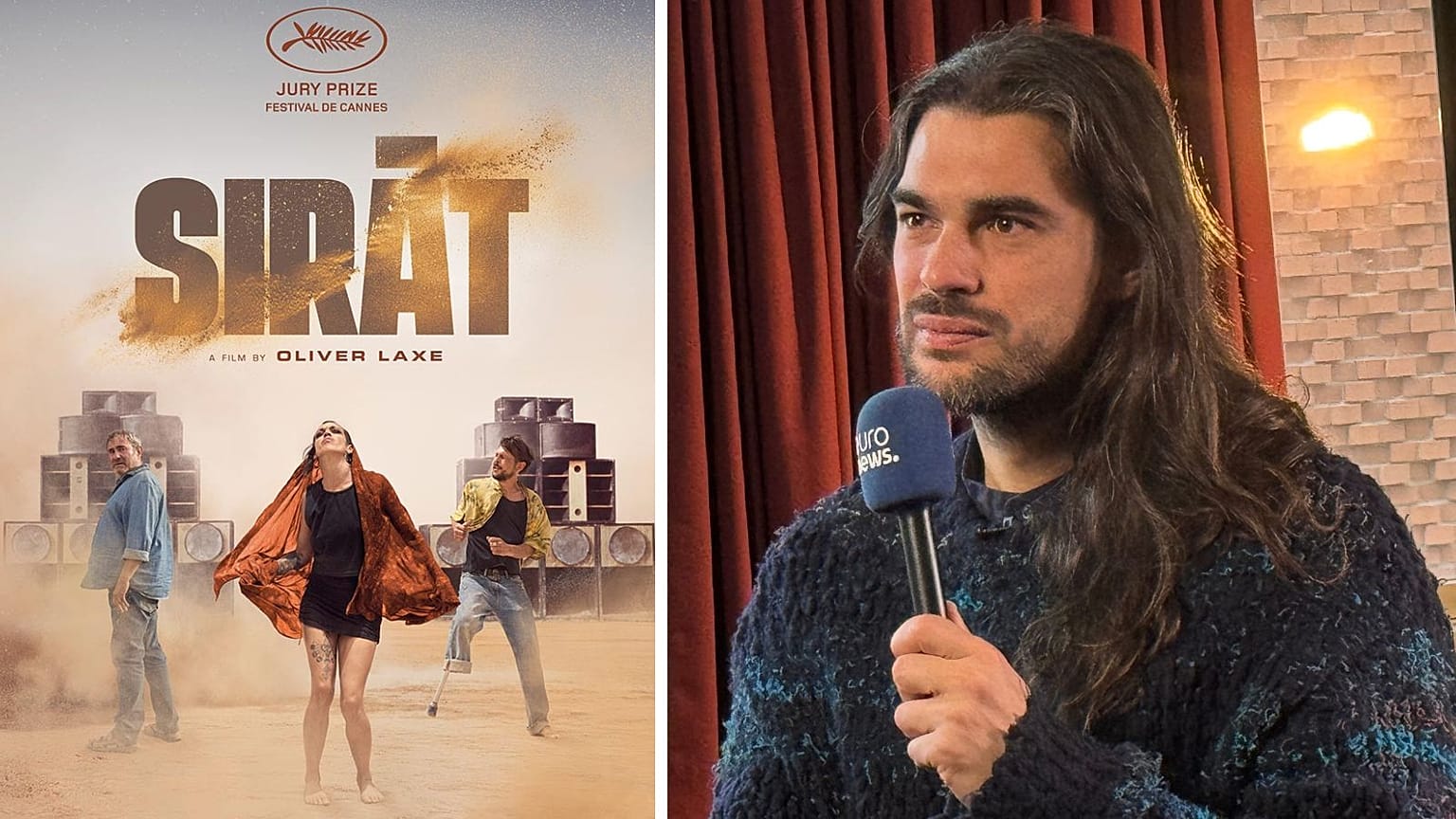














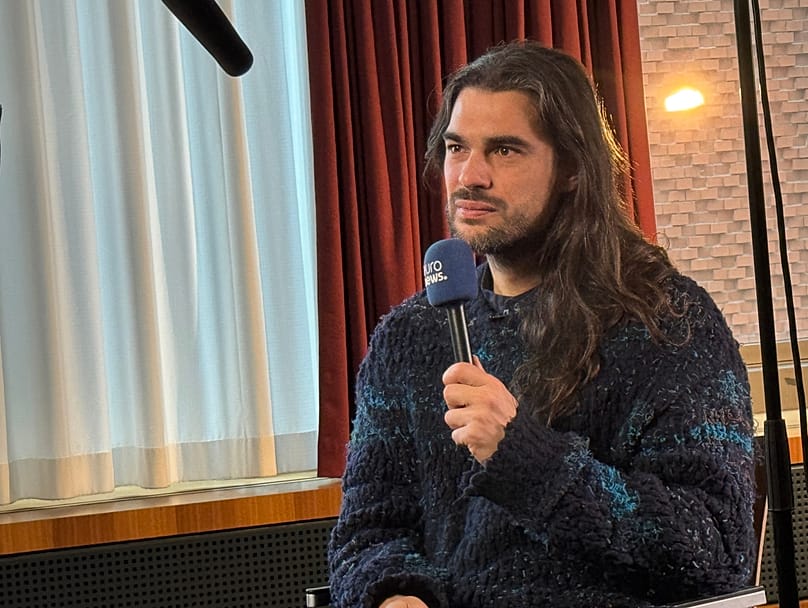
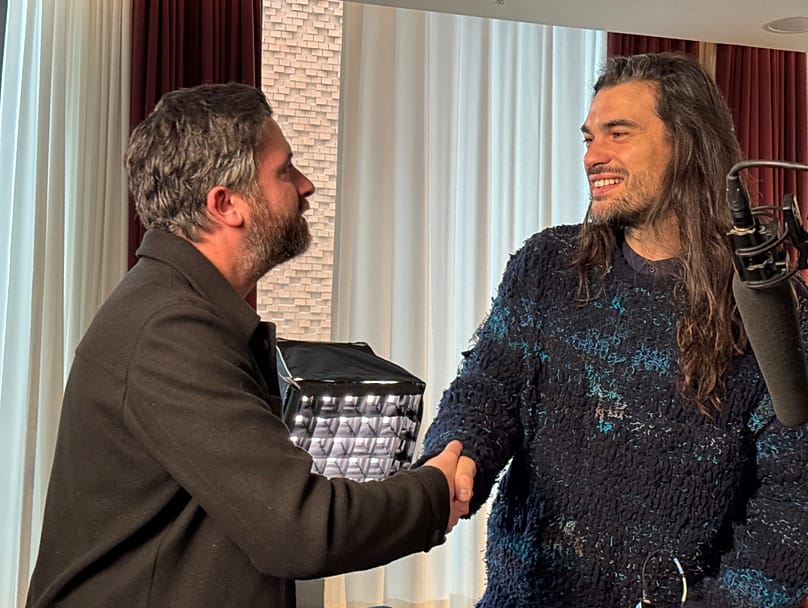
Euronews Culture sat down with director Óliver Laxe at this year’s European Film Awards to discuss his freshly Oscar-nominated film ‘Sirāt’, the pitfalls of streaming platforms and how cinemas are “a place for transformation”.
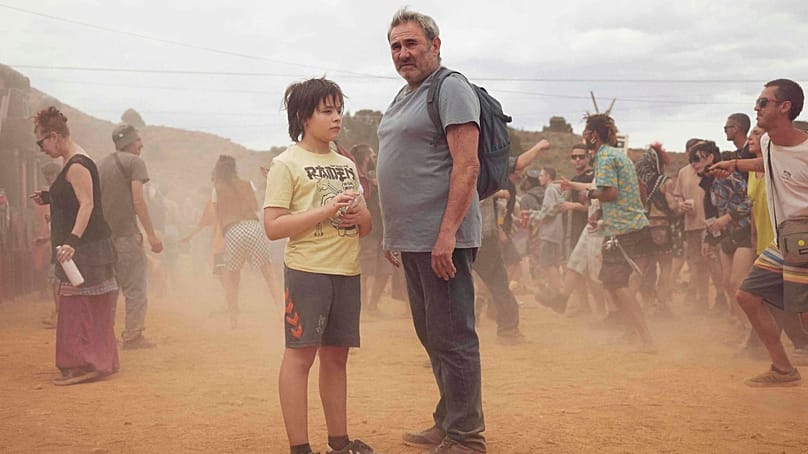
Nothing quite prepared us for Óliver Laxe’s Sirāt when it came out last year.
 ADVERTISEMENT
ADVERTISEMENT
ADVERTISEMENT
The French-born Spanish director had already shown viewers that he was one of the boldest European voices in cinema with the mystical Mimosas (2016) and the arresting O que arde (Fire Will Come - 2019). But Sirāt is something else. You go to the cinema to be entertained, provoked, enraptured or even rattled, but rarely do you encounter a film that leaves you feeling all those things at once.
What starts as a search for a missing person at a Moroccan desert rave turns into an apocalyptic and devastating road movie which has drawn comparisons to Henri-Georges Clouzot’s Le salaire de la peur (The Wages of Fear). Peppered with shocking twists, it’s a profound and purgatorial portrait of the fragility of life and our quest to find a form of release in a crumbling world - one in which we as a species are merely tiny playthings in a wider, crueler game.
The film – one of our favourites of 2025 - premiered in Cannes, where it won the Jury Prize. It has been steadily making its mark on the world stage, with several nominations at the Golden Globes, a whopping 11 nominations at the Goya Awards - and now freshly Oscar nominated for both Best International Film and Best Sound.
Euronews Culture sat down with Óliver Laxe at this year’s European Film Awards, where Sirāt won six awards including Best Cinematography (for Mauro Herce), Best Editing (Cristóbal Fernández), Best Production Design (Laia Ateca) and Best Sound Design (Laia Casanovas).
He spoke to us about his transportive masterpiece, the importance of experiencing movies on the big screen, as well as how to keep hope alive in a world hellbent on dehumanising us.
Check out the video above for extracts of our interview.
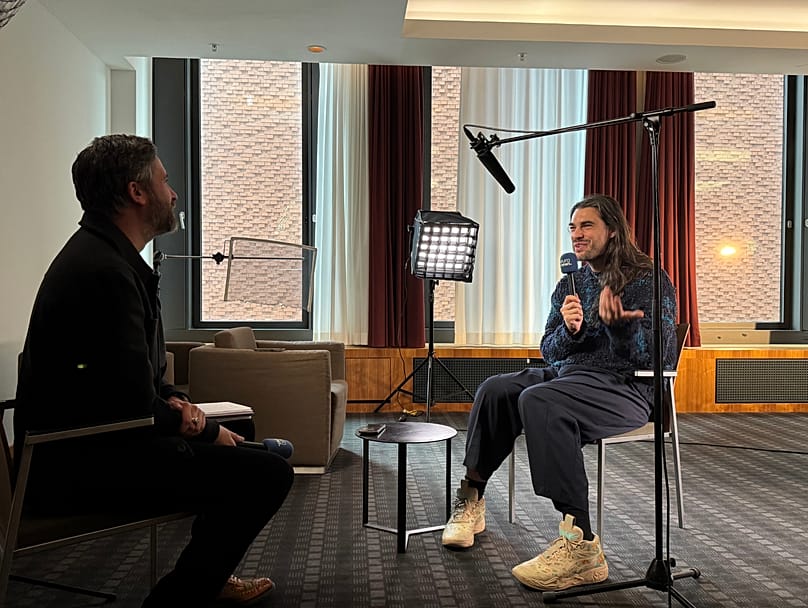
Euronews Culture: How has it been witnessing the reaction to Sirāt, from the premiere and win in Cannes, as well as nominations at the Golden Globes and the European Film Awards?
Óliver Laxe: It’s been great. In Cannes, we felt something. We felt that the film was not only a film. We felt that the film was also a ceremony. And now, after all these months, we know that it is also shock therapy. Bam! You can see how images really stay with the spectators, you know? A lot of people have come to us, the team, and to me, saying, ‘Wow, I'm still feeling the film. The film is in my skin.’ And that's the power of cinema. We are happy because we really trust the images and the complex relation between an image and the human metabolism.
Sirāt has been getting a lot of attention beyond Europe and is getting traction in the US. Do you see that as a promising sign that Hollywood is opening up, globally speaking, or that audiences are keen to watch more radical cinema?
We are living in a really particular moment. For sure, the Academy is more open and more young. Also, I think that we are tired of watching the same films. Human beings feel truth, feel when something was made with guts. This is something that is impossible copy. The guts!
It's also a tough film to recommend without spoiling it because of the impact that it has. As you say, the guts...
How do you recommend it?
I call it savage transcendence, with emphasis on the transcendence part, because your images speak to the subconscious.
You know, I try to preserve the images from myself. I try to protect them. This is the problem with cinema – the images have too much weight. The images are instrumentalized to say some things. But when you want to say too many things, you say nothing. This is the problem. The images arrive really thirsty and tired. The images in the films are dead. There are a lot of films, good ones, ones that are being nominated for awards and I’m sorry to say it, but they don’t have any images. They have images that say things but they don’t evoke anything. They don't have the power, the wildness, the organicity that an image has to have. The symbolism, the universal archetype... All these things, you know? The key of Sirāt is that I protect the images from myself.
Sound also plays such an important part in this film, whether it's the sound design or the score by Kangding Ray, who was nominated for the Golden Globes. The ceremony rather shamefully didn't show the award on the broadcast. Do you think that people are underestimating the role that sound and music have, and the integral role they play in cinema?
I don't know. I think that cinema people are giving too many prizes. Do you get this amount of prizes in journalism?
Definitely not.
When it comes to prizes, I think it’s enough. Let us get on with it. But in any case, I think that sound is part of the ontology of cinema. When I'm imagining an image, it has sound. It's not something separated, and that is also the key of Sirāt - you don't know where the image ends and where the sound starts. Sirāt is sculpture, it is a monster, it is alive!
That’s an important aspect of the film, because I saw it on the big screen and you could fully be enveloped by the sound, the images, and truly experience the film. You could also hear the gasps and the emotions of others watching it. And it’s this theatrical experience which seems to be increasingly threatened. For instance, Netflix co-head Ted Sarandos has argued that the traditional theatre model is outdated...
I will never work with a platform that doesn't respect the chronology of cinema. Films have to go to cinemas. The theatre is a place for catharsis, it’s a place for transformation. What is happening in a cinema doesn't happen in a house. This is the soul of cinema. And when you are with other people, there is a sacred exchange of energy. It’s not the same watching a film one day and another one the next day. It’s really a mystery what happens. It’s a ceremony. It’s a ritual. Like in Sirāt, with the people on the dancefloor. Your body is reacting in a different way. So, you can say to this guy from Netflix that he is completely wrong. Poor.
I doubt he’ll answer my calls, but he’s in dire need of hearing that! One scene that stuck with me in Sirāt is the ending - the train going towards a future with a great amount of uncertainty. I found the image of humans moving forward together, despite the odds, incredibly hopeful. But I've spoken to people who felt scared and unsettled by that scene. Do you see it as a hopeful ending?
I don't like to interpret a film, but I can't tell you that I'm a really hopeful man. I truly believe in human beings and in the future. Obviously, it will be tough. We are experiencing a kind of era change right now, and sometimes, when two eras are changing, it's like a fade of two images. Sometimes the past comes to the present with more presence. But at some point, it will fade. I’m really optimistic, and I like tests. Life will test us, will push us to a place where the only answer will be to be more human. So, thanks Netflix! Thanks AI! Thanks for all this dehumanization! Because these things are going to make us more human.
It's interesting that you mentioned dehumanization, because I had the pleasure of speaking to Juliette Binoche, the President of the European Film Academy, and she said that one of her goals is to rehumanize society through cinema. Do you think that cinema has the power to do that, to rehumanize us at a time when we feel increasingly dehumanized?
I think that cinema and art is a way to heal the collective imaginary. In a certain way, we are doing it. We are healing. Yesterday, I was with some of my colleagues – Mascha (Schilinski – Sound of Falling), Joachim (Trier - Sentimental Value) - and our films are a reflection of a society, trying to look at the wounds and trying to heal transgenerational pain. We have to stop this chain of pain. We suffer so we provoke suffering. So, yes, I think that cinema can elevate our conscience. Hopefully.
Thank you, Óliver, and thank you for Sirāt.
Thank you! We were courageous with it. But just wait until the next one... We’re doubling down and we’re not scared! You’ll see.
This interview has been edited for length and clarity.
Sirāt was released last year in most European territories and featured in Euronews Culture's Best Movies of 2025. It hits US cinemas in February and represents Spain at this year’s Oscars in the Best International Feature Film category.