





























13% of would-be homebuyers plan to move to towns under 10,000 residents. Often single 35-year-olds on average incomes, they see depopulated Spain as their only escape from a housing market that has shut them out.
Spain has a housing problem that has been getting worse for years and has already changed the way its young people think about their future. Buying a flat in Madrid, Barcelona or Málaga is, for most people under 40, a mission impossible. Renting on your own is no more viable: those who move out alone devote on average 98.7% of their salary to housing.
 ADVERTISEMENT
ADVERTISEMENT
ADVERTISEMENT
The result is a generation that feels trapped: only 14.5% of young people aged 16 to 29 have managed to move out, and the average age for leaving the parental home has risen to 30, compared with 26 in the European Union. According to data from the National Statistics Institute (INE), 44.3% of young people aged 26 to 34 were still living in the family home in 2025.
The previous generation was able to buy flats, cars and even second homes on an average wage. Today that is a pipe dream. With a shortage of housing and strong demand, purchase prices rose by 14.7% year on year in the past 12 months and rents by 10.9%, according to Bankinter, while wages for under-35s have barely grown in real terms.
On top of this comes the overcrowding of cities, which have become urban spaces hosting more people than they can cope with, with high levels of pollution and where it is impossible to find the rest and disconnection that still exist in the countryside. For all these reasons, more and more young people are swapping cities for depopulated villages where buying a home has not yet become an unattainable luxury.
The village as a solution
In Spain it has always been a summer tradition to go back to the village. Every child had a village to go to, and those who did not went with friends to their grandparents' village. The youngest enjoyed those communities, far from the hustle and bustle of the city, during their holidays: afternoons swimming in the river, a sandwich with sliced luncheon meat for tea, laughter and games with cousins.
Those children are now adults who see buying a home in a big city as hugely complicated, so they are starting an exodus in reverse to that of their grandparents and parents, heading back to small municipalities where buying a house does not mean an Herculean effort.
In this context, some of the generation who should now be buying their first flat in the city have started to look elsewhere. According to a Fotocasa Research study carried out in the first half of 2026, 13% of people looking for a home in Spain plan to move in the coming months to a municipality with fewer than 10,000 inhabitants. They are not retirees seeking peace and quiet. They are young people, in the middle of their working lives, with a life project still to build.
The study draws a clear profile: they are on average 35 years old, with incomes of between 1,000 and 3,000 euros a month, and in many cases they still live with their parents.
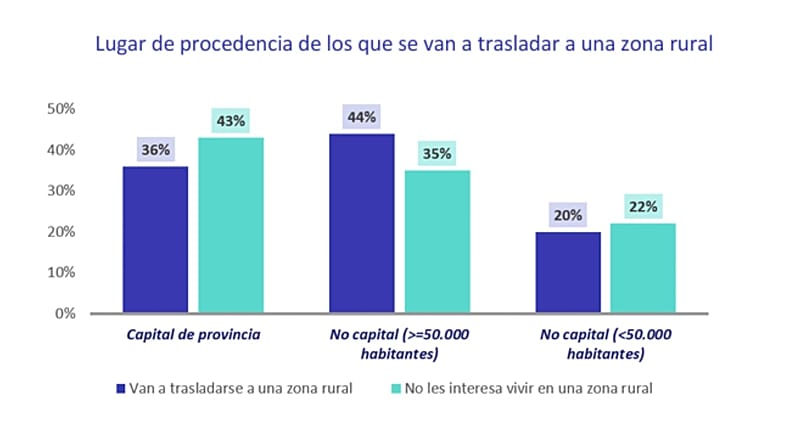
Most of them come from Catalonia (22%), Andalusia (19%) and Madrid (18%), and the most revealing point is that the majority are not from major capitals but from medium-sized cities: 44% currently live in municipalities with more than 50,000 inhabitants that are not provincial capitals. They are people who have already taken a step back from the big city and are now ready to take another.
A generational shift, not a fad
"The traditional image of rural repopulation is changing. Today the people who want to settle in a village are mainly young, of working age and with a life project still to build," says María Matos, head of research and spokesperson for Fotocasa.
Matos says this trend shows that rural areas are starting to establish themselves as a real residential alternative, although she warns that "for this opportunity to translate into a genuine demographic recovery, it will be essential to go on boosting employment, services, connectivity and infrastructure that can attract and retain people on a stable basis."
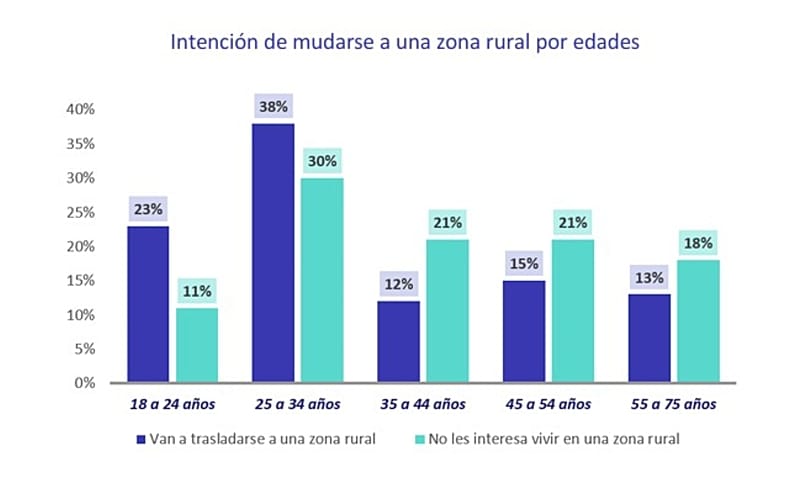
The age factor says it all: the youngest, aged 18 to 24, make up 23% of those planning to move to a rural area, while those aged 25 to 34 account for 38%. These are age groups that in the past would have been the first to look for a flat in the city. Today they are the first to give up on that option.
The most common living arrangements among those planning this move are to live with a partner and children (31%) or with their parents (30%), which reinforces the idea that many of these moves are not a purely vocational choice but also a response to the impossibility of accessing decent housing in urban environments.
"Empty Spain" as a safety valve
What for decades was a problem – rural depopulation, the exodus of young people to the cities – is now, paradoxically, turning into an opportunity. Villages have homes available and at affordable prices.
What they often do not offer is stable employment, quality healthcare, schools, high-speed internet or public transport, because as depopulated areas they have seen few improvements in these basic services. That is the knot that has to be untied if the neo-rural phenomenon is to move from being a statistical trend to becoming a real solution to Spain's housing crisis.
For now, the figures suggest there is a generation willing to give it a try. A generation battered by constant crises that is not asking for luxuries: it is asking to be able to live in a decent and independent way, to have a roof of its own and build a future. And it has reached the conclusion that, in Spain in 2026, that may be easier in a village in Teruel or Cuenca than in any neighbourhood in the big cities.