






























Industrial production in special economic zones rose 42.7% in the first nine months of 2025 in Uzbekistan. From Navoi’s logistics ambitions to expanding trade through Termez, new projects are drawing manufacturers and investors from across the region.
From industrial parks producing export goods to logistics hubs linking Europe, Asia and the Middle East, Uzbekistan's network of special economic zones has become one of the country's main tools for attracting foreign investment and expanding manufacturing capacity.
 ADVERTISEMENT
ADVERTISEMENT
ADVERTISEMENT
Government figures show industrial production in Special Economic Zones reached almost €3.12 billion in the first nine months of 2025, a 42.7% increase compared with the same period a year earlier. Foreign direct investment inflows are also rising as authorities expand infrastructure and industrial capacity to meet growing demand from international businesses.
Uzbekistan currently operates 31 Special Economic Zones, alongside hundreds of smaller industrial sites and technoparks. Demand from international businesses is particularly strong in logistics, export-oriented manufacturing and regional trade.
“Annual foreign direct investment inflows are growing by around 20 to 25 percent,” said Sahib Saifnazarov, head of the Department of Free Economic Zones at the Ministry of Investments, Industry and Trade.
He said growing investor interest is increasing demand for industrial land, transport infrastructure and energy supply, while authorities are also promoting renewable energy projects and seeking greater involvement from experienced international management companies.
“Today, more attention is being paid not only to infrastructure but also to green energy,” Saifnazarov said. “Another important direction is involving experienced foreign companies in the management of these zones.”
Navoi expands manufacturing and logistics capacity
Among the country’s largest industrial hubs, the Navoi Free Economic Zone has become a major centre for manufacturing and logistics.
According to Ma’murjon Murodullayev, deputy director of the zone’s administration, more than 90 projects worth approximately €2.2 billion are currently located there, with 73 already operational and employing more than 8,000 people.
“Seventy-three projects have already been launched, creating more than 8,000 jobs,” he said. “Between 2026 and 2029, another 18 major projects are planned, which are expected to create nearly 2,000 additional jobs.”
The zone exported nearly €132 million worth of products in 2025 to markets including CIS countries (Commonwealth of Independent States), Europe and China. Exports are expected to exceed €141 million next year.
Alongside manufacturing, Navoi is positioning itself as a multimodal transport hub linking Europe, Asia and the Middle East. According to Alisher Klichov, director of Navoi International Airport, major infrastructure projects are underway to support growing cargo volumes and transit traffic.
“Our strategic goal is to create a central Eurasian transit hub in Navoi capable of competing with major hubs in the UAE, Kazakhstan, and the Caucasus,” Klichov said.
Plans include a new cargo terminal, specialised facilities for express shipments and an aircraft maintenance and painting centre expected to open by 2029.
International manufacturers increase presence in Tashkent region
The Tashkent region Special Economic Zone has also emerged as a significant destination for foreign manufacturers.
According to Eldor Ko’chimov, chief specialist of the zone’s administration, 71 foreign enterprises currently operate there, with Chinese investors accounting for the largest share.
“Chinese companies account for the largest share, with 31 projects, while 14 projects involve investors from Russia,” he said. “Negotiations are also ongoing with Japanese and Korean partners.”
Since the zone was established in 2012, 119 enterprises worth €1.3 billion have been launched. Construction continues on a further 112 projects valued at approximately $1.2 billion, with more than 11,000 additional jobs expected. Industrial output has reached almost €870 million, while products manufactured in the zone are exported to nearly 30 countries.
Among the investors is Showaib Mirzoi, whose company is developing a beverage production project in Angren.
“Our planned investment is around €112 million, and it is expected to increase further,” he said. “We plan to add PET lines, glass lines, CO2 gas production, and plastic packaging facilities.”
Mirzoi said his company already operates similar businesses in Afghanistan but selected Uzbekistan for its industrial development opportunities and growing market.
Termez strengthens trade links
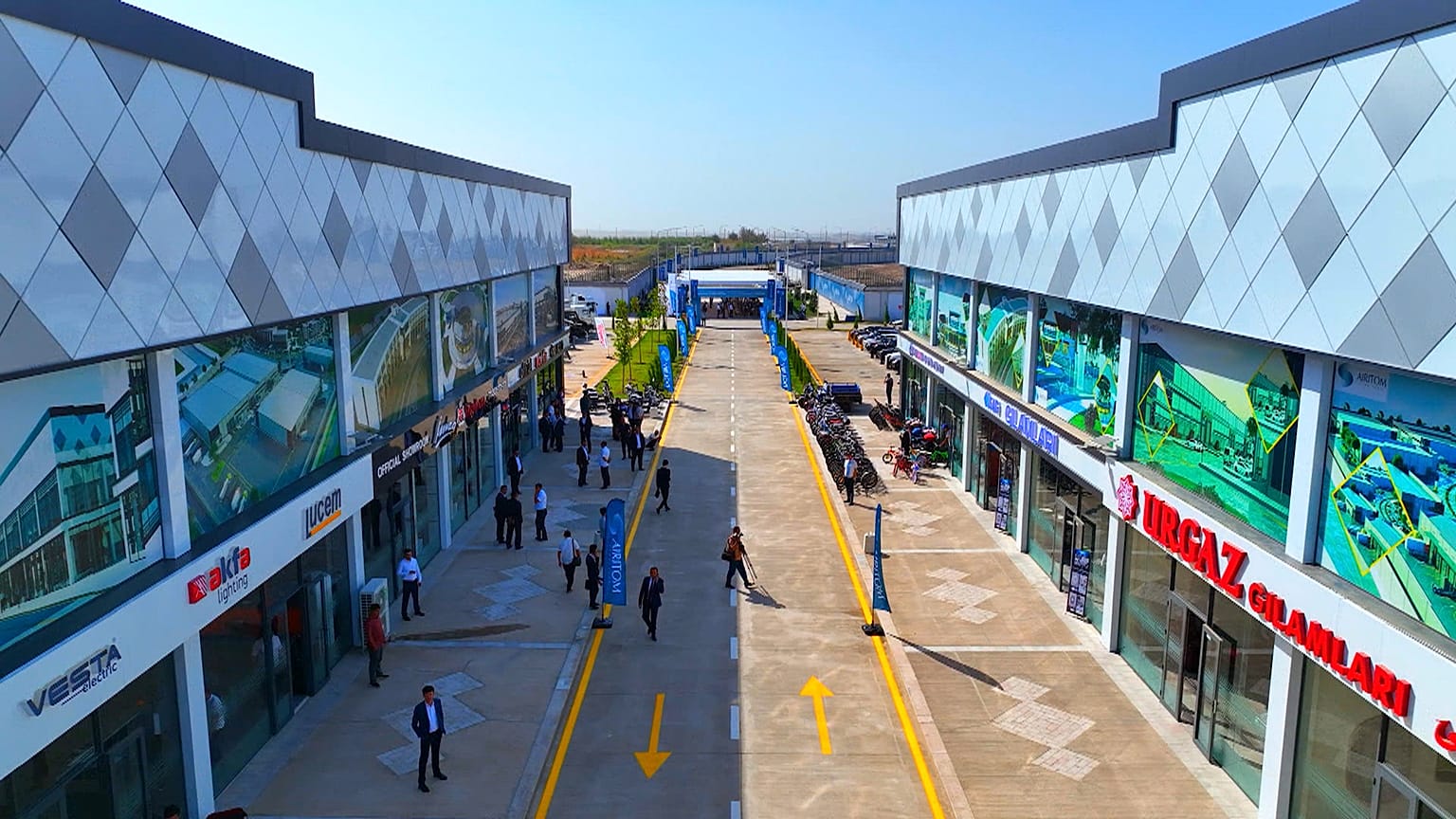
Further south, the Termez International Trade Center near the Afghan border is becoming an increasingly important commercial gateway.
Opened in August 2024, the centre now hosts more than 255 entrepreneurs, including 129 Afghan citizens, according to Mirkhamid Mirpolatov, head of the trade centre. More than 1,300 jobs have been created.
Businesses from Uzbekistan, Russia, Kazakhstan, Kyrgyzstan and Tajikistan have established operations there, while Chinese companies have also begun entering the market.
Mirpolatov said the centre’s location provides businesses with direct access to trade routes through Afghanistan.
“Our center is in a very convenient location for transporting goods through Afghanistan to other countries,” he said. “Interest from international businesses is growing every day.”
Among those using the facility is entrepreneur Shamsiddin Taganov, who exports confectionery products to Afghanistan.
“We mainly export sweets, chocolate, biscuits and similar products produced in Uzbekistan,” he said. “The logistics centres help us organise deliveries to Kabul and Mazar-i-Sharif.”
He added that logistical support and tax incentives have made it easier for local businesses to reach neighbouring markets.
Read more