




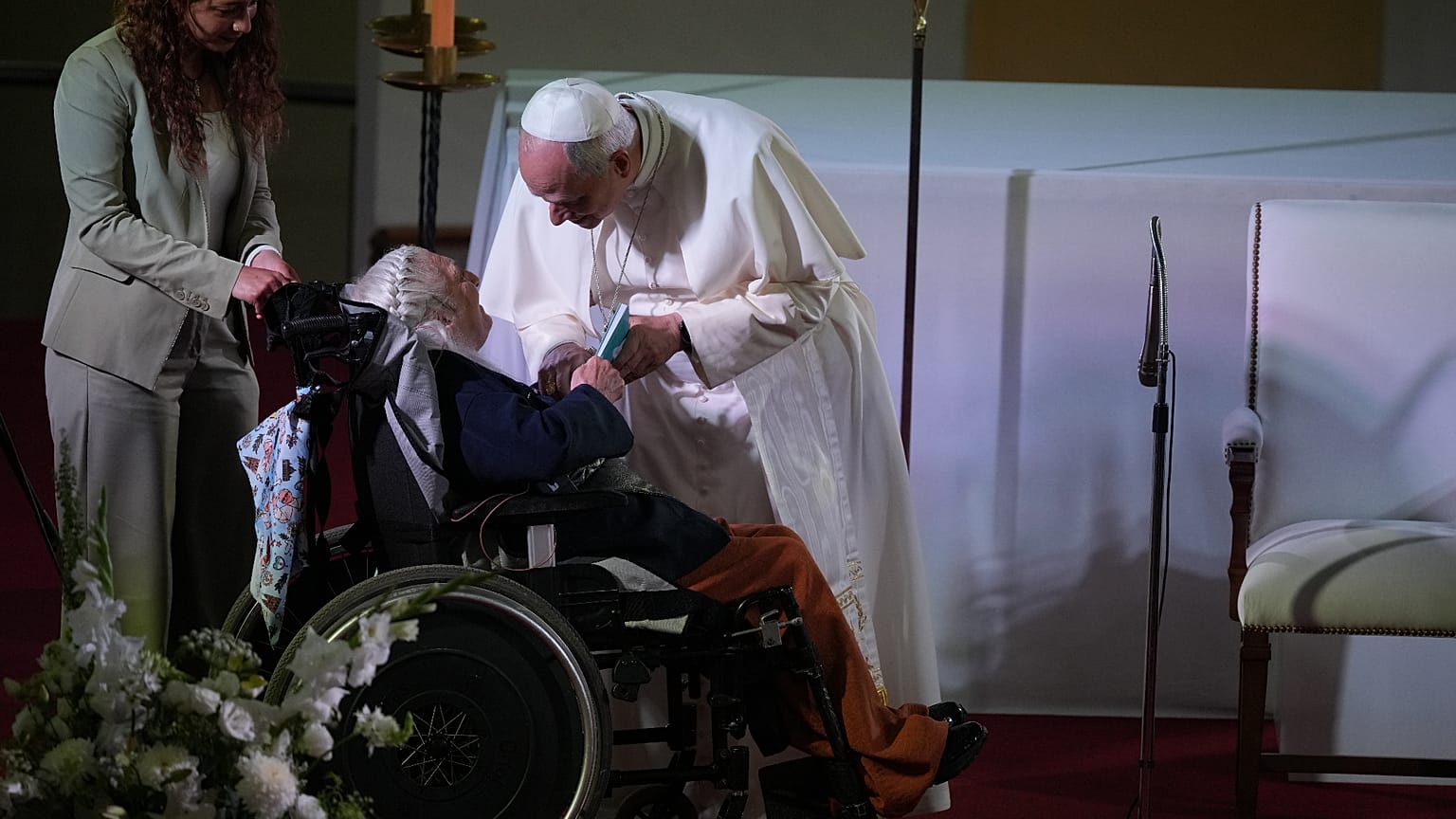














The Pontiff visited the Cottolengo Don Orione, which cares for over 400 people and has been hit by Javier Milei's cuts, and said a nation's progress should be judged by how it treats those most in need.
On Monday Pope Leo XIV called on Argentina to protect the most vulnerable people and placed attention on those with disabilities at the heart of his message during his first full day in the country. The Pontiff visited Cottolengo Don Orione, a care centre located in Claypole, south of Buenos Aires, whose work has been affected by the austerity measures of Javier Milei's government.
 ADVERTISEMENT
The institution, founded in 1935 by an Italian priest, houses more than 400 people with disabilities on a 50 hectare site. Known as the "city of charity", the centre has suffered the consequences of cuts to health and social services, as well as funding difficulties for specialised care and therapy programmes.
Not a burden but a blessing
During his tour, Leo XIV hugged residents in wheelchairs, talked with them and gave them his blessing. The arrival of the Pope brought some workers and residents to tears. Addressing them, he said that their lives are a blessing and not a burden for society.
In the centre's chapel, the Holy Father defended the dignity of all people and called for the importance of solidarity to be restored in the face of the pursuit of economic success and the cult of appearances. "The progress of a nation is also measured by how it welcomes all people with disabilities and particular needs," he said.
The message carries particular weight in a context of tension between the Argentine government and organisations working in the field of disability. Last year Congress overturned Milei's veto of a law that provided for an increase in funds for this sector. However, the executive has resisted implementing it, arguing that it could put at risk the fiscal balance achieved.
Government opposition to funding care of the disabled continues
As a consequence, care centres such as Cottolengo have outstanding debts amounting to hundreds of thousands of euros. In addition, the government's adjustment measures have affected specialised therapy programmes that for decades have been fundamental for many of the approximately five million people with disabilities living in Argentina.
The papal visit also comes just a few days before the Senate is due to study a draft bill that seeks to reserve funds for disability benefits in next year's budget. Milei opposes this initiative.
Kuyen Rolon Rey, a Cottolengo volunteer, highlighted how important it is that Leo XIV chose to start his tour of Argentina precisely in this establishment. "The people here deserve this grace," he said. He also praised the fact that the Pontiff chose a place that is small in size, but big in the love it represents.
A call to business leaders and trade unions
The visit to the care centre opened a day in which Leo XIV was scheduled to meet at the Catholic University of Argentina with business representatives, trade union leaders and representatives of popular movements.
The meeting is part of the message of Catholic social teaching that the Pope is developing during his trip: putting the weakest and most vulnerable people at the centre of economic decisions. This line also revives an integral part of the legacy of Pope Francis, who was Argentine by birth.
On Sunday, during his first speech in the country and in Milei's presence, Leo XIV had already recalled one of his predecessor's recurring ideas: money must be at the service of people and not the other way round. "The economy must serve the person, not the person the economy," he said.
Those expected to take part in Monday's meeting include representatives of national manufacturers, affected by the arrival of low-priced imported products after Milei removed trade restrictions that had been in force for years.
Members of the main Argentine trade union confederation were also invited, whose representatives conveyed to the Vatican in September their concern about job losses and falling wages.
Since coming to power at the end of 2023, Milei has driven a broad austerity programme that has turned him into one of the leading figures in the international conservative backlash against the liberal establishment.
His government has defended cuts to disability programmes as part of a reform process aimed at eliminating fraud and unnecessary spending in the federal administration.