



























Kazakhstan is becoming a key economic and geopolitical partner for Germany. President Tokayev's Berlin visit focuses on Central Asia and cutting reliance on vital raw materials.
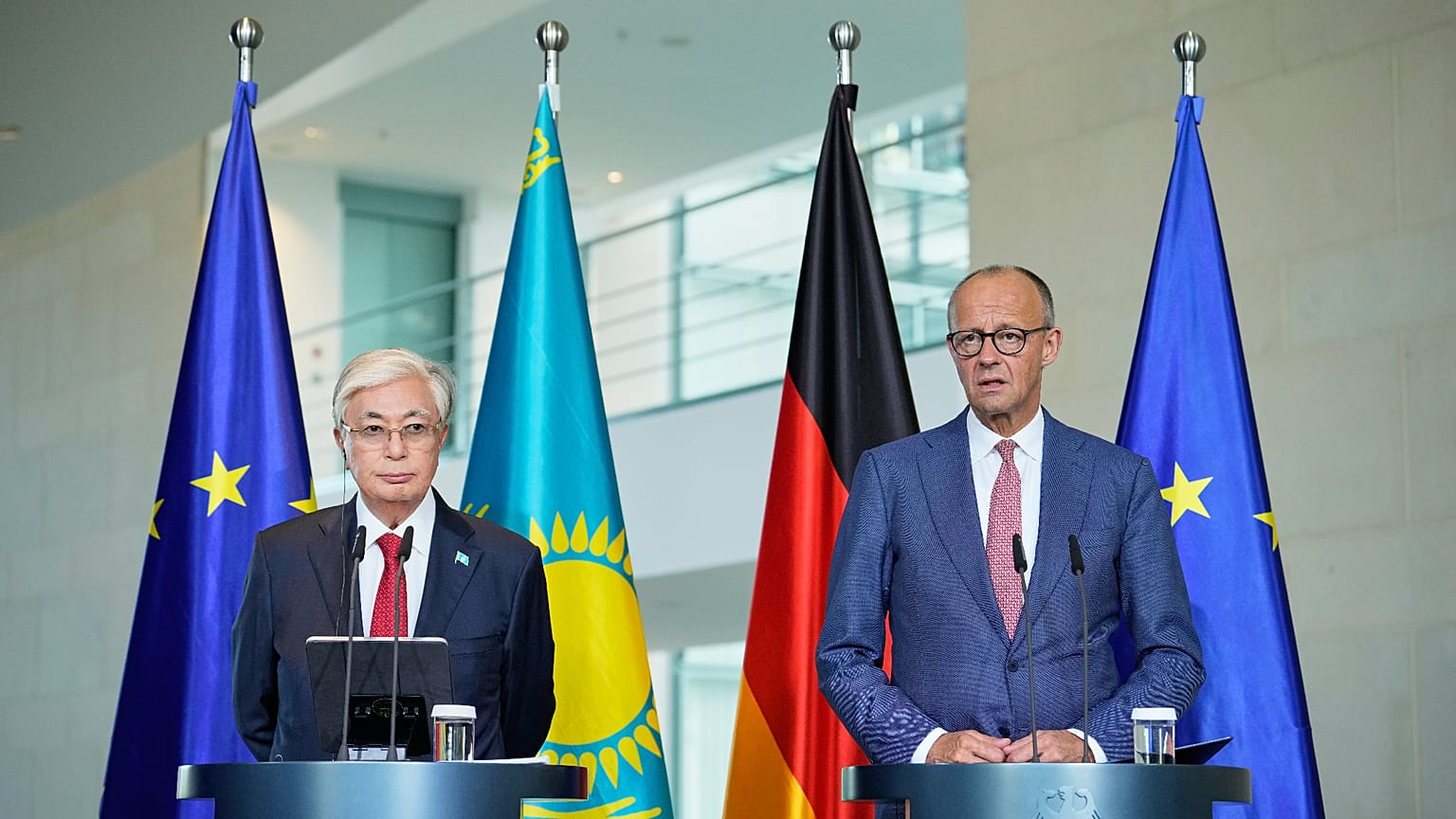
When Kazakhstan's President Kassym-Jomart Tokayev met Federal Chancellor Friedrich Merz at the Chancellery on Tuesday, the talks were about far more than traditional diplomacy. On the agenda were, according to the German government (source in German), the expansion of the bilateral energy and raw materials partnership, regional cooperation in Central Asia and international security policy.
 ADVERTISEMENT
ADVERTISEMENT
ADVERTISEMENT
The aim is to turn a supplier of raw materials into an industrial partner. Kazakhstan offers Germany access to critical raw materials and, in return, wants to use German technology and know-how for processing them and for joint production.
Kazakhstan has extensive reserves of raw materials and also lies on an important transport corridor between China, Russia, the Caspian Sea and Europe. Germany, for its part, is looking for new supply sources for raw materials, which are needed for industry, digitalisation and the energy transition.
According to the Association of German Chambers of Industry and Commerce (DIHK), the country is already Germany's most important economic partner in Central Asia and accounts for around 80 percent of German trade with the region.
Raw materials as the key to the partnership
As early as February it became clear in Berlin how important the region is becoming for Europe. At a meeting between the foreign ministers of the Central Asian states and Foreign Minister Johann Wadephul, rare earths and other critical raw materials were among the main items on the agenda.
President Tokayev of Kazakhstan had already, immediately before his visit to Berlin, been advocating closer cooperation on raw materials and industry. According to him, Kazakhstan already extracts 21 of the 34 raw materials classified by the EU as strategically important. These include lithium, silicon, cobalt, niobium, tungsten and copper. Tokayev explicitly proposed not just selling raw materials but establishing joint value chains: from extraction and processing through to production and recycling.
From the mine to processing
Kazakhstan's desire to upgrade its raw materials industry technologically is illustrated by a project financed by the European Bank for Reconstruction and Development (EBRD). The bank is already providing around 255 million euros for a large plant to process hard-to-access so-called refractory gold ore. Refractory gold ore is used for gold production, but the gold contained in it first has to be released by special processes.
Around half of Kazakhstan's gold reserves are found in ores that are difficult to process using conventional methods. The new facility is intended not only to tap additional deposits but also to increase domestic processing capacity.
Kazakhstan as a hub between Europe and Asia
Another pillar of the economic relationship is logistics. The fact that Kazakhstan is the largest landlocked country in the world and is so favourably located geographically makes it a key hub for alternative trade routes.
At the Astana Finance Days in September experts discussed how Kazakhstan can strengthen its role as a transit country and at the same time become a regional centre for production, trade and investment. Particular emphasis was placed on linking different modes of transport – rail, sea and air. The port of Aktau on the Caspian Sea plays an important role in this.
Germany looks for new partners
The timing of this rapprochement is no coincidence. Europe has for years been trying to diversify its economic dependencies. In the field of critical raw materials in particular, China plays a central role in global supply chains, and Central Asia offers an alternative source from a European perspective.
At the same time various actors are competing for access to the region. Russia and China have strengthened their economic and political ties with the Central Asian states in recent years. Euronews already pointed out in February that Central Asia increasingly lies at a geopolitical crossroads between European, Chinese and Russian interests.
Kazakhstan, for its part, is seeking to expand its relations with a range of partners. For Germany this means that cooperation has to prove itself in an environment in which other states are also pursuing economic and strategic interests.
From supplier of raw materials to industrial partner?
How concrete cooperation already is can be seen from the German-Kazakh Economic Forum, taking place in Berlin today in parallel with Tokayev's political talks. "We want to deepen our economic relations, which is why the economic forum is being held in Berlin this evening," Federal Chancellor Merz stressed at the joint press conference in the afternoon.
Around 300 representatives from politics and business are discussing projects in industry, energy, raw materials as well as transport and logistics. According to the Eastern Committee of German Business, 37 bilateral projects with a total volume of around 1.8 billion euros are to be signed.
Today's meeting between Merz and Tokayev clearly showed the role Germany and Kazakhstan want to play for each other in future.
By mid-afternoon the following agreements had been reached:
Raw materials and mining: Kazakhstan and Germany want to expand their cooperation on critical raw materials. The Kazakh government mentions, among others, lithium, copper, tungsten and other strategic raw materials. The Federal Institute for Geosciences and Natural Resources (BGR) and Kazakh partners are to cooperate on geological exploration and raw material projects.
Lithium: Kazakh company HMS Bergbau is planning geological exploration for a lithium processing plant in eastern Kazakhstan. The planned investment volume is put at 500 million US dollars.
Siemens: A strategic memorandum with Siemens LLP and a strategic partnership agreement between Samruk-Kazyna and Siemens Central Asia have been concluded.
Green hydrogen: Kazakhstan's Ministry of Science and Svevind Energy have agreed to cooperate on research for a green hydrogen project.
Agriculture: Cooperation agreements have been signed with HORSCH and CLAAS. In addition, the joint production of Condor seed drills is to be established in Kazakhstan. Dairy farms also have very good prospects, the Kazakh president emphasised; organic farming likewise plays an important role. What is crucial, however, is that Kazakh companies gain access to the German market.
Financing: The Kazakh holding company Baiterek and KfW have agreed to cooperate; a mandate has also been signed between the Development Bank of Kazakhstan and Deutsche Bank.
Potassium and boric acid: Qazaq Kalium and the KfW/Euler Hermes Group have agreed to cooperate on an enrichment and production complex based on the Satimola deposit.
Transport: A project to build an international cargo and passenger airport is also planned.
Overall: The Kazakh side speaks of 23 further documents signed during the visit between state bodies and companies from both countries.
In addition, at the subsequent economic forum today, 37 bilateral business projects with a volume of around 1.8 billion euros are ready to be signed, according to the Eastern Committee of German Business.
Russia: Tokayev relies on diplomacy, Merz emphasises support for Ukraine
Merz and Tokayev were not entirely on the same line when it came to Russia. Kazakhstan's president pointed out that his country shares the world's longest existing state border with Russia and that he has very good contacts with President Putin: "I regard him as an outstanding personality. Perhaps that may sound somewhat strange to you, but I know him very well and he has the qualities required of a great head of state for such a vast country. Naturally, we insist that every country should preserve its territorial integrity," he said with regard to Ukraine. He added that he holds Ukraine and its culture in high esteem. "Kazakhstan needs peace and stability, and as president I will do everything to achieve that."
Tokayev also stressed that he is advocating a freeze of military operations between Russia and Ukraine so that negotiations can begin.
Federal Chancellor Merz underlined that Germany has been on Ukraine's side from the very beginning and "is doing everything it can to ensure that Ukraine withstands this war. Russia is currently not interested in serious talks," Merz said, "and we will continue to support Ukraine. If Russia is not prepared to end the war, we are ready to support Ukraine over a long period. Russia will not win this war."
On Wednesday President Tokayev is scheduled to travel on to Bavaria, where further talks with political and business representatives are planned.