

















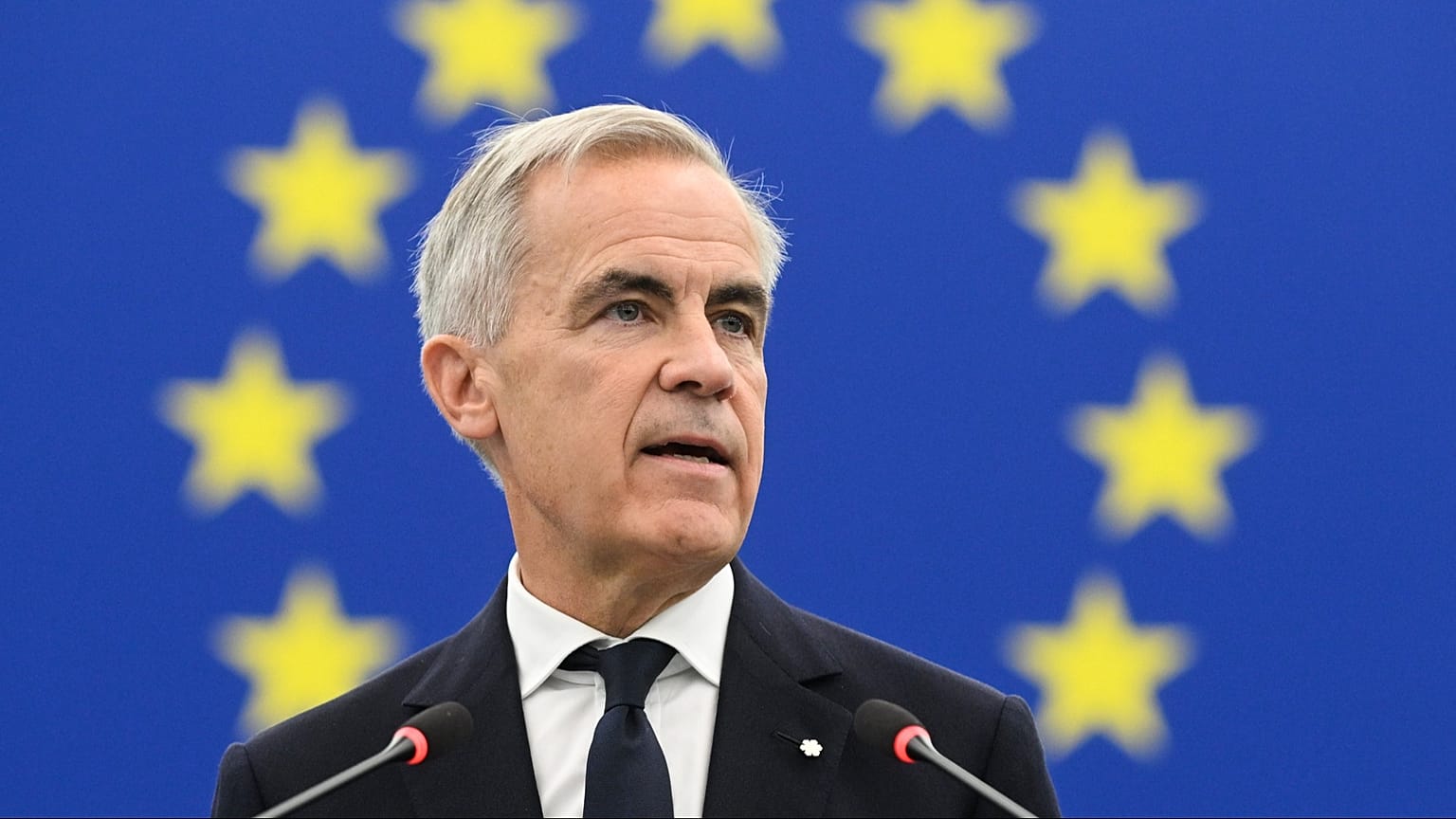














"Canada and Europe are stronger together," Canadian Prime Minister Mark Carney said in his address to the European Parliament.
Canadian Prime Minister Mark Carney has welcomed the invitation for his country to become the European Union's first-ever "associate member" in a speech delivered before the European Parliament on Thursday.
 ADVERTISEMENT
ADVERTISEMENT
ADVERTISEMENT
He later stressed that the outcome of the negotiations would respect Canadian sovereignty and be put to a final vote in Ottawa. Notably, he said the "nomenclature" would be for Brussels to discuss and decide.
"Canada welcomes this ambition. And I will tell you, polling shows that an overwhelming majority of Canadians support much closer ties with Europe," he said in Strasbourg.
Carney portrayed an ever-closer EU-Canada alliance as a "beacon for other democracies" based on shared values and "open enough that others can join".
He cited energy security, critical minerals, defence capabilities, artificial intelligence and finance as areas for deeper integration. He also said the two sides should work to allow young people to "live, work and study" on either side of the Atlantic Ocean.
Carney's speech came a day after European Commission President Ursula von der Leyen invited Canada to become the EU's first-ever "associate member", a novel concept that lacks legal precedent and raises more questions than answers.
Overnight, US President Donald Trump threatened to slap "very serious tariffs" on Europeans if the idea of "associate membership" were carried out as a "hostile act".
Here's how the day unfolded.

 ${title}
Live ended
Key takeaways from Mark Carney's speech in Strasbourg
Canadian Prime Minister Mark Carney delivered a speech on Thursday before the European Parliament in Strasbourg and gave a press conference afterwards.
"Europe and Canada are stronger together," he declared.
Here's what we learned:
- Carney said that Canada "welcomes" the offer extended by Ursula von der Leyen for Canada to become the EU's first-ever "associate member", a status without precedent.
- But he also said that the final "nomenclature" would be for Brussels to define. He repeatedly framed the ideas as an "alliance", rather than "associate membership".
- "What matters is the substance," he said.
- Carey said the concept was in early stages and would need to be further developed ahead of the EU-Canada summit scheduled in Montreal in late October.
- Asked about red lines, Carney said the EU-Canada alliance will respect Canadian sovereignty and be put to a final vote in the Canadian parliament.
- Carney said the alliance should become a "beacon for other democracies" that is "open enough" for other like-minded partners.
- Carney insisted the alliance was not a "reaction" to the threats made by Donald Trump. He also said neither Canada nor the EU would seek to create a "great-power rival".
- He also said the new partnership should pave the way for young people to live, work and study on both sides of the Atlantic Ocean.
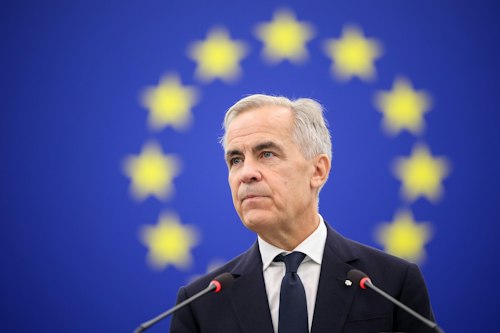
Credit: European Union, 2026.
Carney says Canada not seeking full EU membership
Canada's PM Mark Carney welcomed the invitation to become the first "associate member" of the European Union, but emphasised that the intent is not to become a full member nor to cede sovereignty.
"Canada is not in a position nor seeking to become a full member of the European Union," he said. "Therefore, it's a different framework. It's a framework that is relevant for a country that shares deep bonds with Europe."
Carney also emphasised that the exact name of the arrangement was for Europe to define, as what mattered was the substance of a new, positive framework between the EU and Canada.
The Canadian leader also made clear Ottawa does not intend to cede sovereignty to Brussels, as "we are looking for partnerships that are complementary, that reinforce our sovereignty".
Carney hails EU-Canada alliance but draws lines on membership
Canada's PM Carney welcomed the invitation to become the first "associate member" of the European Union, but emphasised that the intent is not to become a full…
Spain backs Canada's 'associate member' status
Shortly after Carney's speech, Spanish Prime Minister Pedro Sánchez posted an image on X that leaves no doubt as to his enthusiasm for making Canada the EU's first-ever "associate member".
https://x.com/sanchezcastejon/status/2100540056926650762‘We should not be scared of something new,’ Metsola says
European Parliament President Roberta Metsola said the EU should not “be scared of something new” in relation to the unprecedented associated membership status offered to Canada.
“Europe has never been afraid of forging new paths and creating new frontiers,” she said, underlining the role of the European Parliament in the ratification of the CETA trade agreement with Canada.
Metsola also said that “opportunities can only get bigger with Canada”, referring to flagship EU programmes such as Erasmus and Horizon.
New EU-Canada alliance is not 'reaction' to Trump, Carney says
During the press conference, Mark Carney was asked about Donald Trump's threat to slap tariffs if the EU's "associate membership" for Canada was done as a "hostile act".
"This is a positive initiative. It's ambitious, and it's positive. It's about building for people, creating opportunity. Just think of the opportunity for young people in Europe (and) in Canada to study, to live and work in those jurisdictions, to learn from each other, build the bonds that will strengthen our ties," Carney said.
"This is a fundamental point. This is for a better future for our citizens. It's not a reaction to something else. It's moving to the future."
New alliance will respect Canada's sovereignty, Carney insists
The new alliance between the EU and Canada will respect Canadian sovereignty, Mark Carney has said, pushing back against critics.
"It will make Europe stronger. It will make Canada stronger. It will make -- I'll speak for Canada -- Canada a better partner with the United States," the premier said when asked about red lines.
"And with respect to sovereignty, as I detailed in my remarks and as has been our strategy from the start, we are looking for partnerships that are complementary, that reinforce our sovereignty, and that's what is on offer here," he added.
"Canadians are united that nobody is going to tell us what language we speak. No one is going to dictate our culture or with whom we can strike international agreements."
Carney says 'associate member' status is up for EU to determine
Mark Carney has stressed that Canada is not seeking to become a full-time member state of the EU and the final name that defines the relationship will be for Brussels to determine.
"President von der Leyen used both terms: alliance for the future and associate membership. The nomenclature, the precise nomenclature, is a question for Europe," he said.
"What matters is the substance. What are we actually building together? How do we combine our strengths in a way that serve our people better, protect our fundamental rights, and create prosperity?"
"Canada is not in a position nor seeking to become a full member of the European Union. Therefore, it's a different framework," he went on. "It's a framework that is relevant for a country that shares the deep bonds, histories and the ambitions for people that the European Parliament has for Europeans and the Canadian government has for Canadians."
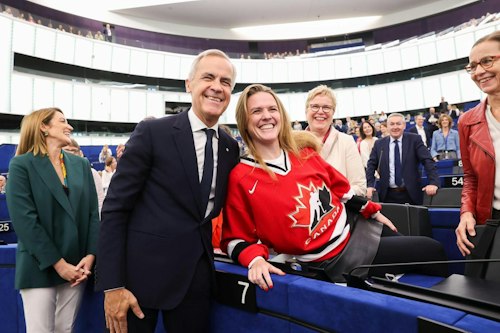
Greens leader listened to Carney’s address wearing a Canada hockey team T-shirt
MEP Terry Reintke, leader of the Greens/EFA group, listened to Carney’s address wearing a Sidney Crosby Canada hockey team T-shirt, which brought a smile to Carney’s face when he greeted her before the start of the session.
Several other MEPs wore red in the hemicycle.
Associated membership could affect trade, defence and foreign policy, according to MEPs
EU lawmakers are still trying to figure out what Canada’s “associate membership” would mean in practice, a day after Ursula von der Leyen announced it in her State of the Union speech.
As the details remain unclear, senior MEP Sandro Gozi of Renew Europe believes it could entail greater cooperation in three main areas: trade, defence and foreign policy.
“Maybe Carney would join EU leaders’ summits and his ministers would meet with EU ministers regularly,” he told Euronews. “But it is difficult to know what von der Leyen really has in mind.”
According to European People’s Party MEP Siegfried Mureșan, the proposed associate membership would enable the EU and Canada to deepen cooperation on the economy, security and investment, while also strengthening people-to-people ties.
“The vision is that we want closer ties with friendly countries, with liberal democracies outside Europe,” he told Euronews.
Carney calls for integrated EU-Canada capital markets
In his speech, Carney said that “Canada and Europe should also explore creating an integrated market for financial services", arguing that integrated capital markets would “broaden choice and reduce costs for our citizens, improve access to capital for our companies while maintaining our world-leading financial resilience”.
The European Union is currently undertaking a legislative reform of capital markets aimed at overcoming fragmentation, a major obstacle for companies and investors alike.
The reforms are a main component of the bloc's competitiveness agenda, which was inspired by a landmark competitiveness report by former Italian Prime Minister Mario Draghi.
European Central Bank President Christine Lagarde has advocated for capital markets reform as a prerequisite for EU to advance.
The legislative files on capital markets are currently under negotiation. The EU has the aim to finalise the agreement by the end of the year, but disagreement still persists.
New alliance will be put to a vote in Canadian parliament, Carney vows
The new alliance between Canada and the EU, which could involve "associate member" status, will be "ultimately" put to a vote in the Canadian parliament, Mark Carney has said.
"We will have a series of debates, I'm sure, in parliament (and) relevant committees. And ultimately, there will be a vote in the Canadian parliament for the final structure of the alliance that we're working on," he said, next to Metsola.
"I observe that there has been a fair bit of preparation for this," he added, noting the discussions were the "start of a process" that needed to be further fleshed out. The next key moment will be the EU-Canada summit in Montreal at the end of October.
"It will all roll out transparently," he said. "It's an exciting time because this is an opportunity to speak for Canada to make Canada stronger, more sovereign, more independent, more prosperous, more sustainable."
Carney and Metsola hold press conference
Mark Carney and Roberta Metsola are now holding a joint press conference.
Stay tuned.
Let's flourish as free people together, Carney says, concluding among applause
Mark Carney concludes his speech by bridging the past and the future of EU-Canada relations.
"My country, it's often said that Canada became a nation during the Battle of Vimy Ridge, and certainly the thousands of Canadians who didn't return from that battle sacrificed their lives for something much bigger than themselves," he tells lawmakers.
"One who did come home stopped first to pick up some acorns. And today, the same Vimy Oaks grow in Canada as in France," he adds.
"Living proof that what we cultivate together can survive the darkest winter to thrive again. So let us now deepen those roots, widen this canopy and grow a transatlantic forest under which our citizens can flourish as free people on free ground every single day."
The speech concludes with loud applause from MEPs.
Carney offers energy supplies as well as critical raw materials to the EU
Carney proposed on Wednesday that the Europeans meet their needs for critical raw materials and energy.
The statement comes as European Commission President Ursula von der Leyen invited Canada on Wednesday to join a new alliance designed to deepen economic relations between the EU and Canada.
“Canada has deposits of over 34 critical minerals, and we are among the top producers of the ten most essential for the world’s energy transition,” Carney said. “Our alliance can help fill Europe’s need for reliable supply.”
The proposal will fit into the EU’s strategy to diversify, as it still relies on China, which holds a monopoly over the production and processing of some key materials.
Carney also said that his country can contribute LNG and hydrogen “at large scale” to support “Europe’s energy security.” The proposal includes the development of new port infrastructure in the high north and on Canada’s east coast.
“We, in turn, can benefit from your leadership in many clean energy technologies,” Carney added.
Canada-EU alliance should be open for others to join, Carney says
Mark Carney has framed the nascent Canada-EU alliance as a "beacon for democracies" that can be "open enough" for other nations to join.
"A Canada-EU alliance would create a beacon for other democracies. An alliance not defined by what we oppose but about what we are for: freedom, solidarity, prosperity, sustainability," he said.
"An alliance that builds resilience for what it allows us to do for our citizens and our citizens to do for themselves. An alliance strong enough so that no one can dictate our choices. An alliance open enough that others can join. An alliance principled enough that our strength reinforces international law rather than seeks to replace it."
I'm not proposing a 'great-power rival', Carney says
Mark Carney says his vision of a closer EU-Canada partnership does not seek to create a "great-power rival", in another apparent dig at Donald Trump.
"I also want to be precise about what I am not proposing. I'm not proposing a third bloc in order to become a great power rival, only with better manners," he says, prompting laughter in the room.
"We do not seek power to dominate others. On the contrary, we are pursuing resilience. So no one, no one can control our open markets, impair our sovereignty, threaten our territorial integrity, or undermine our freedoms, our democracies, our rule of law," he adds.
"It's these motivations, these fundamental motivations, combined with our latent hard power, that mean that we can help to create the next just, stable and prosperous world order."
‘We will definte it together,’ Carney welcomes associated membership
The Canadian leader has hailed the invitation of European Commission President Ursula von der Leyen to become the first EU associate member.
“We welcome this ambition - polling shows an overwhelming majority of Canadians support much closer ties. An alliance for the future is a unique, positive approach that we will define together, building on our common strengths and based on shared values,” he said.
Carney went on to detail what he sees as the potential advantages of such an arrangement, notably in terms of critical minerals, defence industrial capacity, AI and compute, energy security, space, and payments.
Sovereigny requires collectively addressing strategic gaps
Canadian PM considers Europe and Canada can collectively stand stronger together by filling in strategic capability gaps that would allow both to better withstand shocks.
“Sovereignty goes beyond being able to feed, fuel and defend ourselves. It now requires secure access to AI, semiconductors, critical minerals, payment systems, clean energy technologies, vaccines and space-based communications,” he said.
For Carney, the need to fill these gaps are even more important as ‘global’ companies appear to be aligned with a national government, falling short of mentioning the US.
“Closing these gaps is not possible alone, but it is very achievable collectively,” he added.
Carney mentions Canadian participation in landmark EU defence programme, SAFE
Mark Carney highlights that Canada is participating in the European Union’s €150 billion Safe Action For Europe (SAFE) defence loan programme, as “the first non-European member”.
"But the ecosystem we have built is not yet equal to the ferocity of the changing climate,” he said to the hemicycle, in reference to the loan as well as other initiatives such as CETA, the EU and Canada’s free trade agreement.
Carney did concede, however that “we should recognise that the ecosystem we built is not yet equal in ferocity of the changing climate, and nor is it moving fast enough to match the speed of upheaval.”
'The ecosystem we have built is not yet equal to the ferocity of the changing climate,' Carney
Canadian Prime Minister Mark Carney told MEPs that the current trade agreement with the EU – CETA – as well as Ottawa’s participation in SAFE is not enough and that EU-Canada cooperation should be pushed further.
“The ecosystem we have built is not yet equal to the ferocity of the changing climate. Nor is it moving fast enough to match the speed of the upheaval.”
CETA was concluded in 2016. It removed tariff barriers between both sides of the Atlantic, while SAFE was created by the Europeans in 2025 to boost the EU’s defence industrial base through joint procurements.
Carney welcomes 'associate member' invitation
Mark Carney says Canada welcomes the "associate member" status offered by Ursula von der Leyen.
"Yesterday, President von der Leyen spoke of moving beyond CETA (the free trade deal) to an alliance for the future, opening the door to Canada to become the European Union's first associate member," he says to applause from lawmakers.
"Canada welcomes this ambition. And I will tell you, polling shows that an overwhelming majority of Canadians support much closer ties with Europe. An Alliance for the future is a unique, positive approach that we will define together, building on our common strengths and based on our shared values."
Europe and Canada bound not by geography but "by affinity", Carney says
"Canada and Europe are not bound by geography (...) we are bound by an affinity: elective, chosen, renewed and stronger for being so," Carney has told the chamber.
He added that our societies are "shaken by new storms", referring to climate change shocks, the "erosion of democratic norms" and the weaponisation of trade.
Carney: 'Europe and Canada are stronger together'
"Collectively, Canada and Europe are each strong. Europe and Canada are stronger together," Carney says.
"The institutions we've inherited are organised by geography, the strategic capabilities that we need are organised by function."
'A strong economy is a means to a just society,' Carney says
Carney says the "essence" of the EU-Canadian partnership is "seeds, values, ideas, trade, people and progress carried back and forth across the Atlantic for centuries".
"We are not fairweather allies. We do not pursue zero-sum deals," he says, in apparent dig at Donald Trump.
"Our commitment to the rule of law and our unyielding defence of human dignity, individual freedom and democracy share the same deep roots, the same unwavering dedication. We hold common values for which we have always fought, and in whose defence we must always remain vigilant," he adds.
"We believe that a strong economy is not an end in itself, but a means to a just society."
Carney: 'Freedom and life must be earned every single day'
"Freedom and life must be earned every single day. Every day," Carney says, reflecting on World War II.
"Not once in 1945 or 1956 or 1989. Every day, including this one."
Carney begins his speech in French
Mark Carney began his speech by speaking French, the co-official language of Canada.
Metsola honours Canada's alliance during WWII
Roberta Metsola has begun her speech by paying tribute to the sacrifices made by Canadian forces during World War II to defeat Nazim.
"Europe will always be grateful for the sacrifice of so many who stood with us and defended freedom and democracy. We will never forget," she said.
Did it all start in Davos?
Ursula von der Leyen's invitation for Canada to join the EU as associate member has seized the political spotlight this week -- but the seeds of the idea may have been planted months ago.
In his address to the World Economic Forum in Davos in January, Carney called for a coalition of "middle powers" to join forces to revive the rules-based world order, just as Trump ramped up his tariff war and threatened to annex Canada.
"The question for middle powers like Canada is not whether to adapt to the new reality – we must. The question is whether we adapt by simply building higher walls, or whether we can do something more ambitious," Carney told the audience in Davos.
He also said that "when we only negotiate bilaterally with a hegemon, we negotiate from weakness", adding that middle powers had a choice between "competing with each othe for favour" or combining to "create a third path with impact".
That speech -- read in Washington as an affront to the world's greates economic powers -- also drew a rebuke from US President Donald Trump.
The speech also led to months of closer political collaboration. Carney became the first non-European leader to attend a summit of the European Political Community (EPC) in May, and Canadian minsiters have become a regular feature of EU ministerial meetings.
Roberta Metsola greets Mark Carney
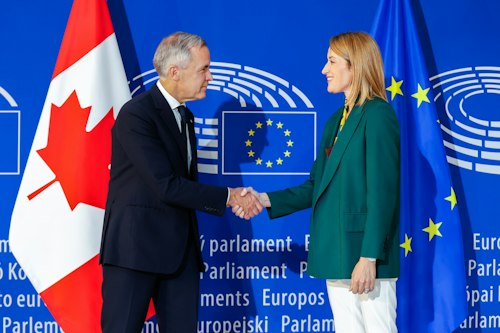
Credit: European Parliament.
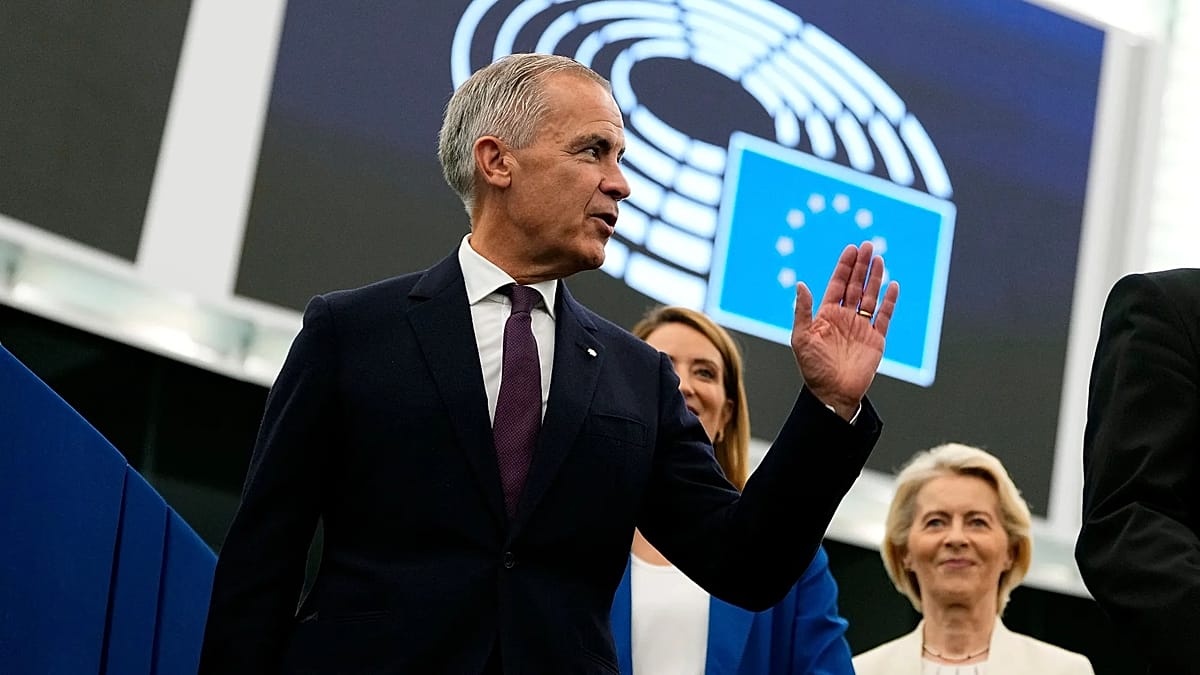
Carney enters the hemicycle
Canadian Prime Minister Mark Carney has just entered the hemicycle. He's joined by Roberta Metsola, the president of the European Parliament. He's now greeting some MEPs and taking selfies.
Von der Leyen enters the hemicycle
Ursula von der Leyen, the president of the European Commission, has entered the hemicycle to listen to Mark Carney's speech. Yesterday, he listened to her State of the Union address, which lasted over one hour.
Plenary prepares for Carney
The debate in the European Parliament just finished. The team is seting up the stage for Mark Carney's speech, expected to begin at 11.30 CET.
‘It is the sovereign choice of states to join their destinies together,’ French foreign minister
French Foreign Minister Jean-Noël Barrot responded on Thursday to US President Donald Trump’s overnight threat to impose tariffs on the EU if Canada were to become an EU associate member.
“It is the sovereign choice of states to join their destinies together,” Barrot said on French TV LCI. “Sovereignty is like borders, it is like democracy: it is not negotiable.”
Trump’s criticism came after European Commission President Ursula von der Leyen invited Canada to become an “associate” member of the EU, signalling an effort to deepen ties between Brussels and Ottawa.
Canada has increasingly looked to strengthen its relationship with Europe following the collapse of trade talks with Washington and the ensuing trade war.
Quizzed by the journalist about this new status of “associate” member, which remains unknown as it does not exist in EU treaties, the French Foreign Minister added that it will need “to be debated, examined in detail and analysed” before France takes a position.
However, he also said that the French are “committed to building increasingly closer ties with Canada.”
Could Article 217 pave the way for Canada's 'associated membership'?
There's no precedent for the "associate membership" that Ursula von der Leyen has offered to Canada. The concept doesn't exist. It's basically invented. So what's next?
Amid the confusion and speculation, a possible legal path has emerged: Article 217 of the EU treaties.
"The Union may conclude with one or more third countries or international organisations agreements establishing an association involving reciprocal rights and obligations, common action and special procedure," the article says.
This provision, which is broadly worded and therefore subject to interpretation, underpins the European Economic Area that brings Iceland, Norway and Liechtenstein into the single market and extends the four freedoms (goods, services, capital and people) to their territories.
Since both von der Leyen and Mark Carney are aiming for closer economic ties, Article 217 could pave the way for bringing the relationship to the next level while stopping short of actual membership.
Carney's diplomatic dash to Liverpool
Canadian Prime Minister Mark Carney was a first-row guest in the European Parliament chamber in Strasbourg yesterday morning, and is back this morning for his much-anticipated speech.
But between these appearances he made a swift, diplomatic dash to the north of England for his first formal meeting with UK Prime Minister Andy Burham.
Carney and Burnham held talks at Everton's Hill Dickinson Stadium before attending the club's EFL Cup fixture against Wolves. Both leaders were seen in a warm embrace when Everton scored the only goal of the match after 80 minutes.
The two men used their meeting to discuss opportunities for closer collaboration on defence, according to Carney's office. Burnham is reportedly considering joining the Canadian-led Defence, Security and Resilience Bank (DSRB), which intends to provide Canada and European countries with low-cost funding for defence and military projects.
The meeting also took on a personal tone. Days after Burnham lost his father to Alzheimer’s disease, Carney revealed that his father had died of the same cause. "I know that struggle," Carney told Burnham.
The first time I went to an Everton match was during the FA Cup in 1989. Unfortunately, it went the wrong way. Tonight, they didn’t disappoint. Thanks for the…
Poll ahead of Carney's speech shows 49% of Canadians support EU membership
Just how much do Canadians support EU membership?
Ahead of Mark Carney's speech in Strasbourg, Abacus Data published a new poll showing the sentiment among Canadian citizens. Here are some of the findings, which are truly remarkable considering the country lies on the other side of the Atlantic Ocean.
- 49% support Canada becoming an EU member state, 30% oppose, and 21% are unsure
- 71% of Canadians have a positive impression of the EU, while 16% have a negative perception
- 80% support deepening strategic cooperation with the EU on foreing policy, defence and economic priorities, while 10% oppose and another 10% are unsure
- 81% support closer integration between Canada and the EU, while 10% oppose it and 9% are unsure
- 56% feel they have more in common with the EU than with the US, 20% say they have about equally in common with both, and 16% say they have more in common with the US than with the EU
- 61% think a closer EU-Canada relation would increase Canada's economic independence, while 9% think it will decrease it and 16% think it will have no real impact
The survey was conducted with 1,479 Canadian adults from September 4 to 9, 2026. You can read the detailed findings here.
The EU-Canada trade relationship: from the CETA trade deal to von der Leyen’s “Alliance” offer
European Commission President Ursula von der Leyen called on Wednesday for an “Alliance for the Future” with Canada to move beyond CETA – the trade deal clinched by the EU and Canada in 2016.
Von der Leyen’s offer comes as Ottawa has been trapped in a trade war with the US since late August, pushing Canada to seek a closer relationship with the EU.
“We will move from CETA to an Alliance for the Future to create a common prosperity and economic security space,” von der Leyen said.
She added that the Alliance will include work on “intelligent” manufacturing, on “a tech alliance” and “defence industrial bases.” She also cited “a flagship joint project” in the Arctic and work “on energy, critical minerals and batteries,” as well as “AI, quantum, cyber and economic security.”
The Alliance should push further cooperation beyond CETA, which has already removed tariff barriers on most goods, except for sensitive farm products. However, it has not yet been ratified by all EU countries and had to be provisionally applied to come into force.
An EU-Canada summit is due to take place at the end of October in Montreal, where economic and security cooperation will be discussed.
Canada might offer better access to its critical raw materials to the EU, which seeks to move away from China for its supply. Energy could also be on the list of the Canadian proposals. A digital agreement would also be in the making.
Von der Leyen’s new security strategy raises several questions
Commission chief previewed some of the main elements of the upcoming EU security strategy, namely a European Security Council, an emergency protocol and a strategic enabler instrument.
The announcements have prompted more questions than anything else. How much will the new initiatives overlap with existing structures and the coalition of the willing? Will they effectively deter Russia’s ongoing escalation? Where will Europe find the money to replace the EU withdrawal of strategic capabilities?
Oana Lungescu, NATO's former spokesperson, said that while it's welcome that the Commission President wants closer EU-NATO cooperation, it's hard to see how this would actually deter Russia. "Protocols and playbooks already exist in both organisations," she said.
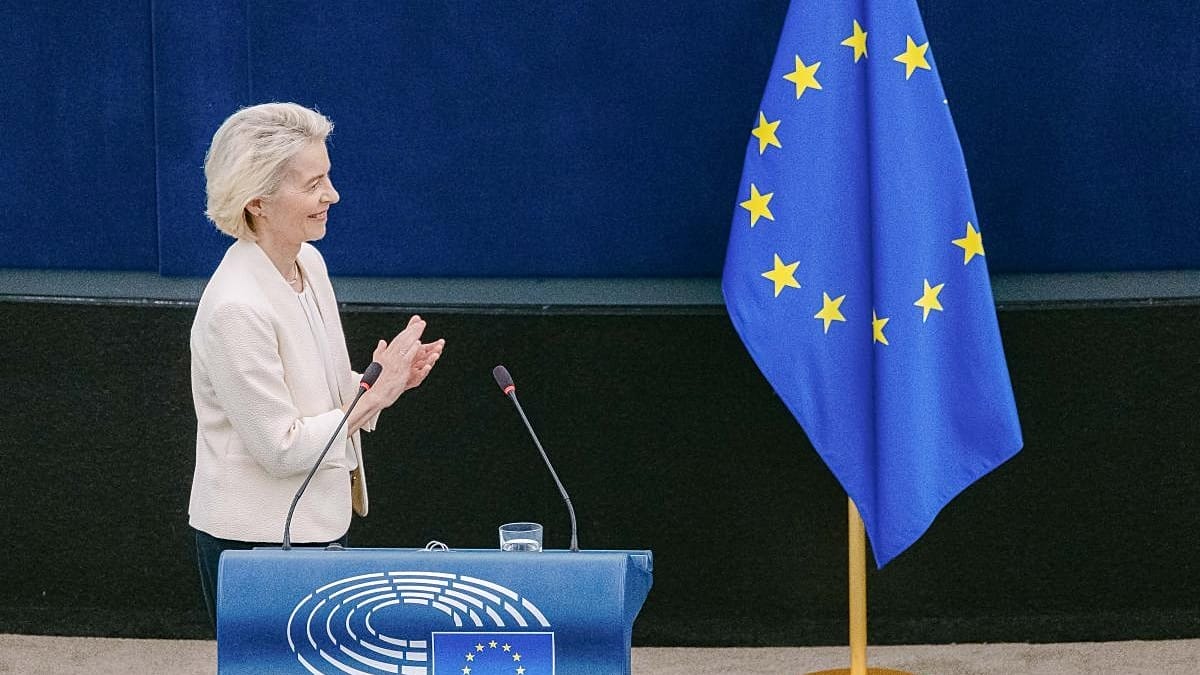
Inside von der Leyen’s pitch for a new EU security architecture
The State of the Union speech saw the Commission president outline what sound like grand plans for European security, but big questions remain unanswered. #Eur…
What is the EU-Canada defence relationship?
Canadian Foreign Minister Anita Anand told Euronews in May that Ottawa was “very enthusiastic” to continue working with Europe and other “like-minded countries”.
“What I believe we should be looking at is how we can work together pragmatically for our respective countries to deliver economic benefits and defence and security benefits,” she said.
From a defence perspective, this is already exemplified through the EU and Canada Security and Defence Partnership, finalised in 2025. This was seen as one of the first steps by Canada to shift its reliance away from the United States, and an increasingly bellicose Donald Trump, towards like-minded allies.
Most importantly, this partnership paved the way for Ottawa to participate in the EU’s €150 billion SAFE loan programme. As part of the European Commission’s push to ensure that the 27 EU member states have enough financing and capabilities to ward off aggression, it means that the Canadian defence industry can supply a portion of capabilities as part of these orders.
Hypothetically, this could span the production of anti-drone technology to weapons supporting a land army, for example.
How that could be expanded upon with potential EU associate membership is yet to be seen, but the new relationship could also forge deeper collaboration in regions that occupy the focus of both Brussels and Ottawa, such as the Arctic.
As the US trade war escalates, Canada looks to diversify its trade ties
Yesterday’s surprise invitation from European Commission President Ursula von der Leyen for Canada to become an “associate” member of the EU came as Ottawa’s relationship with its closest ally, the United States, continues to deteriorate amid a trade war that has been ongoing since late August.
Two weeks ago, trade talks broke down after Canada left the negotiating table, accusing Washington of seeking concessions on French-language protections, with French being one of Canada’s two official languages.
US President Donald Trump responded by announcing tariffs of up to 50% on Canadian cars and trucks. On Tuesday, the measures were extended to additional products, including certain steel goods. Canada has also imposed tariffs on $20 billion (around €17.5 billion) worth of US imports.
In the days that followed, Canadian Prime Minister Mark Carney called for stronger ties with the EU.
Ottawa faces mounting pressure to diversify its trade relationships, given its heavy dependence on the US: more than 70% of Canadian exports were destined for its southern neighbour in 2025.
While Canada will need to broaden its economic focus towards Europe and Asia, the two North American economies remain deeply integrated, making any rapid shift away from the US market difficult.
Foreign Affairs top MEP rebukes Trump for tariffs threat
German MEP David McAllister, chair of the European Parliament’s Foreign Affairs Committee, criticised US President Donald Trump after he threatened to impose tariffs in response to the EU’s proposal to make Canada the bloc’s first associate member.
"If Trump would have listened carefully, he would have understood that this is not against any third country," McAllister told Euronews in an interview.
Most MEPs have reacted positively to Ursula von der Leyen's proposal yesterday to make Canada an associate member of the EU.
Climate action key for EU-Canada deepening ties, Minister says
In an interview with Euronews in June, Canadian Climate Minister Julia Dabrusin had hailed a "wonderful and strong" partnership with the EU, noting that cooperation on climate action will "deepen" the ties between the two blocs.
She highlighted carbon pricing, a carbon border tax, methane laws and the massive infrastructure investment needed to electrify the economy as common challenges and opportunities faced by the EU and Canada to deepen transatlantic ties.
"Climate action can be very much at the center of the work that we're doing, so I think that it's a lovely moment for Canada and the EU, and I'm really happy after having spent these few days here in Europe, to be able to see how we can build this stronger relationship together, and I know that that is definitely a focus for our Prime Minister Mark Carney as we move forward,” Dabrusin said in June.
Commissioner Hoekstra: 'Extraordinary step' taken by EU and Canada a 'sign of the times we live in'
The fact that Canada and the European Union take the "extraordinary step" of seeking associate EU membership for Ottowa is "a sign of the times we live in", European Commissioner for Climate, Wopke Hoekstra, has told Euronews' EU Editor Maria Tadeo in Strasbourg.
"The world is in turmoil, that many of the rules that we thought were holy and were to be respected, are no longer (respected)," he said. "And therefore you have to look for allies who share the same values, have the same outlook, have same interests in geopolitics, in climate, in the economy, in trade."
The invitation for Canada to become an associate member of the bloc is widely seen as the result of President Trump's aggressive trade policy, and the US's escalating trade conflict with its North American neighbour.
Carney, due to address the European Parliament's chamber at 11.30 CET, had earlier this year pitched for a global alliance of "middle powers" to lead on re-establishing a world based order eroded by Trump.
Canadian opposition criticises Carney over 'associate membership'
The Conservative Party of Canada, the main opposition force, has sharply criticised Prime Minister Mark Carney for seeking "associate membership" with the European Union without a mandate from the Canadian parliament. The idea, it must be noted, was put forward by Ursula von der Leyen, not Carney.
Conservatives portrayed the project, which is yet to be fleshed out, as a transfer of national sovereignty to Brussels.
"The Prime Minister can’t seem to get his story straight about the 'associate membership', 'unique alliance', or whatever else he is negotiating with the EU," Conservative leader Pierre Poilievre said on social media.
"Conservatives are clear: we support the decades-old free trade & NATO defence alliance with Europe. But no EU taxes, no EU laws, and no EU open-border immigration policies should be imposed on Canadians," he added. "Canada must be independent and sovereign. Period."
Shuvaloy Majumdar, a Conservative lawmaker, stressed that Parliament should be consulted. "To what degree is the Prime Minister offering up Canadian sovereignty to become the 28th member of the European Union?" he said, according to local media.
'We are expressing solidarity with Canada,' EU Trade chief
EU Trade Commissioner Maroš Šefčovič told Euronews that the status of “associate” member of the EU attributed to Canada on Wednesday was a way to stand in solidarity with Canada in its trade war against the US.
Washington and Ottawa have been at loggerheads since late August after trade talks collapsed. The US has announced tariffs of up to 50% on a range of products, while Canada has retaliated with tariffs on US imports worth around $20 billion.
“What we are expressing here from one side, it's solidarity with Canada. At the same time, I believe that American and Canadian negotiators will find way back to the negotiating table,” Šefčovič said.
The Commissioner added that the status of “associate member” also reflected that the EU and Canada were “very compatible”, “not only societies, but also economies”.
“I think in this fragmented world, we are looking for the allies, all of us.”
Šefčovič said that Canada and the EU were looking for partners sharing the same values when it comes to reform of the World Trade Organisation, future trade partnerships, security cooperation and defence.
Canada wants to join Erasmus+
The Canadian government is in talks with the European Commission to join the Erasmus+ exchange program, which would allow European and Canadian students to study and be trained in each other’s universities.
"Canadians want to participate in Erasmus+. It will be expensive for them, but they are ready to do that," MEP Javier Moreno Sánchez (Spain/S&D), chair of the European Parliament's delegation to Canada, told reporters.
The talks are still at an early stage. Several other non-EU countries take part in what is considered one of the most successful European projects, which would likely provide the framework for Canada’s participation.
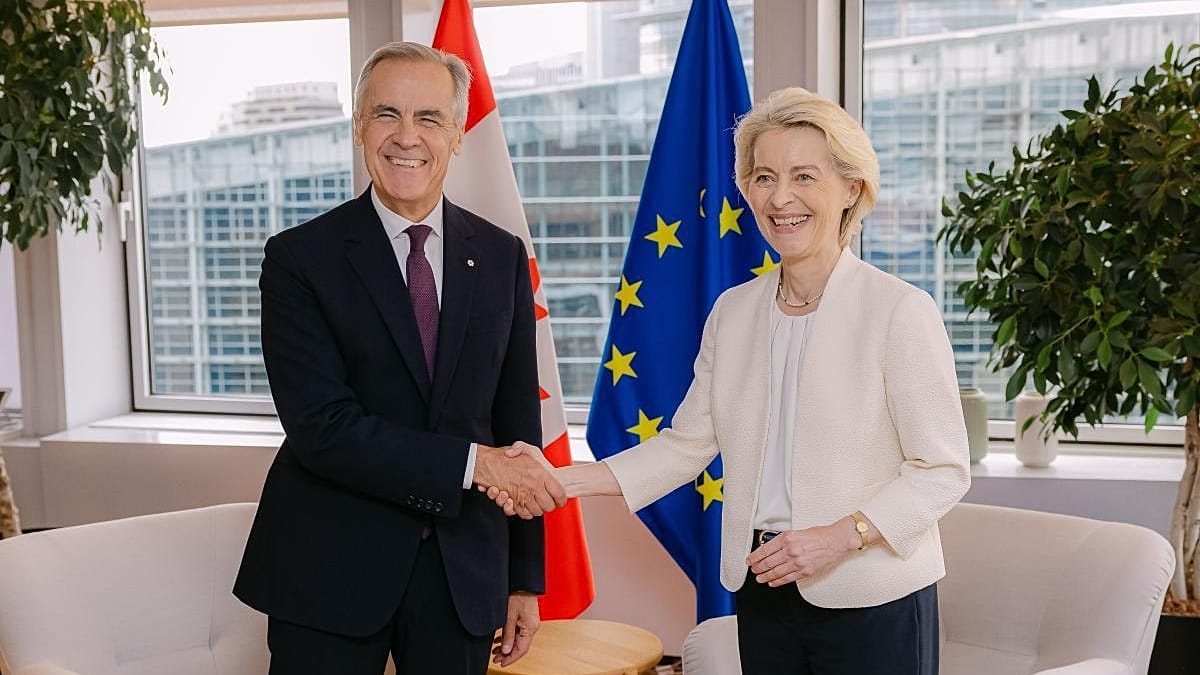
Canada in talks to join EU’s Erasmus+ exchanges programme
Canada is in early talks to join Erasmus+ and possibly Horizon Europe, as Ottawa and Brussels weigh an unprecedented “associate membership” of the EU short of…
Which European companies could benefit from closer ties with Canada?
In her State of the Union address, Commission President Ursula von der Leyen invited Canada to be the first associate member of the EU and described the broader relationship as an “Alliance for the Future”, covering defence, energy, technology, critical minerals and the Arctic.
For European companies, that shift is already creating opportunities in defence, aerospace and industrial technology.
Read Piero Cingari's story here :
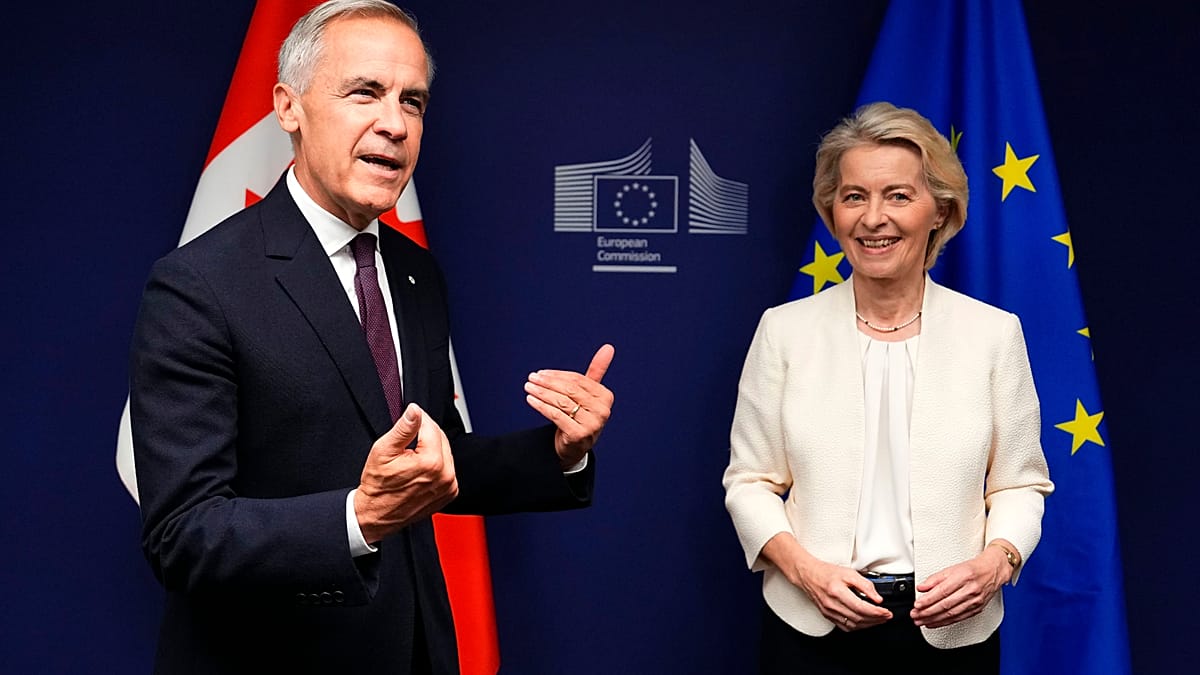
The ‘Canada effect’: Which European companies could win?
The US trade war is pushing Canada towards Europe. Defence, aerospace and industrial technology are where European companies may gain first.
Canada positions itself as methane ally as US climate policy shifts
In a recent talk with Euronews, Canada’s climate minister Julie Dabrusin pointed to the country’s role as a co-convener of the Global Methane Pledge — an international initiative launched at COP26 by the US and the EU — and said Ottawa would continue working with other countries to cut the potent greenhouse gas.
Canada has been a leader for a very long time on methane, the minister said, pointing to strengthened domestic rules covering oil and gas as well as landfill emissions.
The message comes as the EU faces pressure over its own methane rules, including debate over a binding proposed temporary waiver of penalties.
Canada and EU deepen climate partnership
Canada’s climate minister Julie Dabrusin described the relationship with Brussels as a “strong and deepening” partnership, highlighting cooperation on methane and the countries’ joint role as co-conveners of the Global Methane Pledge, an international initiative launched at COP26 by the US and the EU in 2021.
Talking to Euronews in late June, Dabrusin also pointed to Prime Minister Mark Carney’s focus on strengthening ties with Europe.
The comments come as the EU looks for international partners on climate at a time when Washington’s approach to energy and climate policy is increasingly diverging from Brussels.
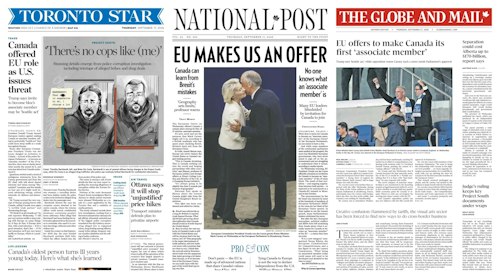
'Associate membership' tops Canadian front pages
The main newspapers in Canada have put Ursula von der Leyen's pitch for "associate membership" at the very top of their front pages today, showing the strong interest inside the country.
Metsola: Deeper EU-Canada ties 'not against anyone'
Roberta Metsola, President of the European Parliament, has told Euronews that closer ties between the European Union and Canada are "not against anyone", adding that she didn't fear retaliation from Washington.
The interview was recorded before US President Donald Trump threatened to cut trade with the EU or impose "very serious tariffs" in response to the bloc's proposal to make Canada its first-ever "associate member".
Trump dismissed the prospect of Canada joining the EU as "laughable" and described the country as a "terrible trade partner".
"We are not saying this is against anyone, or any country in particular," Metsola said. "But when friends come to us and say, 'let's do more', we will be the first ones to fling open the door." She added that the United States had no grounds for retaliation.
"We are equal partners," she said. "We want to deal with each other with equality, with dignity and respect."
Metsola also said Australia and New Zealand could follow Canada in seeking associate EU membership.
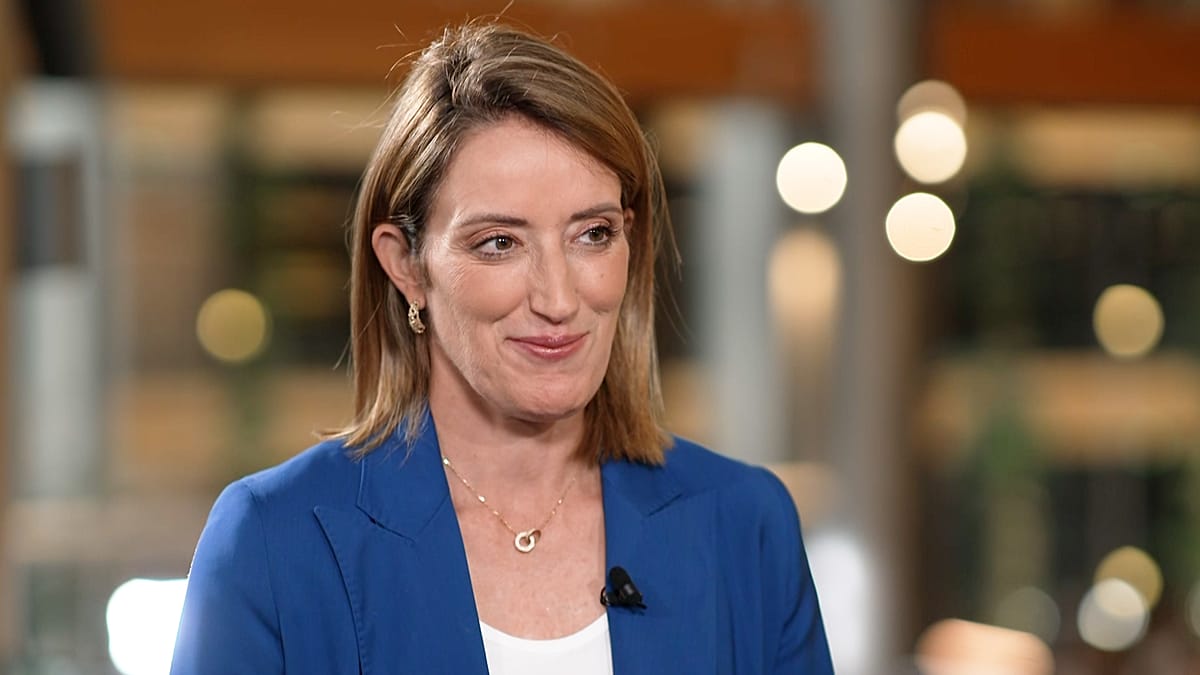
Metsola: Australia, New Zealand could be next EU ‘associated members’
Metsola tells Euronews pitch for “associate membership” with Canada will strengthen cooperation with like-minded countries and incite new ones. #EuropeToday
Ireland backs 'associate membership' for Canada
Ireland has thrown its weight behind the novel idea of granting "associate membership" for Canada, becoming one of the first, if not the first, EU countries to endorse the move explicitly.
"I welcome the announcement of President von der Leyen in her State of the Union address to explore associate membership for Canada," Ireland's Foreign Minister Helen McEntee said on Wednesday.
Thomas Byrne, Ireland's minister for European affairs, who attended von der Leyen's speech, said the proposal was a "significant moment".
"The EU-Canada partnership is one of mutual benefit and common strength," Byrne said.
Ireland currently holds the EU Council's rotating presidency.
I welcome the announcement of President von der Leyen in her State of the Union address to explore associate membership for Canada.
— Helen McEntee TD (@HMcEntee) September 16, 2026
'Associate membership' for Canada is 'not against anyone', Brussels tells Trump
We've just heard a brief reaction from the European Commission to remarks by US President Donald Trump, who threatened to impose "very serious tariffs" on the EU if the idea of granting "associate membership" to Canada were carried out as a "hostile act".
"As our President made clear yesterday, the proposed strengthening of our partnership with Canada is not against anyone else, but for our common strength," a Commission spokesperson said.
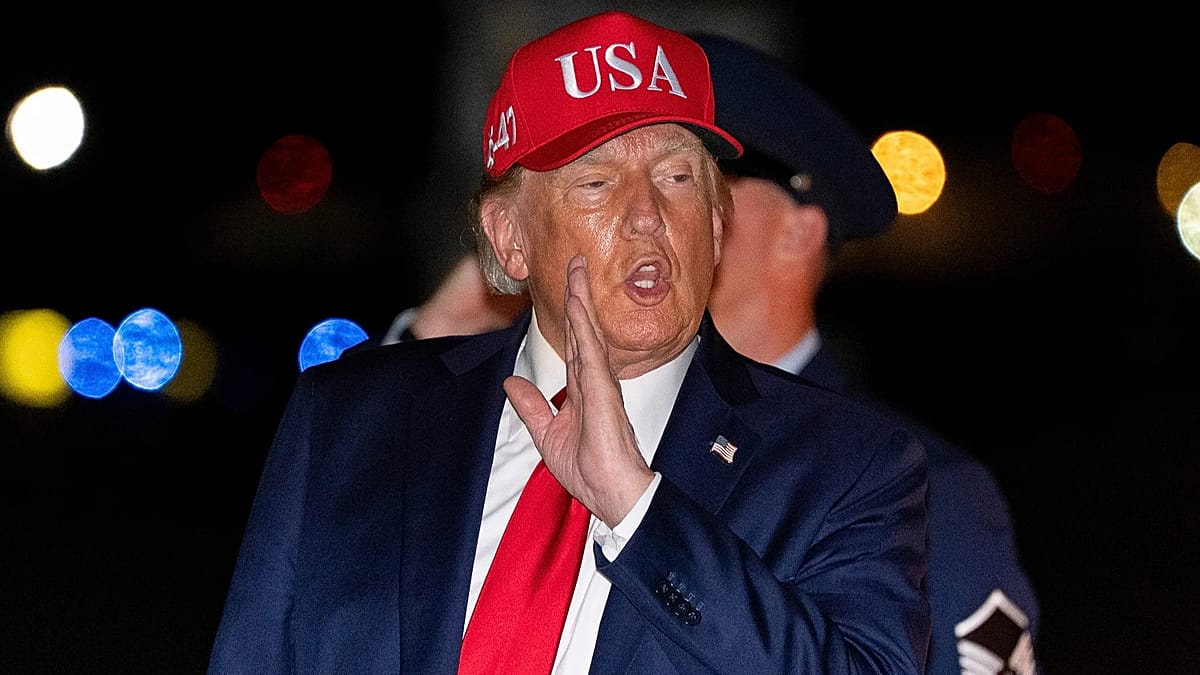
Trump threatens EU over ‘hostile’ plan to make Canada associate member
European Commission chief Ursula Von der Leyen pitched the idea of associate membership for Ottawa during her annual State of the Union speech on Wednesday, wi…
Welcome to the Euronews live blog
Good morning! We are following the aftermath of Ursula von der Leyen's headline-making invitation to Canada to become the European Union's first-ever "associate member".
Canadian Prime Minister Mark Carney is set to address the European Parliament at 11.30 am. Will he offer his own interpretation of what "associate membership" means?