















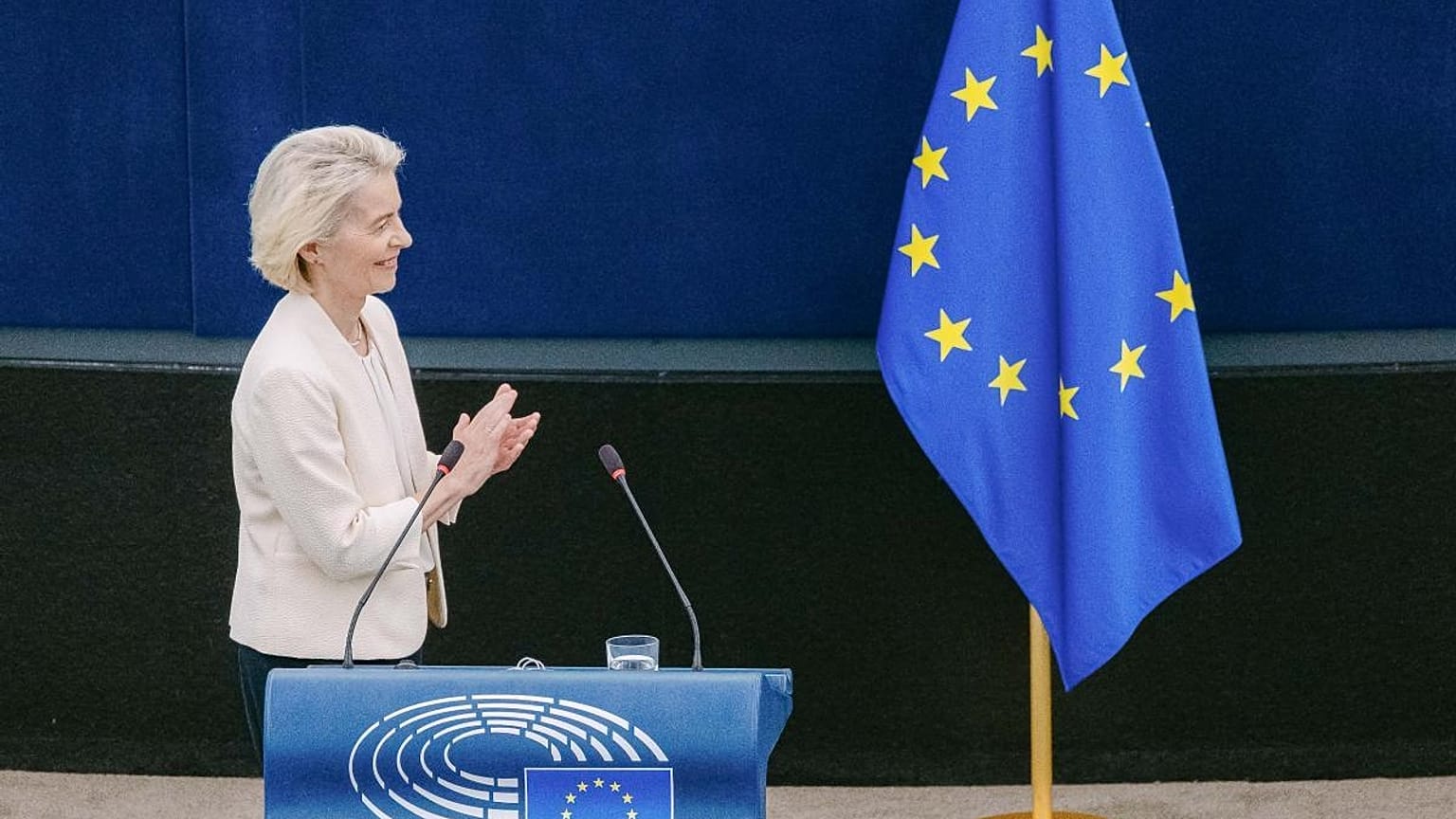













The State of the Union speech saw the Commission president outline what sound like grand plans for European security, but big questions remain unanswered.
A new European Security Council, an emergency protocol and a new strategic enabler initiative: in her State of the Union speech on Wednesday, Commission President Ursula von der Leyen laid out a new security architecture for Europe. But several question marks still hang over it.
 ADVERTISEMENT
ADVERTISEMENT
ADVERTISEMENT
With the war in Ukraine increasingly spilling over into Europe's eastern flank and Russia intensifying its campaign of sabotage attacks and drone incursions, security and defence took centre stage in von der Leyen's annual address.
"We already have many tools. And we are strengthening our work with NATO. But our doctrine, our institutions and our decision-making have not kept pace with the new reality," she said.
The speech previewed several of the main elements expected in the EU's new security strategy, due next month, which is meant to redefine Europe's security architecture.
European Security Council
Among the most significant proposals von der Leyen teased is a new security-focused political format dubbed the European Security Council, a special configuration of the EU leaders' summit that will include partners such as Ukraine, the United Kingdom, Norway and Canada.
In practice, leaders like Ukrainian President Volodymyr Zelenskyy are already frequently invited to European Council meetings. The new format would institutionalise this relationship, giving it a dedicated framework to discuss security matters.
"For a long time, we have discussed a leaders' format focused on the security of our continent," von der Leyen said. "This is even more urgent now, given the nature and scale of the risks at play. This is why we will set out our ideas to make a European Security Council a reality."
The idea itself is not new. French President Emmanuel Macron floated it during his 2017 presidential campaign, and it received formal backing the following year in the Franco-German Meseberg Declaration.
"We cannot allow ourselves to stay with the status quo. Doctrines and institutions, which were created during peacetime, are not fit any more for the purpose," said European Commissioner for Defence Andrius Kubilius.
Still, how this moves from proposal to reality remains unclear: von der Leyen set no start date and offered no tangible deliverables beyond future-proofing Europe's security. How far the new initiative will overlap with NATO and the so-called Coalition of the Willing is also an open question.
"A European Security Council is no panacea. Consensus would presumably still be necessary, but compared to the European Council, a shared threat perception would presumably instil a greater sense of trust and shared destiny amongst its members," wrote Nathalie Tocci, director of Rome's Istituto Affari Internazionali, in a policy brief.
Emergency security protocol
Hybrid warfare was another major flashpoint, after weeks marked by a flurry of Russia-suspected sabotage acts, attempted attacks and drone incursions intended to destabilise EU countries.
"Europe needs its own counter-hybrid playbook," von der Leyen said on Wednesday. "We urgently need a consensus on how to respond to certain incidents: those which fall below armed aggression but clearly threaten our national security. In other words, a mechanism to flank NATO's Article 4."
Article 4 allows NATO members to formally request emergency consultations when they believe their security, territorial integrity or political independence is under threat.
For von der Leyen, the bloc needs its own version of Article 4, dubbed an Emergency Security Protocol, built on the EU treaty's mutual defence clause, which states that "when an EU member state is the target of armed aggression on its territory, the other member states must assist it by all the means in their power".
The mutual defence clause resurfaced earlier this year when an Iranian-made drone, suspected of being launched by the Lebanese militia Hezbollah, targeted a British airbase in Cyprus – a member of the EU, but not of NATO.
Discussions around the clause prompted a "war gaming" exercise conducted by EU ambassadors to map out what triggering it would mean in practice, and von der Leyen's security protocol appears to take the preparation one step farther.
"When triggered by one member state, all member states would convene to coordinate a European response [and] to deter further escalation and mitigate the impact," she said.
At the same time, EU officials have previously warned that invoking the mutual defence clause could further incentivise the US to disengage from NATO – even though "assistance" doesn't automatically mean joining an armed conflict, and could instead take the form of financial support or civilian protection.
As hybrid threats across Europe grow increasingly kinetic, the advantage of a European defence clause is that it can be activated even for lower-intensity activity, without necessarily requiring a military response, Euronews understands.
Oana Lungescu, NATO's former spokesperson, said that while it's welcome that the Commission President wants closer EU-NATO cooperation, it's hard to see how this would actually deter Russia.
"Protocols and playbooks already exist in both organisations," she said.
Strategic enablers
With the US signalling its intention to reduce its military presence in Europe, subject to a posture review due later this year, the EU is now scrambling to fill key defence capability gaps known as strategic enablers.
Strategic enablers are the logistical backbone of modern warfare: satellites, airlift, refuelling and intelligence capabilities that allow military forces to operate effectively.
"The war in Ukraine has shown us the importance of strategic enablers," von der Leyen said. "These systems are essential, and we need more of them. Only together does Europe have the scale to deliver them."
To that end, she announced a new European Instrument for Strategic Enablers, meant to channel the long-term investment needed to build up these capabilities in alignment with NATO.
In June, Commissioner Kubilius warned that replacing US military assets in Europe would require an eye-watering €500bn investment.
How exactly the new instrument will close this gap remains unclear, as Brussels tries to work out how to incentivise national investment in the area.
"We welcome our European allies and partners stepping up to do more in support of our shared security," a NATO official told Euronews. "NATO is the bedrock of our collective defence, and we will continue to work closely with the EU in pursuit of our shared agenda."