

















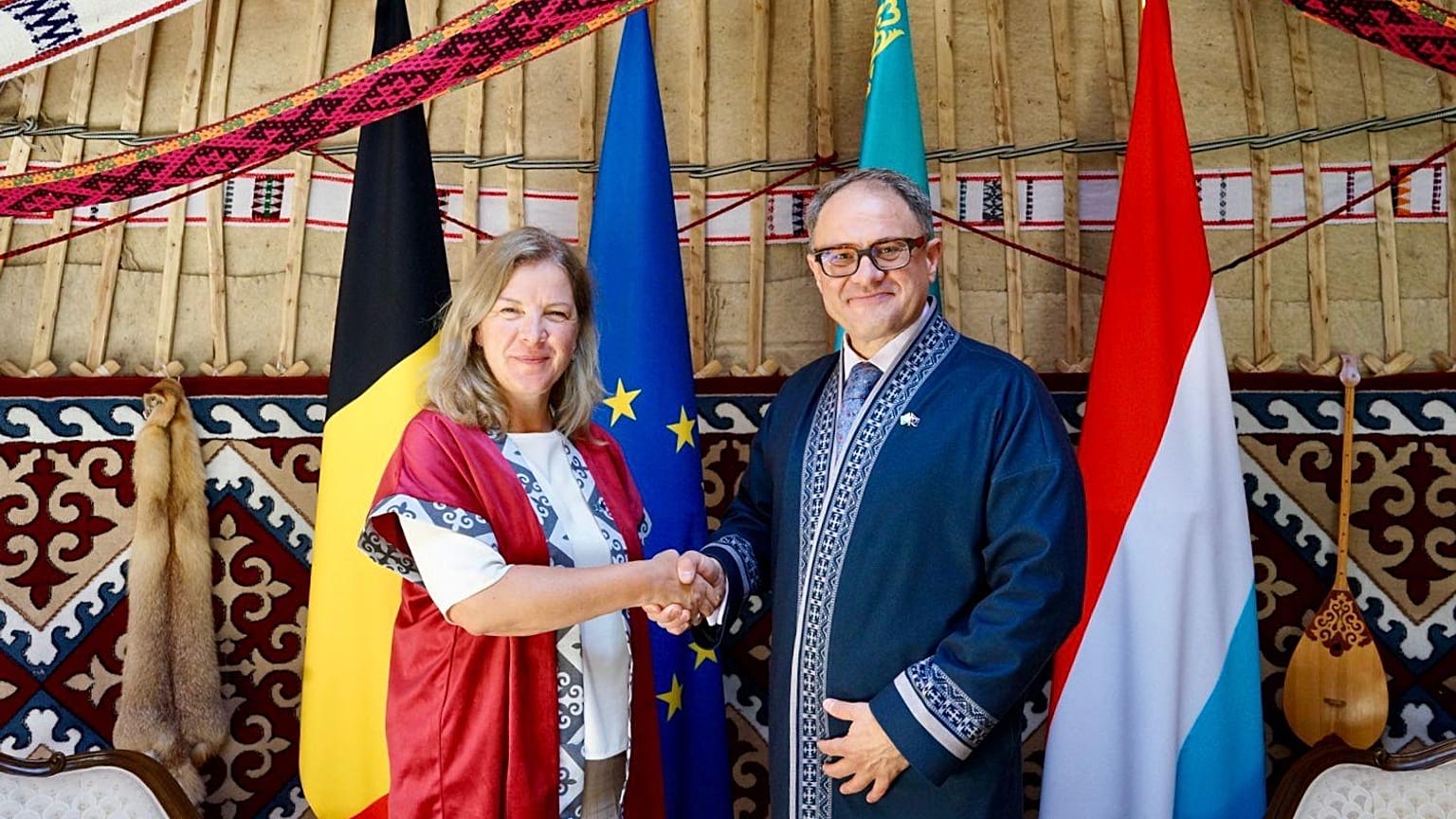














Kazakhstan's Ambassador to the EU, Roman Vassilenko, and the EU Ambassador to Kazakhstan, Aleška Simkić, reflect on a landmark year for bilateral relations and discuss the next priorities, from transport and trade to education and visa facilitation.
At the heart of a traditional Kazakh yurt, seated around a low table known as a dastarkhan and laid with traditional Kazakh treats, Kazakhstan's Ambassador to the European Union, Roman Vassilenko, and the European Union Ambassador to Kazakhstan, Aleška Simkić, came together for the latest edition of their now annual podcast conversation.
 ADVERTISEMENT
ADVERTISEMENT
ADVERTISEMENT
The tradition was launched by Simkić last year, when the two diplomats recorded their first discussion at the EU Delegation in Astana. This time, the setting shifted to Brussels, where they met in a yurt on the grounds of the Embassy of Kazakhstan, symbolically reversing last year's geography.
From partnership to "strategic friendship"
Looking back on the past twelve months, the diplomats agreed it had been an exceptionally eventful year for Kazakhstan-EU relations. Among the key milestones they highlighted were the official visit of the President of the European Council, António Costa, to Kazakhstan in December 2025 and President Kassym-Jomart Tokayev's visit to Brussels on 22–23 June this year.
During the latter, around 30 commercial agreements worth nearly €10 billion were signed, while both sides reaffirmed their commitment to developing the Middle Corridor. Cargo volumes along the route have grown fivefold over the past six years to 4.1 million tonnes annually, with Kazakhstan aiming to increase capacity to 10 million tonnes. The visit also resulted in agreements to improve transport connectivity, expand air links and facilitate visa procedures.
Reflecting on the broader partnership, Vassilenko described the European Union as Kazakhstan's largest trading and investment partner.
“European investment in Kazakhstan has now exceeded $210 billion. There are 4,000 companies with European participation in Kazakhstan.”
Beyond the economic figures, Simkić argued that the partnership has evolved into what she called a "strategic friendship."
"That's what I call a strategic partnership. In fact, it's even more than that. It's a strategic friendship."
She welcomed the growing diversification of bilateral cooperation. While energy remains a cornerstone of the relationship, she noted that both sides are increasingly expanding into new sectors.
One of the key examples discussed was the Middle Corridor. "We see that this is a corridor that is really coming alive and becoming a major artery connecting Asia and Europe," Vassilenko said.
Vassilenko also highlighted the growing cooperation in innovation and digital connectivity. As an example, he pointed to Luxembourg-based SES, which is using EU funding to provide satellite internet access to remote communities in Kazakhstan and across Central Asia in partnership with Kazakhstan's space company, Gharysh Sapary.
Looking ahead
Despite the significant progress, both diplomats agree that EU–Kazakhstan cooperation is still far from reaching its full potential.
Looking ahead, Simkić said she hopes that by the time the next edition of the podcast is recorded, the visa facilitation agreement will have been finalized. Once implemented, it is expected to reduce application fees, shorten waiting times and harmonise documentation requirements for Kazakh citizens applying for Schengen visas.
Beyond mobility, Simkić believes that people-to-people ties should become an even stronger pillar of the partnership, with education playing a central role.
"We have to bring Kazakhstan closer to Europe, and I think in the education field we can do more."
She noted that while many Kazakh students choose to study in Europe, far fewer European students come to Kazakhstan. Expanding academic exchanges and launching new joint educational programmes, she argued, would benefit both sides.
Vassilenko pointed to encouraging developments already underway. Participation of Kazakh researchers in the EU's Horizon Europe programme has grown rapidly in recent years, with the number of grants awarded increasing fourfold. Kazakhstan is now also seeking associated membership in Horizon Europe, which would deepen scientific cooperation with the European Union.
Vassilenko added that Kazakhstan is steadily strengthening its position as an educational and research hub in the heart of Eurasia. Universities from France, Germany, Poland, Italy and other European countries have already established a presence in the country, with more expected to follow.
"Now there are about 35,000 foreign students in Kazakhstan. That number was perhaps 5,000 just 5 years ago,” – he said. “And it will be 150,000 if things proceed at that stage in the next 5 years, with hopefully more European students.”