
















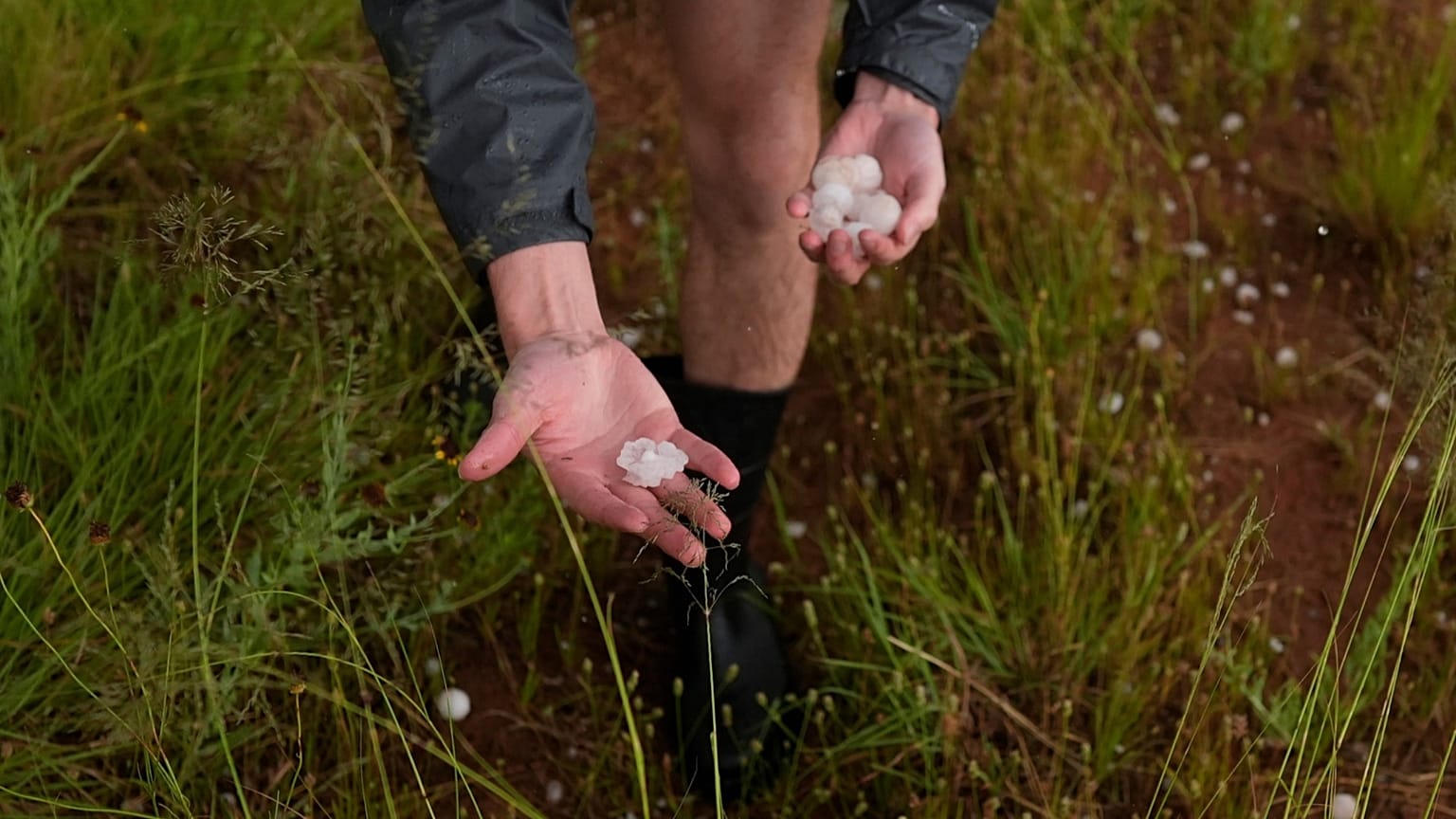













Europe suffers huge economic losses due to hailstorms, but climate experts warn that rising temperatures is only making them bigger and more damaging.
Global warming will likely make bigger hailstones that could cause "major damage" to vehicles, solar panels and other infrastructure.
 ADVERTISEMENT
ADVERTISEMENT
ADVERTISEMENT
Human-caused climate change from burning polluting fossil fuels makes more high-energy unstable air, which is conducive to hail forming and global storms.
According to a study published in the science journal Nature this week, hail bigger than a large marble will increase between 38 and 47 per cent by the end of the century, depending on how much heat-trapping gas the world spews. Storms that produce smaller hail will shrink by four to eight per cent, researchers also found.
The astronomical cost of hail
While hail generally doesn’t kill people, it is surprisingly expensive. It already costs around $80 billion (€68 billion) globally, says study co-author John Allen, a meteorology professor at Central Michigan University.
In Europe, hailstorms are among the most destructive weather phenomena and have already increased by a staggering 267 per cent in the past five years due to climate change, up from 3,217 hailstorms in 2019/2020, according to insurance group Chaucer.
A 2026 study published in Science Direct warns that hail seasons of 2022 and 2023 both caused record losses exceeding €5 billion.
Hail does more damage than tornadoes and generally costs “more than a couple of hurricanes a year now,” Allen adds.
“We’ve seen record hailstones in recent years. I find this extremely concerning because we’re not really building our environment to be resilient to hail. We don’t include this in our design standards, for example, for built homes in the US or indeed internationally.”
Allen’s computer simulations show that the mix of larger stones will grow with climate change. Those are the ones that cause more damage, he and outside scientists said.
The biggest threat to solar
The more a hailstone weighs, the faster it falls through the air - meaning it hits infrastructure with much more power.
Andreas Prein, a climate scientist at ETH Zurich, says that small hail can wreak havoc on crops, but when stones get to around five centimetres in size, they risk "major damage" to vehicles, roofs, solar panels and other infrastructure.
Solar farms are often required to prove that their panels can be positioned at a 70-degree angle to protect against hail from cracking their protective glass, which is costly to repair. But upgrading Europe's booming solar industry with remote-tilting capabilities is a "significant challenge", says Chaucer.
One hole on a roof from a single hailstone can be patched, but many large stones hitting that roof usually mean an expensive roof replacement, Allen explains.
What happens is there’s more water vapour in a warmer atmosphere and “that increases the available energy to the atmosphere and so we tend to end up with stronger updrafts,” Allen says. “And that leads to more thunderstorms with updrafts capable of producing hail.”
Warmer air can, however, melt smaller hailstones, which could lead to a reduction in hailstorms in tropical areas.
Europe isn't immune to climate-fuelled hail
Many previous studies have focused on hail in the US, which has the most hail, but experts warn that Europe, Canada, and Argentina will likely see the biggest increase in large hail due to global warming.
"[It's] not just a US problem,” Allen warns. “Yes, we do see large losses here, but the global hail losses seem to be something that is really spiralling in recent years.”
A 2025 study from Newcastle University and the UK's Met Office found that climate change is "supercharging" Europe's biggest hailstones. The research found that in a high-emissions scenario where Europe does not cut greenhouse gas emissions, severe hail is likely to become less common overall. However, when hail does form, the stones themselves could regionally be much larger.
'A meaningful climate signal'
Study authors looked at hail bigger and smaller than 30 millimetres in diameter, which is somewhere between a marble and a golf ball, and about the size of a US 50-cent coin.
The team looked at three scenarios based on carbon emissions from the burning of coal, oil and gas. In a slightly optimistic scenario of not so much carbon pollution, larger hail increases by 38 per cent.
In a more pessimistic scenario, where temperatures rise nearly 1°C even warmer than the other scenario, larger hail jumps by 47 per cent.
"This is a meaningful climate signal,” says Walker Ashley, a Northern Illinois meteorology professor. “But disaster losses are not driven by the peril alone.”
As more people, houses, solar farms, and infrastructure move into hail-prone areas, the risk of damage increases.
“Climate change may be increasing the potential for larger, more damaging hail in some regions, but the future loss signal will also depend heavily on where people build, what they build, how resilient those structures are, and how land use changes," Ashley adds.