





























Beyond political signalling, the Regional Ecological Summit in Astana delivered tangible commitments. A total of 17 agreements worth over $2.3 billion were signed at RES 2026, with the bulk of investments channelled into renewable energy, waste management, and industrial decarbonisation.
Central Asian nations have agreed, for the first time, to confront their environmental crises together.
 ADVERTISEMENT
ADVERTISEMENT
ADVERTISEMENT
At the Regional Ecological Summit 2026 in Astana, heads of state signed a joint declaration titled “Ecological Solidarity of Central Asia”, marking an unprecedented regional commitment to coordinated climate action.
The move comes as the region faces a worsening water crisis driven by rising temperatures, glacier melt and competing demands for dwindling river resources.
Central Asia’s water stress intensifies
Water security has become one of the main priorities of the declaration. For decades, transboundary rivers like the Syr Darya and Amu Darya, which flow across several countries, have been a major source of tension in the region.
Instead of being managed together, they were often handled separately by each country, which created disagreements and pressure on water use.

This agreement shows a shift toward working together on shared water problems, moving from separate national approaches to a more coordinated regional effort.
As part of this effort, the countries backed a proposal by Kazakhstan’s President Kassym-Jomart Tokayev to establish an International Water Organization under the UN.

“Global governance on water is fragmented and increasingly ineffective. There is no single institution capable of dealing with the complexity of water management,” said Kairat Sarybay, first Secretary General of the CICA.
“What we see instead is growing bureaucracy and overlapping mandates, including within the UN system. The idea of creating one dedicated international body for water is not just relevant. It’s necessary.”
Alongside the main summit, Central Asian leaders held a separate high-level meeting on the future of the Aral Sea.
The talks coincided with Kazakhstan concluding its three-year chairmanship of the International Fund for Saving the Aral Sea (IFAS), a platform that has long struggled to translate political will into coordinated regional action.
“Water security is of critical importance for Kazakhstan and the entire region. Our future depends on managing this vital resource wisely and fairly,” President Kassym-Jomart Tokayev said.
He pointed to partial progress. Around 36% of the Northern Aral Sea has been restored, improving water quality, fish stocks and local living conditions.
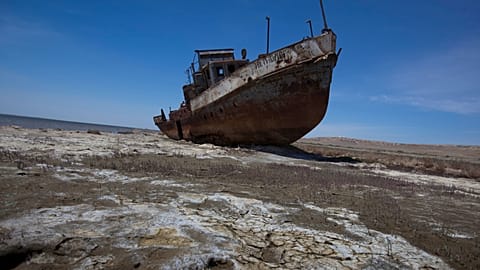
Uzbekistan is pushing ahead with one of the region’s most ambitious adaptation efforts — planting forests on more than 2 million hectares of the dried seabed to stabilise the ecosystem and reduce toxic dust storms.
Beyond the Aral Sea, attention is shifting to other looming water threats
The Caspian Sea — the world’s largest inland body of water — is steadily shrinking, with levels dropping by around 10 centimetres per year.
In response, countries endorsed plans to develop an interstate programme for the preservation of its water resources under the new solidarity framework.
Meanwhile, glacier melt is accelerating across Central Asia, threatening the long-term stability of river systems that millions depend on. Up to 60% of the region’s water resources originate on Tajikistan's territory, underscoring its strategic role in regional water security.
Tajikistan's president Emomali Rahmon framed water and energy as inseparable, highlighting hydropower development and clean energy as national priorities.

Rahmon urged regional partners to maintain momentum, inviting them to attend a high-level international conference on water cooperation set to take place in Dushanbe this May.
Kyrgyzstan, however, has stepped away from the International Fund for Saving the Aral Sea, highlighting persistent divisions in regional water governance. The country, located upstream and rich in water resources.
As part of the “ecological solidarity” declaration, countries also agreed to develop an interstate programme aimed at preserving the Caspian Sea’s water resources.
Dust storms emerge as a cross-border threat in Central Asia
Dust storms are becoming one of the most visible and transboundary environmental threats in Central Asia, with leaders warning that their scale and impact are accelerating.
At the summit, President of Tajikistan raised concerns over worsening dust storms, underscoring the growing scale of atmospheric pollution in the region.

Kazakhstan’s President Kassym-Jomart Tokayev pointed to the deteriorating situation in the Aral Sea basin, where climate change and land degradation are driving extreme environmental shifts.
“These changes are fuelling a rise in the frequency and intensity of dust storms, particularly from the exposed seabed of the Aral Sea — the Aralkum desert,” said Kazakh president Kassym-Jomart Tokayev.
“Tens of millions of tonnes of salt, sand and chemical particles are lifted into the atmosphere each year from this area,” president added.
He said summer temperatures in the region have risen by 2–2.5°C, while precipitation within a 100-kilometre radius has significantly decreased, deepening arid conditions.
In response, Uzbekistan proposed the creation of a regional 'Clean Air' consortium, aimed at addressing worsening air quality and dust pollution across Central Asia.
The initiative would function as a joint operator for green financing, supporting industrial modernisation and the introduction of emission reduction technologies.
Uzbekistan also proposed upgrading its existing Centre for Combating Desertification and Early Warning of Sand and Dust Storms at the Green University into a regional platform based in Tashkent.
The centre would consolidate scientific expertise and develop a unified monitoring system for land degradation and dust emissions.
A push toward circular economy cooperation
At RES 2026, a total of 17 agreements worth more than $2.3 billion were signed, according to the International Centre for Green Technologies and Investment Projects.
The main share of investments is directed towards renewable energy, waste management, industrial decarbonisation and fertiliser production.
A significant portion of the deals focuses on green energy and waste treatment infrastructure, including the construction of waste-to-energy plants in Astana, Shymkent and Almaty, with a combined value exceeding $560 million.

Kazakhstan’s Minister of Ecology, Yerlan Nyssanbayev, said the country is now proposing to go further by establishing a regional circular economy alliance, designed as a permanent platform for cooperation between governments and business.
“By 2060, global resource extraction could increase by another 60% if we continue to follow a linear model,” said Inger Andersen, Executive Director of the UN Environment Programme.
“Central Asia is not unique in this regard, the region faces the same challenges, and population growth will further increase waste volumes.”
Uzbekistan is rapidly scaling up its circular economy agenda. Last year, the country established an Agency for Waste Management and Circular Economy Development, responding to annual waste generation of around 40 million tonnes.
According to Sharifbek Khasanov, Director of the Agency, Uzbekistan plans to construct 11 waste-to-energy incineration plants, with two expected to become operational this year.
“Resources are limited. We want to construct 11 incineration plants for waste-to-energy conversion. We produced around 40 million tonnes of waste in one year. We will begin generating electricity from waste,” he said.

President Shavkat Mirziyoyev confirmed that two new plants will be launched this year, with nine more over the next two years.
Once fully operational, the system is expected to process 5.5 million tonnes of waste annually, generate 2.2 billion kWh of electricity, and reduce emissions by more than 1 million tonnes.
In total, Uzbekistan is implementing circular economy and waste-to-energy projects worth over $1.5 billion, with full deployment of the 11-plant system planned by 2028, including two facilities already coming online this year.
Green transition accelerates
Kazakhstan, Kyrgyzstan and Uzbekistan also discussed a joint project to build the Kambarata hydropower plant with a capacity of nearly 2,000 MW.
International financial institutions are playing an increasingly active role in the region’s transition. The EBRD, one of the key partners, says more than half of its portfolio is now directed toward green projects.

“First of all, we have promised our shareholders that more than 50% of the projects we finance are going to be green projects. But while supporting green projects, we take a systemic, holistic approach to green investments,” said Huseyin Ozhan, Managing Director for Central Asia and Mongolia at the EBRD.
Kazakhstan has also signed a memorandum with the European Bank for Reconstruction and Development (EBRD) to establish a country-level energy transition investment platform called “QaJET”.
The country aims to commission at least 10 GW of renewable energy capacity by 2035, attract around $20 billion in investments, and reduce emissions by more than 20 million tonnes annually.
Regional drive to save biodiversity
Alongside climate, water and pollution challenges, Central Asian countries are also moving to strengthen cooperation on biodiversity conservation.
At the Regional Ecological Summit (RES), the countries signed a Regional Declaration on the Conservation of Biodiversity, marking a rare coordinated political commitment to protect ecosystems and endangered species across the region.

“I think everyone was very much glad to see that the countries have signed their regional declaration,” said Vera Voronova, Executive Director at Association for the Conservation Biodiversity of Kazakhstan.
“This would serve as a regional framework, and it clearly shows a high level of political will for biodiversity conservation in Central Asia.”
The Association for the Conservation of Biodiversity of Kazakhstan (ACBK), which has been active for more than 20 years, has implemented projects aimed at restoring key species, including the saiga antelope, Przewalski’s horse, kulan and several bird populations.

In Kyrgyzstan, conservation efforts are focused on the snow leopard, a flagship species for mountain ecosystems. The animal has been officially recognised as a national symbol, with its population estimated at more than 550 individuals.
Kazakhstan is also working to protect the species, where the population is estimated at over 200 snow leopards, with around 70% of their habitat under protection.
Why should Central Asian nations unite today?
The region is warming fast. It is becoming one of the world’s "hot spots". Over the past century, temperatures in Kazakhstan have risen by almost 6°C, in Kyrgyzstan by around 2°C, while in Turkmenistan they have passed the threshold of +1.5°C.
Today, Central Asian countries are coming together and launching new joint projects in response to the shared climate challenge.