















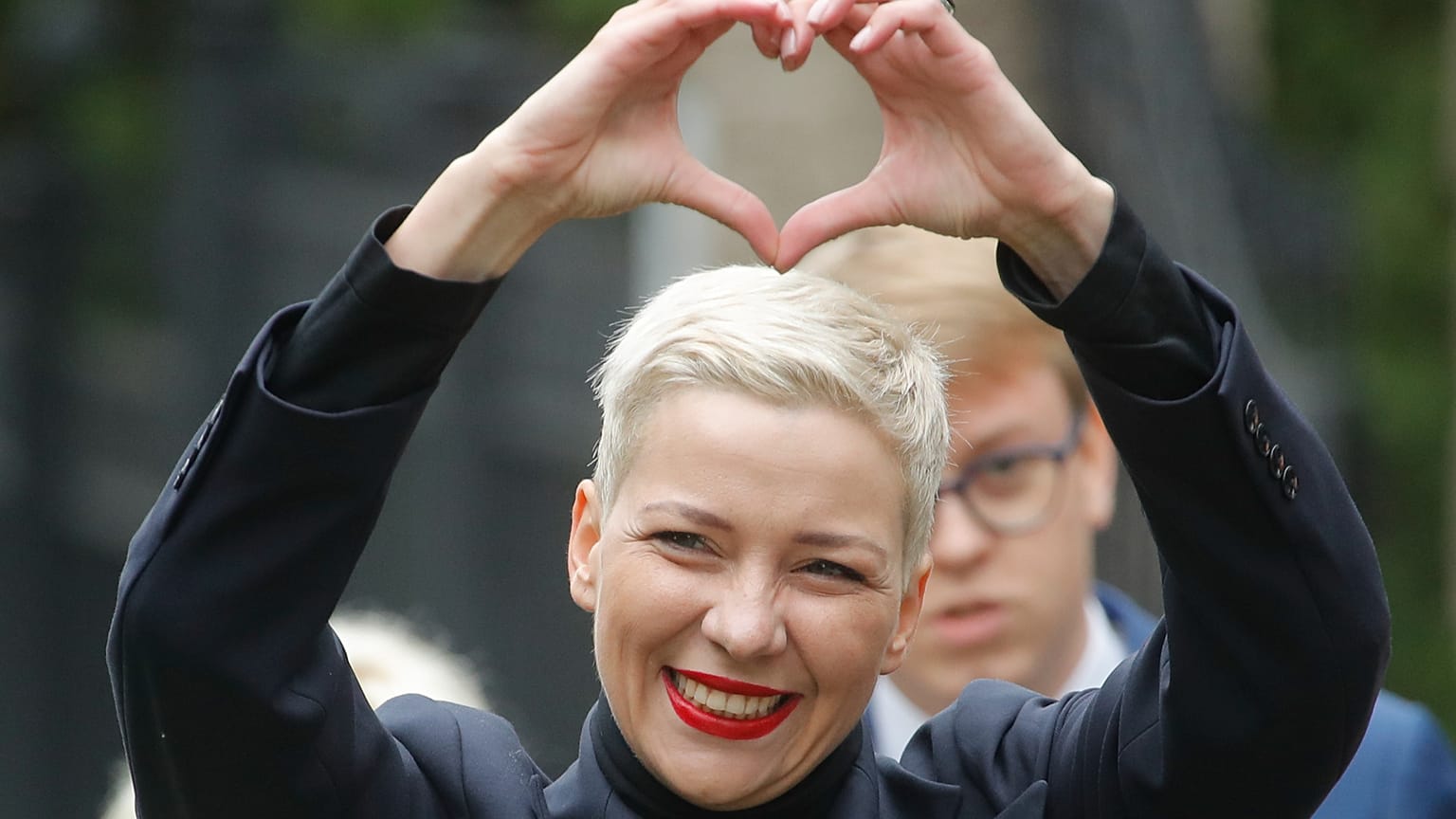














After almost five and a half years in prison, Belarusian opposition activist Maria Kalesnikava has a clear warning for Europe, as she sees Belarus increasingly under Russian influence.
Belarusian opposition activist Maria Kalesnikava received the Charlemagne Prize in person on 14 March, four years after being awarded the honour while imprisoned for standing up to President Aliaksandr Lukashenka.
 ADVERTISEMENT
ADVERTISEMENT
ADVERTISEMENT
Kalesnikava, 43, was released in December 2025 after spending more than five years in prison following her role in the 2020 protests against Lukashenka's disputed re-election.
The former flautist spoke to Euronews in Berlin about the future of Belarus and warned of growing Russian influence over her country.
"There are great concerns that Belarus could lose its sovereignty because economically we are no longer as independent as we used to be," Kalesnikava said.
Western sanctions have pushed Lukashenka closer to Russia, she said, and Russian President Vladimir Putin benefits from Minsk's lack of contact with the EU.
Lukashenka has ruled Belarus since 1994. He is considered Putin's closest ally and allowed Russia to use Belarusian territory as a staging ground for the full-scale invasion of Ukraine in February 2022.
Minsk has not actively participated in the war against Ukraine. However, in December 2025, Russia and Belarus conducted a military exercise involving 12,000 soldiers along the Polish border, raising fears of hidden mobilisation of Russian troops, and Moscow reportedly deployed some of its nuclear-capable missiles in Belarus.
'Tearing up passport easier than ordering salad'
In 2020, three women challenged Lukashenka: Maria Kalesnikava, opposition leader Sviatlana Tsikhanouskaya and Veronika Tsepkalo. They campaigned against the Belarusian ruler and received huge support.
But on 9 August 2020, Lukashenka was re-elected with 80% of the vote. Many Belarusians and Western countries said the elections were rigged.
Protests erupted across Belarus. Lukashenka's regime responded with extreme violence, mass arrests and brutal beatings.
Tsikhanouskaya and Tsepkalo went into exile abroad. Kalesnikava was forcibly taken to the Ukrainian-Belarusian border. When she realised she was to be deported, she tore up her passport.
"The decision to tear up my passport was much easier than ordering a salad in a restaurant," she said, laughing.
She was arrested in September 2020 and sentenced to 11 years in prison on charges including conspiracy to seize power.
Kalesnikava has no regrets. She would do everything the same today, including going to prison, she said.
"It was very important for me as a politician to be close to my people even in bad times and to be able to walk this terrible path with them," she said.
Kalesnikava now relies on European support to advance the path toward greater democracy and independence in Belarus.
Belarus youth growing up on Putin's propaganda
Younger generations in Belarus are no longer aware of the 2020 protests and the opposition movement, she said. This poses a threat to the democratic future of Belarus, especially in view of aggressive Russian propaganda.
"They would not understand why we fought, what freedom feels like and what the European lifestyle is like," she said.
The EU should talk to Lukashenka, Kalesnikava said. "Talking does not mean accepting, but representing the EU's own interests and thus finding a way to influence Belarus."
Kalesnikava's release would not have been possible without dialogue and was the result of talks held between US President Donald Trump, lawyer John Coale, Deputy Assistant Secretary Chris Smith and Lukashenka.
She was released on 13 December as part of a US-brokered deal in which 123 political prisoners were freed in exchange for easing sanctions on Belarus's potash industry.
More than 1,200 political prisoners remain in Belarus under harsh conditions, according to rights group Viasna.
Kalesnikava warned: "If you don't want to talk to Lukashenka, there will come a time when you have to talk to Putin." In her view, that would be much worse.