













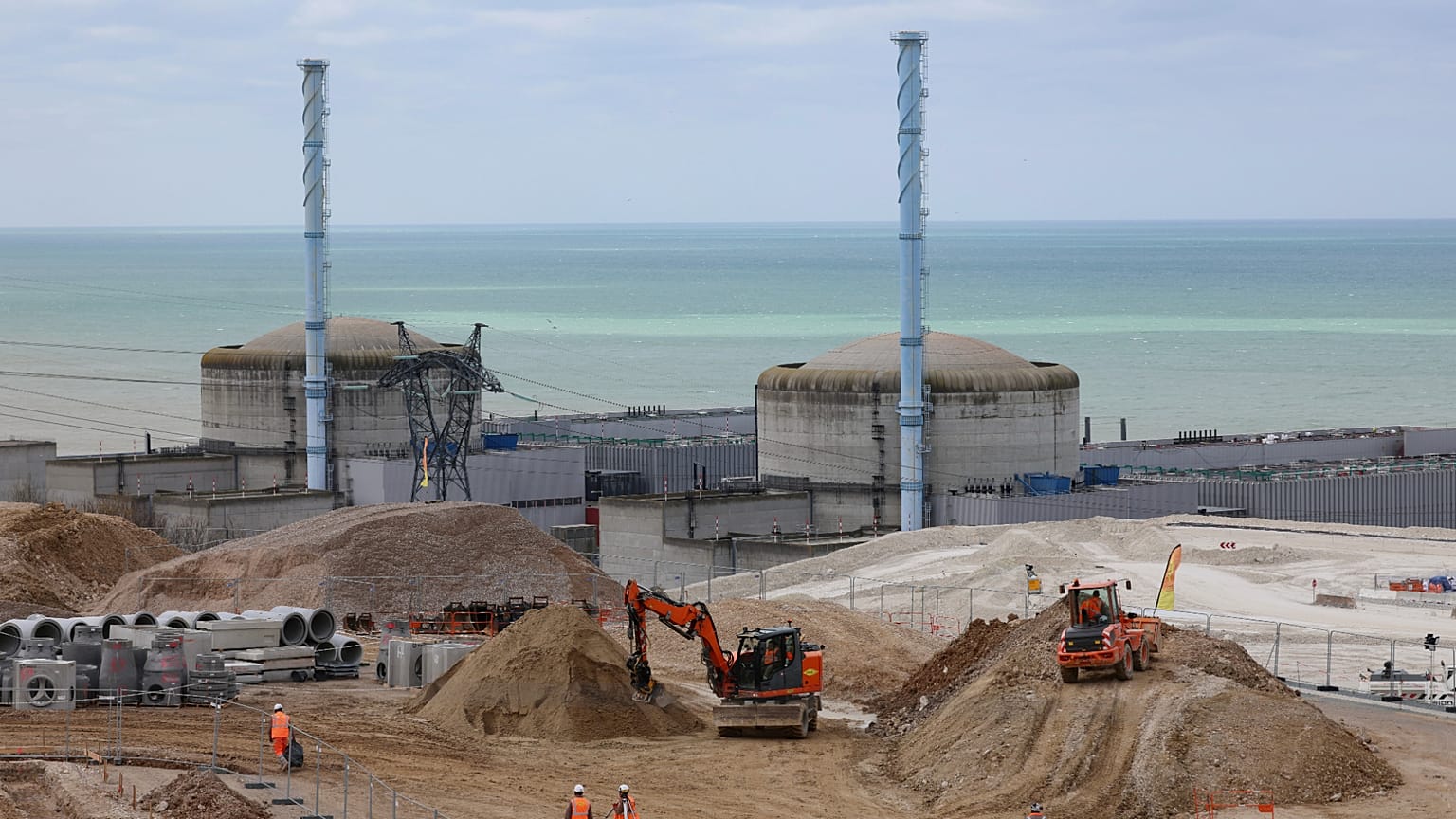













Nuclear power accounts for 12% of the EU’s energy mix. Yet despite recent increases, overall nuclear power production is declining.
The prospect of joint US-Israeli strikes on Iran and Tehran's potential retaliation against Gulf states is high on the agenda in Europe, where governments are weighing the risks to energy supply and fuel prices.
 ADVERTISEMENT
ADVERTISEMENT
ADVERTISEMENT
Much will depend on the energy mix. Countries with stronger investment in renewables and nuclear power may be better insulated, while those heavily reliant on natural gas face greater exposure.
So, which countries produce the most nuclear energy? What is the share of nuclear power in the overall energy mix and in electricity production?
Twelve EU countries produce nuclear energy.
“The EU remains technologically neutral when it comes to energy sources, meaning the decision of where to supply energy from is for each EU country to take,” according to the European Commission.
In 2024, these countries generated 649,524 gigawatt-hours (GWh) of electricity. This was a 4.8% increase compared with 2023. It was also the second consecutive annual rise, following a drop in 2022 (609,255 GWh).
Does this point to a long-term upward trend? Not really.
Despite the increases in the past two years, nuclear power production has declined over time. It fell by 20% between 2014 and 2024, and by 30% between 2004 and 2024, according to Eurostat.
Petroleum and crude oil
In 2024, the EU’s energy mix consisted of five main sources.
Crude oil and petroleum products had the largest share at 38%.
Natural gas accounted for 21%, followed closely by renewable energy at 20%. Nuclear energy made up 12% while solid fuels accounted for 10%.
Energy mixes vary widely across Europe. Some countries have significantly increased their use of renewable energy while nuclear remains the main source in a few.
France leads in nuclear energy share at 40%
As of 2024, France has by far the largest share of nuclear energy in its energy mix, at 40.3%. Slovakia ranks second with 29.7%, followed by Sweden (25.6%) and Bulgaria (23.7%).
The share of nuclear energy is also above 20% in Finland (23.4%) and Slovenia (21.7%). Czechia is close to that level at 19.5%.
Hungary (16.6%), Belgium (13.2%), Spain (11.1%) and Romania (9.1%) are also nuclear energy producers with notable shares, while this figure is just 1.1% in the Netherlands.
Germany, France and Slovakia
Germany has stopped producing nuclear energy. According to Eurostat, 2023 was the last year it generated nuclear power, and production fell to zero in 2024.
The share of nuclear power in electricity production is higher in all these countries. In the EU, it stood at 23.4% in 2025 according to Ember and the Energy Institute’s Statistical Review of World Energy.
France and Slovakia rely heavily on nuclear energy for electricity. The share of nuclear power is 69% in France and 66.4% in Slovakia.
In five countries, the share of nuclear power in electricity production is around 40%. These are Czechia (42.3%), Finland (40.4%), Hungary (39.8%), Slovenia (39.2%) and Bulgaria (39.1%).
The share of nuclear power is also above the EU average in Belgium (33.1%), Switzerland (31.2%) and Sweden (27.6%).
In addition to the 12 EU countries, data for this indicator is also available for Switzerland and the UK.
Romania (20.5%) and Spain (18.7%) meet around one-fifth of their electricity needs from nuclear power.
In the UK, the share of nuclear power is 12.4%, while the Netherlands has the lowest level at 3%.
In 2024, the EU produced 43% of its energy while 57% was imported according to the European Commission.
Fuel prices, including petrol and diesel, differ significantly across Europe. Electricity and natural gas prices for households also vary widely.