














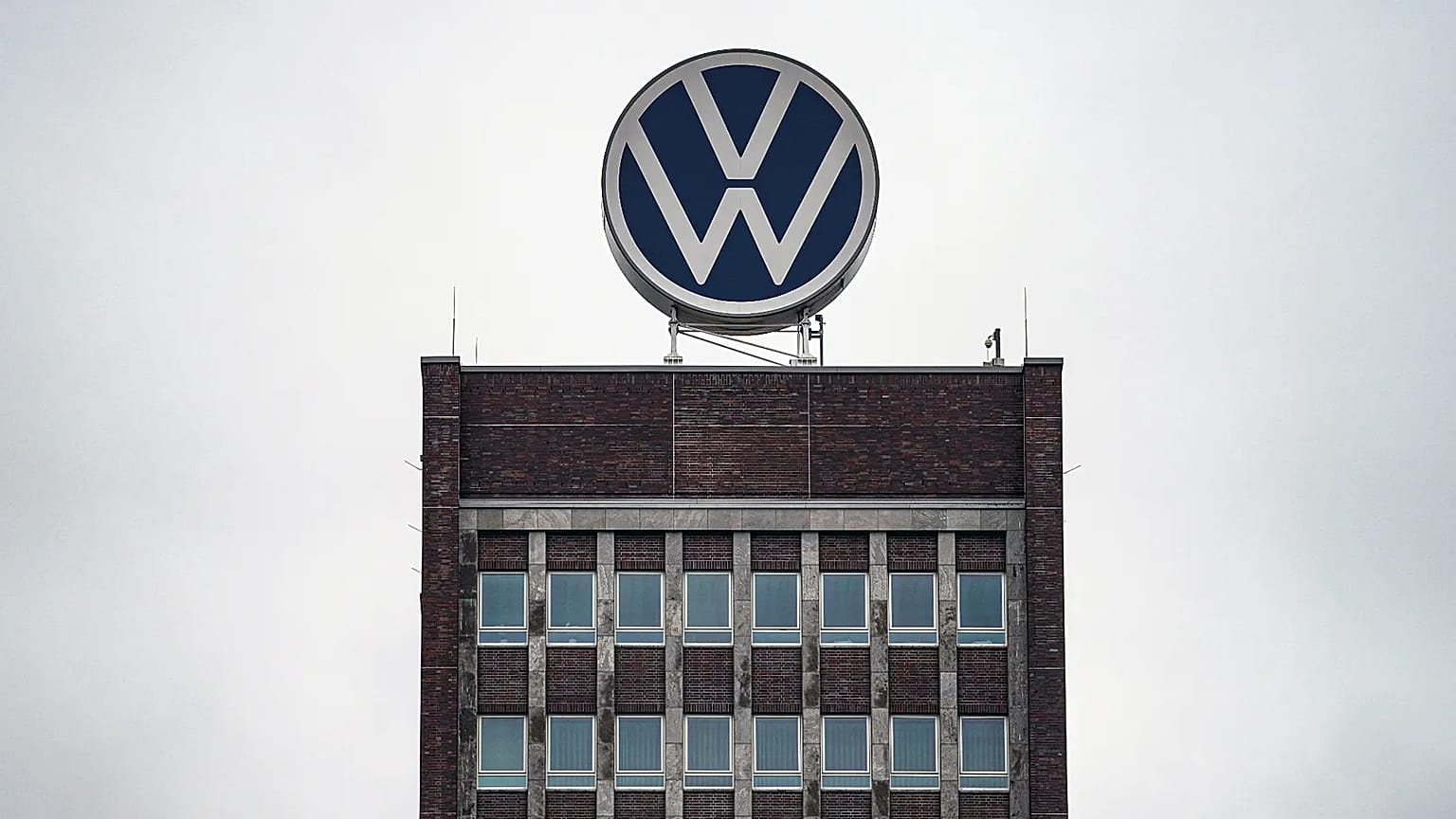













Volkswagen is reportedly in talks with Israeli defence company Rafael Advanced Defense Systems about potentially converting VW's Osnabrück plant, currently threatened with closure, to producing defence-adjacent parts.
Volkswagen has ruled out weapons production at its Osnabrück plant but has declined to confirm or deny media reports that it is in talks for other military-adjacent production with Israeli defence firm Rafael Advanced Defense Systems, makers of the Iron Dome missile defence system.
 ADVERTISEMENT
ADVERTISEMENT
ADVERTISEMENT
The German carmaker told Euronews Business it is "in dialogue with various market players" as part of an "open review process" for the site once car manufacturing wraps at the beleaguered site in 2027, but stressed there are "currently no concrete decisions or conclusions regarding the future direction of the site."
Media reports, initially published in the Financial Times, have suggested those conversations may include Rafael, raising the prospect of the plant — one of Volkswagen's smaller plants but a key source of jobs in the region — pivoting from car production to components for air defence systems.
Volkswagen did not confirm those reports directly.
"The production of weapons by Volkswagen AG remains ruled out," a spokesperson said, adding that the company does not "engage in speculation regarding further plans for the Osnabrück site."
The plant, which the company describes as a "project- and order-oriented facility for small-series and special projects," has been developing various vehicle concepts in recent months to explore potential new uses.
Whether any will lead to concrete projects, Volkswagen said, "remains to be seen".
The German carmaker has been exploring prospects for the Osnabrück site for some time, with around 2,300 jobs on the line if the plant fully shuts down.
If an agreement is reached with Rafael, all 2,300 jobs at the plant, which is threatened with closure, could be saved.
A cooperation between Volkswagen and Rafael Advanced Defense Systems would be a particularly prominent example of how the German automotive industry is increasingly looking to join forces with the booming defence sector in the country.
From Israel's point of view, Germany fulfils key requirements and is also considered an ideal location due to its location and the trust-based cooperation that exists between the two countries regarding sensitive projects.
In the past, military lorries have already been manufactured through Rheinmetall MAN Military Vehicles, a joint venture in which Rheinmetall holds a controlling stake alongside VW subsidiary MAN Truck & Bus.
The conversion of production at the plant in Osnabrück would therefore involve comparatively little investment and could be realised within 12 to 18 months.
However, this would first require the approval of the workforce. Given VW's labour history and the sensitivity of defence production, this could be a potentially significant obstacle.
According reports, the plant in Osnabrück could manufacture various components for the Iron Dome Defence System, including heavy-duty trucks for transporting the missiles as well as launchers and power generators.
Volkswagen would not produce the interceptor missiles themselves, a weapons-production red line reiterated in comments given to Euronews.
The share price of Volkswagen was up by more than 1.3% before noon on Wednesday.