















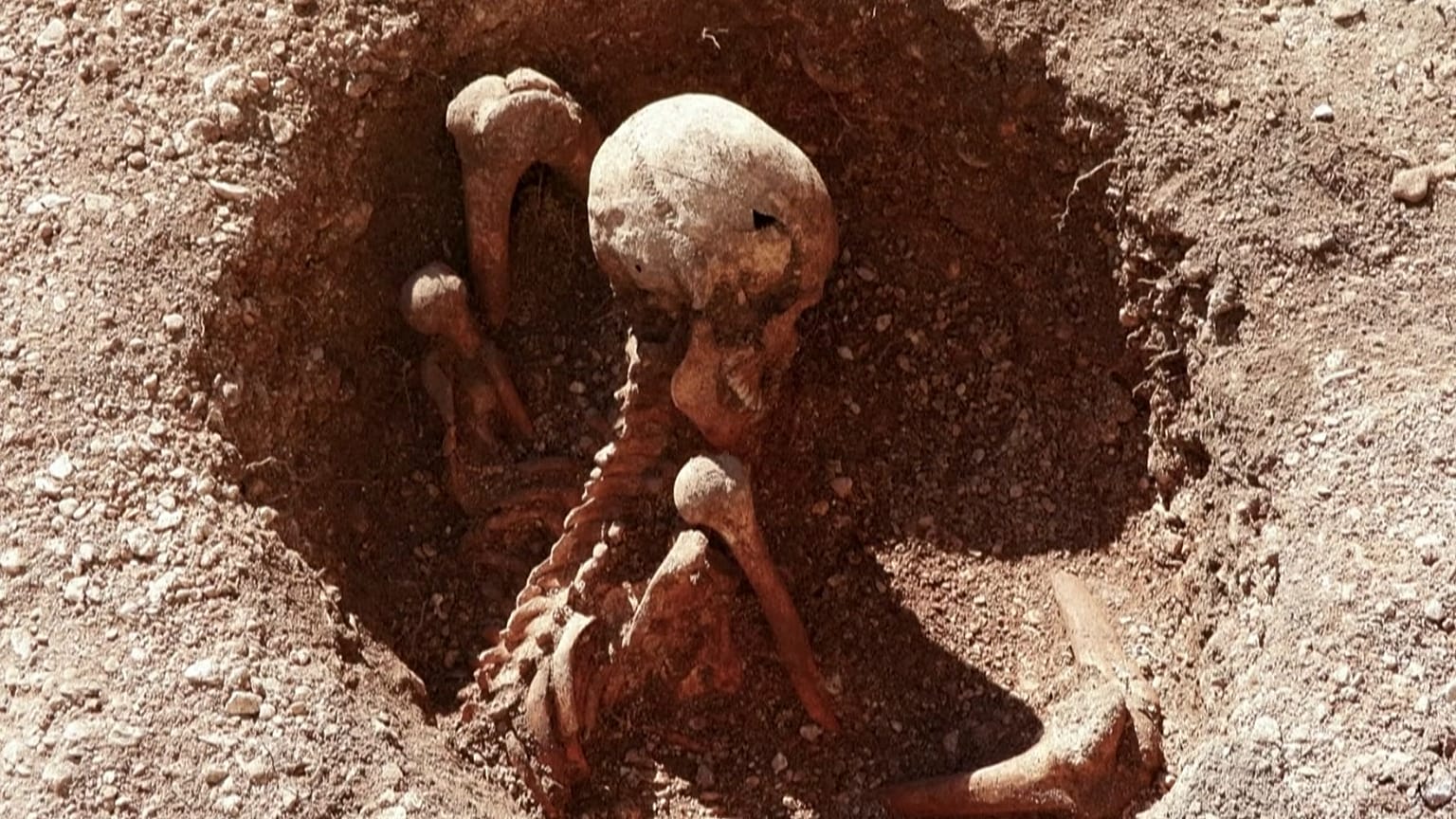














French archaeologists have discovered five new Gallic 'seated' burials at an excavation site in Dijon town centre. While barely 75 skeletons in this position have been found anywhere in the world, the latest discovery brings to 20 the number found in the city famed for its mustard.
It's a hole in the ground with no decorative or distinguishing marks whatsoever.
 ADVERTISEMENT
ADVERTISEMENT
ADVERTISEMENT
Inside, a young Gaul, legs curled up, head bowed, sleeps. Alongside five other skeletons, his seated form catches the eye of curious schoolchildren.
It could be a scene from a horror movie but it's a description of the latest playground discovery at Joséphine Baker primary school in the French city of Dijon, where archaeologists have been hard at work since January 2025.
All the graves contain men aged between 40 and 60, ranging in height from 1.62 to 1.82 metres. In relatively good health and with good teeth, the bodies show signs of physical assault, including one with a deadly wound to the skull.
Crime and punishment
The discovery is exceptional because of their positions and the good condition of the skeletons. Each is seated at the bottom of a pit one metre in circumference and around 40 centimetres deep.
"Even more unusual," says the institute, "are the unhealed marks of violence on five or six of them, probably indicative of an intentional killing: gashes on the humerus. One of them received two blows to the skull from a sharp object.
Their arms extend down their torsos, their hands are resting close to their pelvis, and their backs are resting against the eastern wall, looking westwards.
It remains unclear however if the site was a burial ground for criminals, human sacrifices, or people buried by enemies of Gaul to dissuade others from fighting.
There are no funerary objects, furniture or ornaments in the tombs. Only a black rock armband enabled archaeologists from France's National Institute for Preventive Archaeological Research to date the tombs to the Gallic period.
It is difficult for archaeologists to determine what these burials correspond to, and speculation is rife. Were they killed before being buried? Was their position a mark of respect or posthumous shame? For the time being, Inrap has no preferred explanation. The only conclusion archaeologists can draw is that these burials were part of a larger complex operation.
Dijon, a Gallic city
The skeletons were not discovered by chance by curious children digging in their playground, but were part of a research project planned by teams from Inrap.
In France, all development work must be preceded by a visit from an archaeologist. If the archaeologist sees any signs that archaeological material is present in the soil, an Inrap team is sent out for several months to record, study and exhume it, to ensure that the work does not cause traces of the past to disappear.
For more than 30 years, the preventive excavations carried outin Dijon have often revealed heavy occupation by the Gauls. A goldmine for archaeologists, because while the name of the Celtic people is familiar to most in France, whether thanks to the Asterix and Obelix comic strip or history lessons, many of their customs are still a mystery to historians and archaeologists.
Much of what we know about the Gauls comes from Caesar's writings on his conquest of Gaul, which were not primarily concerned with objectivity and anthropological research.
A structured Gallic occupation
The area of Dijon around the Josephine Baker school complex is full of these signs. A few months ago, 13 Gallic skeletons were found on the same site, just 20 metres away.
In the 1990s, work in the nearby Sainte-Anne neighbourhood also revealed burials similar to those found in the courtyard of the school.
According to Inrap, however, this year's discovery could prove the existence of a structured Gallic occupation of the site, traces of which are now buried in the very heart of the city.
The digs revealed an imposing defensive ditch, a traffic route bordered by an area dedicated to burying animals dating from the end of the Gallic period, around the 1st century BC.
In all, this small area of Dijon contains around 20 tombs of seated Gauls, out of the 75 currently recorded worldwide (France, Switzerland and Great Britain).