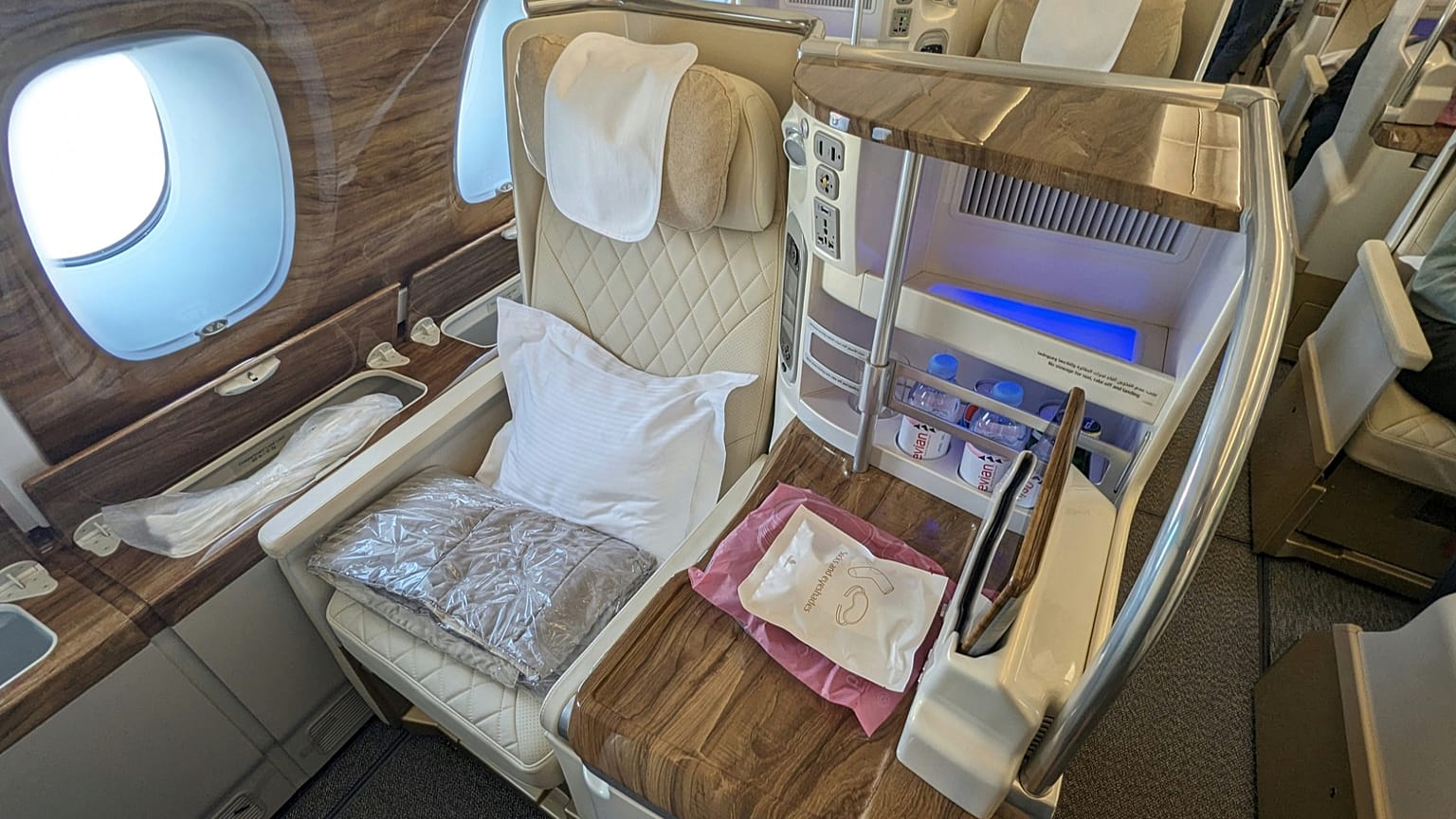













Scrapping premium seats could help halve global aviation emissions, according to a major new study.
Few everyday activities carry a bigger carbon footprint than flying, but some passengers have a far greater impact than others.
 ADVERTISEMENT
ADVERTISEMENT
ADVERTISEMENT
Business and first-class seats are up to five times more carbon-intensive than economy seats, according to International Air Transport Association (IATA) data.
Scrapping premium seating could help to halve global aviation emissions, a recent study has found.
Emissions could be cut even further by operating only the most fuel-efficient aircraft and increasing passenger occupancy.
Together, these three actions have the potential to slash emissions by between 50 and 75 per cent, according to the study – without the need to wait for elusive sustainable aviation fuel (SAF) to materialise affordably and at scale.
While the study’s authors acknowledge these changes would have to be made gradually, they show that an 11 per cent reduction in global aviation emissions is achievable immediately.
How polluting is flying?
Flying is responsible for around four per cent of the world’s human-driven emissions.
But not all flights are created equal: individual emissions vary widely depending on the efficiency and configuration of the aeroplane.
The study, published last month in the science journal Nature Communications Earth & Environment, analysed more than 27 million commercial flights in 2023, covering 26,000 city pairs and nearly 3.5 billion passengers.
On average, global aviation emissions stood at 84.4 grams of CO2 per kilometre for each paying passenger in 2023.
Emissions ranged from 30 grams of CO2 per passenger kilometre on some routes, to nearly 900 grams on others.
Within the period and routes studied, the USA was the highest emitter globally (144.6 million tonnes of CO2 – 25 per cent of total emissions) at an average of 96.5g CO2 per passenger kilometre. China came second (49.7 Mt and 88.6g) and the UK third (24.1 Mt and 81.1g).
Within Europe, the UK was followed by Spain (16.8 Mt), Germany (16.7 Mt), France (14.8 Mt) and Italy (9.9 Mt). Norway, meanwhile, is flagged for operating particularly inefficient flights, which are often associated with smaller airports and less busy flights – in some countries, such routes are government-funded and essential for connectivity to remote areas.
Flight demand is outpacing efficiency gains
Although major efficiency gains have been made – back in 1980, average CO2 per passenger kilometre stood at 280g – the study warns that the growth in demand for flying has historically outpaced these gains.
Emissions have also risen as a result of airspace closures due to conflicts like Russia’s war on Ukraine, which has increased flight distances and global fuel consumption.
Future developments are likely to worsen this trend. As airlines try to reduce heat-trapping contrails by avoiding certain flight zones, fuel use is expected to rise, offsetting some efficiency gains.
The return of supersonic travel – promised as early as 2029 – would further reduce fuel efficiency and increase the warming impact of aviation on the atmosphere.
Cutting business class could slash emissions
Re-configuring planes to economy class only would accommodate more passengers, slashing emissions by between 22 and 57 per cent, the study found.
Ensuring fewer empty seats would also have a significant impact. In 2023, aircraft passenger occupancy averaged 79 per cent, with some planes flying at as little as 20 per cent capacity.
Increasing the average to 95 per cent per plane would further reduce emissions by 16 per cent, the analysis found.
Switching to more efficient planes
Replacing older aircraft with newer, more efficient fleets – meaning planes that are lighter, more aerodynamic and more fuel efficient – could cut fuel use by between 25 and 28 per cent, the study found.
The most efficient plane types – the Boeing 787-9 for long-haul flights and the Airbus A321neo for short- and medium-haul – were found to produce 60 grams of CO2 per kilometre for each passenger. On the other end of the scale, the least efficient aircraft produced as much as 360 grams per passenger.
“Realistically, this would be a long-term transition – one that could be promoted by policies that reward efficiency, so that the most efficient aircraft are favoured whenever replacement decisions are made,” says study co-author Dr Milan Klöwer from the University of Oxford.
Policy tools to incentivise the switch to more efficient planes could include introducing SAF fuel quotas, carbon intensity caps, emissions trading schemes and emissions ratings for airlines, as well as adjusting air passenger duties and landing fees based on aircraft performance, the authors suggest.
Airlines could make an immediate emissions reduction of around 11 per cent, however, by flying their most efficient aircraft on routes where they already operate.