



























As heads of state and government gather in Munich, a new report warns that the international order is under growing pressure, alliances are becoming more fragile, and geopolitical tensions are intensifying.
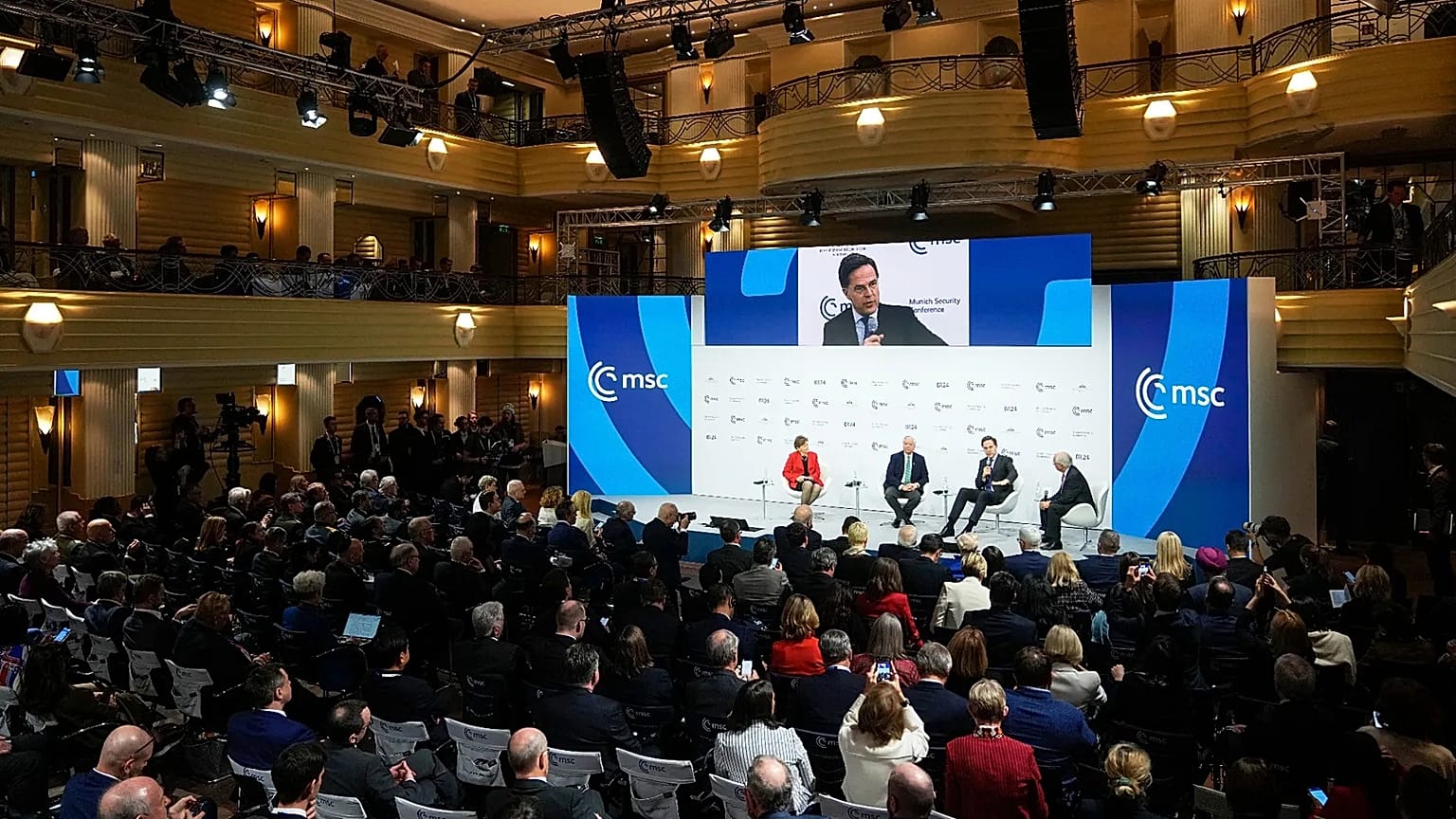
A large number of European and international heads of state and government will this week descend on Bavaria for the Munich Security Conference (MSC), which takes place from 13 to 15 February.
 ADVERTISEMENT
ADVERTISEMENT
ADVERTISEMENT
Around 65 heads of state and government are expected to attend, alongside some 450 representatives from global politics, academia and the defence industry.
In the foreword to the newly released 2026 MSC report, conference chair Wolfgang Ischinger writes that "rarely in the conference's recent history have there been so many fundamental questions on the table at the same time".
He points to core issues such as Europe's security, the future of the transatlantic partnership, and whether the international community is still capable of managing an increasingly "complex and contested" world.
The report portrays a world in the midst of far-reaching political, economic and security upheaval. At its centre is a diagnosis that sets the tone for the entire document and the conference itself: "The world has entered a period of wrecking-ball politics."
'Reassurance, conditionality and coercion'
According to the report, cautious reforms and incremental policy adjustments are increasingly giving way to more radical restructuring that deliberately calls existing systems into question, or even seeks to dismantle them.
The country most prominently associated with this shift, it argues, is the United States. The very state that played a decisive role in building the post-war international order is now seen as one of the main drivers of its transformation. More than 80 years after it first took shape, that order is itself now "under destruction".
The report stresses that this is not just about individual policy decisions, but about a broader change in direction in US politics.
Washington, it argues, is challenging core principles that have shaped international cooperation for decades, from the role of international organisations and the importance of rules-based trade to close partnerships with democratic allies.
The effects of this shift are being felt worldwide, but especially in Europe, which has long relied on the US for security but which now experiences its partnership as "unsteady", shifting between "reassurance, conditionality, and coercion".
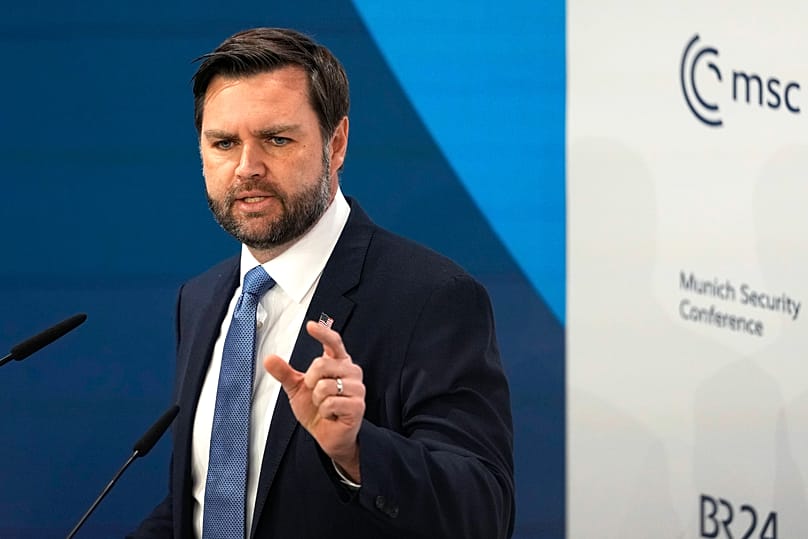
US Secretary of State Marco Rubio is expected to attend this year's conference. According to media reports, Vice President J.D. Vance's participation was initially confirmed, then cancelled a week later.
His speech at last year's conference was widely described as a "reckoning with Europe" and drew criticism from several politicians, including Germany's Chancellor Friedrich Merz and Defence Minister Boris Pistorius.
Chancellor Merz will lead this year's German delegation. NATO Secretary General Mark Rutte, European Central Bank President Christine Lagarde and numerous European heads of state and government are also expected to attend.
Rubio will attend "with a large delegation", and US congresswoman Alexandria Ocasio-Cortez has also confirmed her participation.
At the conference kick-off, US Ambassador to NATO Matthew Whitaker commented on the report's findings, rejecting its conclusions and stressing that the US has no intention of undermining NATO or other alliances.
"That's the first thing I reject; we're trying to make NATO stronger, not to withdraw or reject NATO, but make it work like it was intended as an alliance of 32 strong and capable allies," he said.
He reiterated that European allies must increase their defence spending and demonstrate that they can "deliver" on their commitments, including the new NATO spending targets.
Erosion of trust
Another key finding of the MSC report is a growing loss of trust in political systems. In many Western countries in particular, confidence is visibly declining.
Politicians are increasingly seen as "guardians of the status quo", "administering paralysed political systems that appear unresponsive to the majority of people". As faith in politics' ability to improve everyday life wanes, the report argues, electorates start to become open to more radical approaches. For many, abrupt breaks begin to seem more appealing than gradual change.
As a result, political actors who deliberately embrace confrontation and promise to tear down existing structures rather than reform them are gaining influence.
Before the conference, there was debate over whether the far-right Alternative for Germany (AfD) should be invited. Ischinger takes the view that the party should be included as long as it is not banned by the German authorities, and three AfD policy specialists, including Bundestag member Rüdiger Lucassen, are now set to attend.
Alongside the transatlantic relationship, the MSC report also addresses Russia's war on Ukraine and the associated hybrid threats facing Europe. It argues that Europe must prepare for a situation in which American support remains important, but can no longer be taken for granted.
Many European governments are therefore taking a dual-track approach: keeping the US closely engaged while at the same time building up greater capacity to act independently, for example through rearmament.
The report stresses that this sense of uncertainty is not only limited to Europe. In the Indo-Pacific, doubts are growing about the US' long-term commitment to the regional security order, while China's rise and "increasingly coercive behaviour" are contributing to a more "unstable" environment.
At the same time, the report also frames the current upheaval as an opportunity, noting that when old structures are shaken, "long-blocked" developments can begin to move again.
For instance, pressure on European NATO members has led many countries to significantly increase their defence spending. New partnerships are also emerging in trade, security and technology to end Europe's dependence on the US.
Yet whether this will ultimately lead to a more stable world remains uncertain – and many of the heads of government gathering in Munich this weekend worry that a looser global order could primarily benefit the largest and most powerful states.