




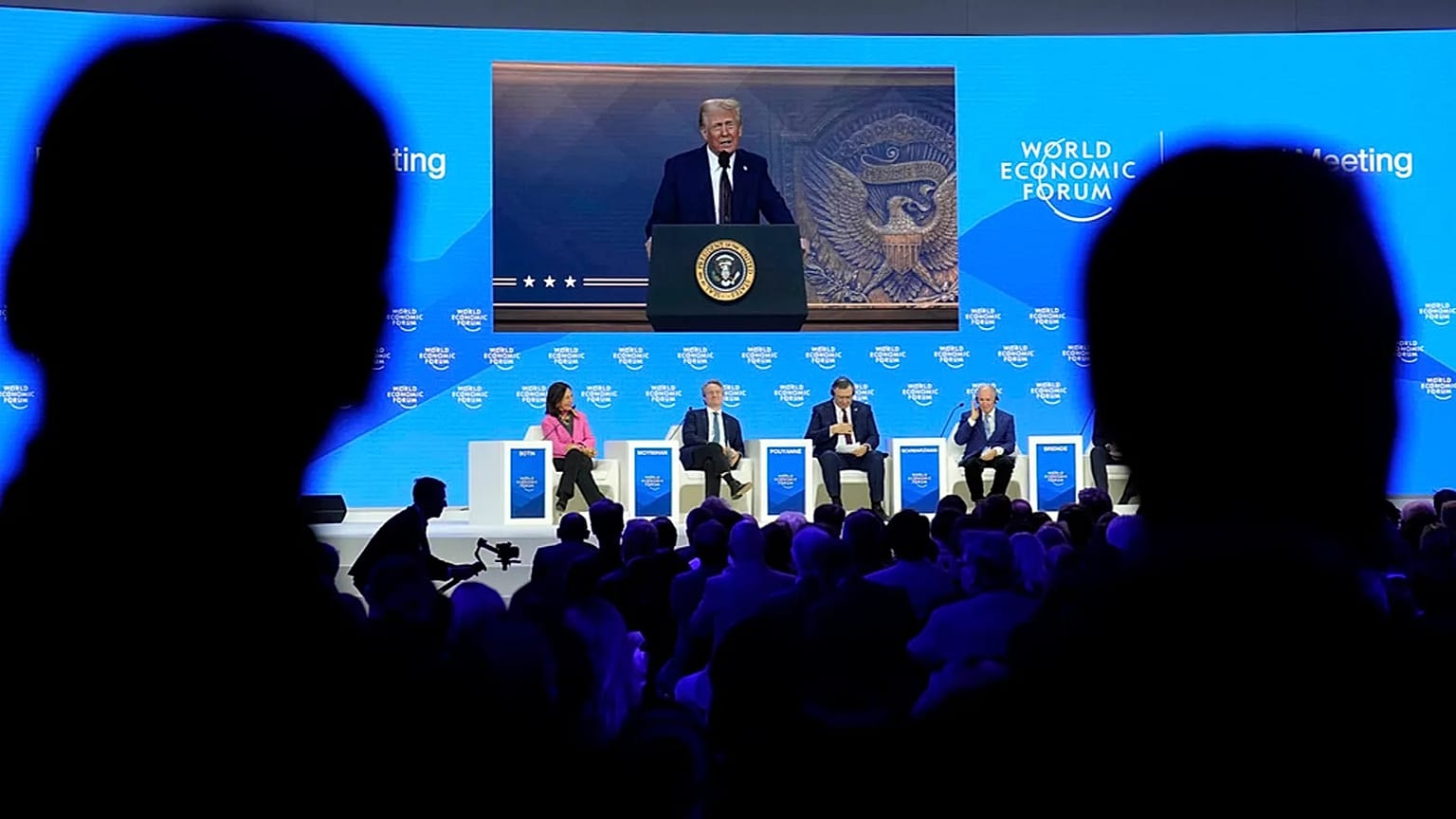














Geoeconomic confrontation — ranging from sanctions to tariffs — is the top threat, found the World Economic Forum (WEF)'s Global Risks Report on the eve of its annual meeting gathering the world's business and political elites, set to take place in Davos next week.
Escalating economic confrontation between major powers is now seen as biggest threat to global stability for the year, the World Economic Forum (WEF) said on Wednesday in its Global Risks Report 2026.
 ADVERTISEMENT
ADVERTISEMENT
ADVERTISEMENT
Geoeconomic confrontation — which refers to the use of tools such as sanctions and tariffs — ranked above misinformation and disinformation, societal polarisation, extreme weather and state-based armed conflict as the top global risk for 2026.
The annual report takes into the account the views of more than 1,300 leaders and experts from sectors including business, academia, civil society and government.
It found that half of those surveyed anticipate a turbulent or stormy world over the next two years, a notable increase from 36% in last year's report.
A further 40% of respondents said they expect the two-year outlook to be unsettled at best, while only 9% foresee stability and 1% anticipate calm. The outlook darkens further over the next decade, as a clear majority predict there will be prolonged global instability.
The report was released days before the WEF's annual meeting in Davos, where managing geopolitical and economic risks — along with responsible deployment of technologies such as generative AI — will be high on the agenda.
"The Global Risks Report offers an early warning system as the age of competition compounds global risks — from geoeconomic confrontation to unchecked technology to rising debt — and changes our collective capacity to address them," said WEF Managing Director Saadia Zahidi.
"But none of these risks are a foregone conclusion," she added.
Rising geopolitical and economic and risks
Geoeconomic confrontation topped the near-term risk rankings in the WEF's report, with 18% of respondents naming it the most likely trigger for a global crisis in 2026.
It also ranked first for severity over the next two years, climbing eight positions from last year. State-based armed conflict came in second for 2026 but dropped to fifth place in the two-year outlook.
Amid rising rivalries and prolonged conflicts, geoeconomic confrontation threatens supply chains, global economic stability, and the cooperative capacity needed to respond to economic shocks, according to the WEF.
The findings come after a year in which US President Donald Trump upended Washington's trade policy and shook the world through his use of tariffs.
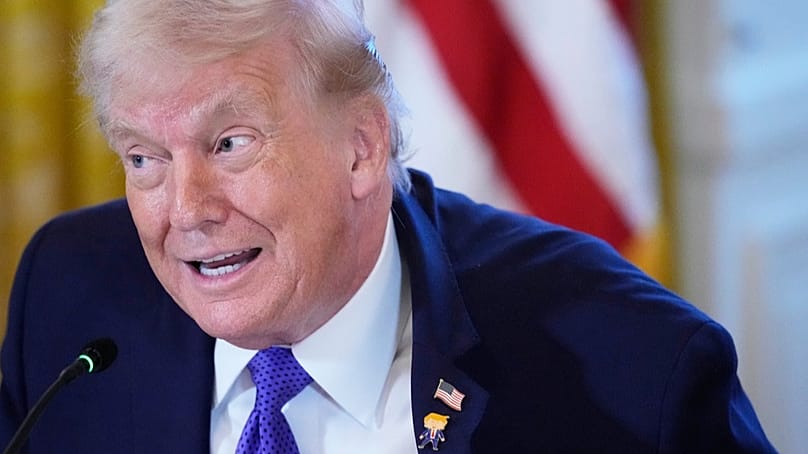
His double-digit taxes on imports from almost every nation have disrupted global commerce and strained the budgets of consumers and businesses worldwide.
Meanwhile, on the geopolitical front, 68% of respondents told WEF they expect a "multipolar or fragmented order" over the next decade, a slight rise from 2025's findings.
Economic risks showed the largest overall increase in the two-year outlook.
Both economic downturn and inflation risks jumped eight positions, to 11th and 21st, respectively, while the threat of an asset bubble burst rose seven places to 18th.
Mounting debt concerns and potential asset bubbles, compounded by geoeconomic tensions, could spark a new phase of global market volatility, according to the WEF.
Tech threats to climate concerns
Misinformation and disinformation ranked second as the biggest global risks in the two-year outlook, while cyber insecurity was in sixth place.
Adverse outcomes of artificial intelligence had the steepest rise in WEF's report, climbing from 30th in the two-year horizon to fifth over the next decade, reflecting growing concern about AI's impact on job markets, societies, and security.
Societal polarisation was considered the fourth largest threat this year, and the third biggest in the outlook stretching to 2028.
Inequality held seventh place in both the two- and 10-year outlooks and was also identified as the most interconnected risk for a second consecutive year.
With short-term concerns overtaking long-term objectives, environmental risks dropped in ranking in the two-year outlook.
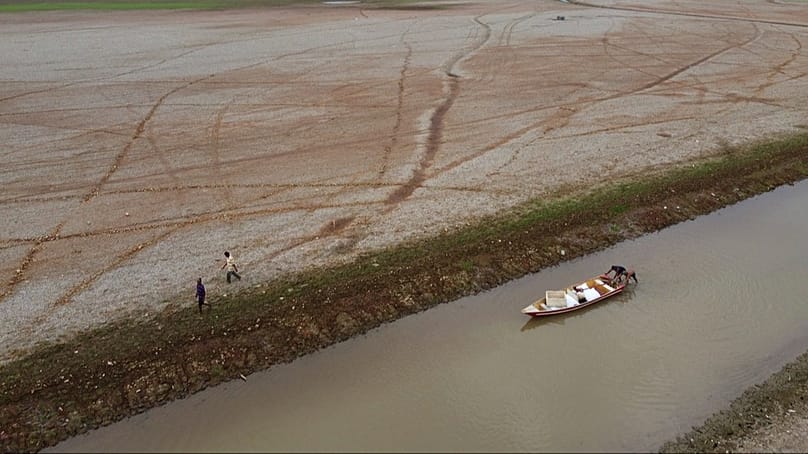
Extreme weather fell from second to fourth, pollution from sixth to ninth, and critical changes to earth systems and biodiversity loss fall seven and five places, respectively.
Yet over the 10-year period, environmental threats were considered the most severe — with the top three being extreme weather, biodiversity loss, and critical change to Earth systems.
Three-quarters of respondents said they expect a turbulent or stormy environmental outlook, the most negative of any risk category.
Zahidi of the WEF said that the Global Risks Report, now in its 21st year, showed that "cooperation is indispensable for global risk management.
"The challenges highlighted in this report — spanning geopolitical shocks, rapid technological change, climate instability, societal strife, and economic risks — underscore both the scale of the potential perils we face and our shared responsibility to shape what comes next," she said.