




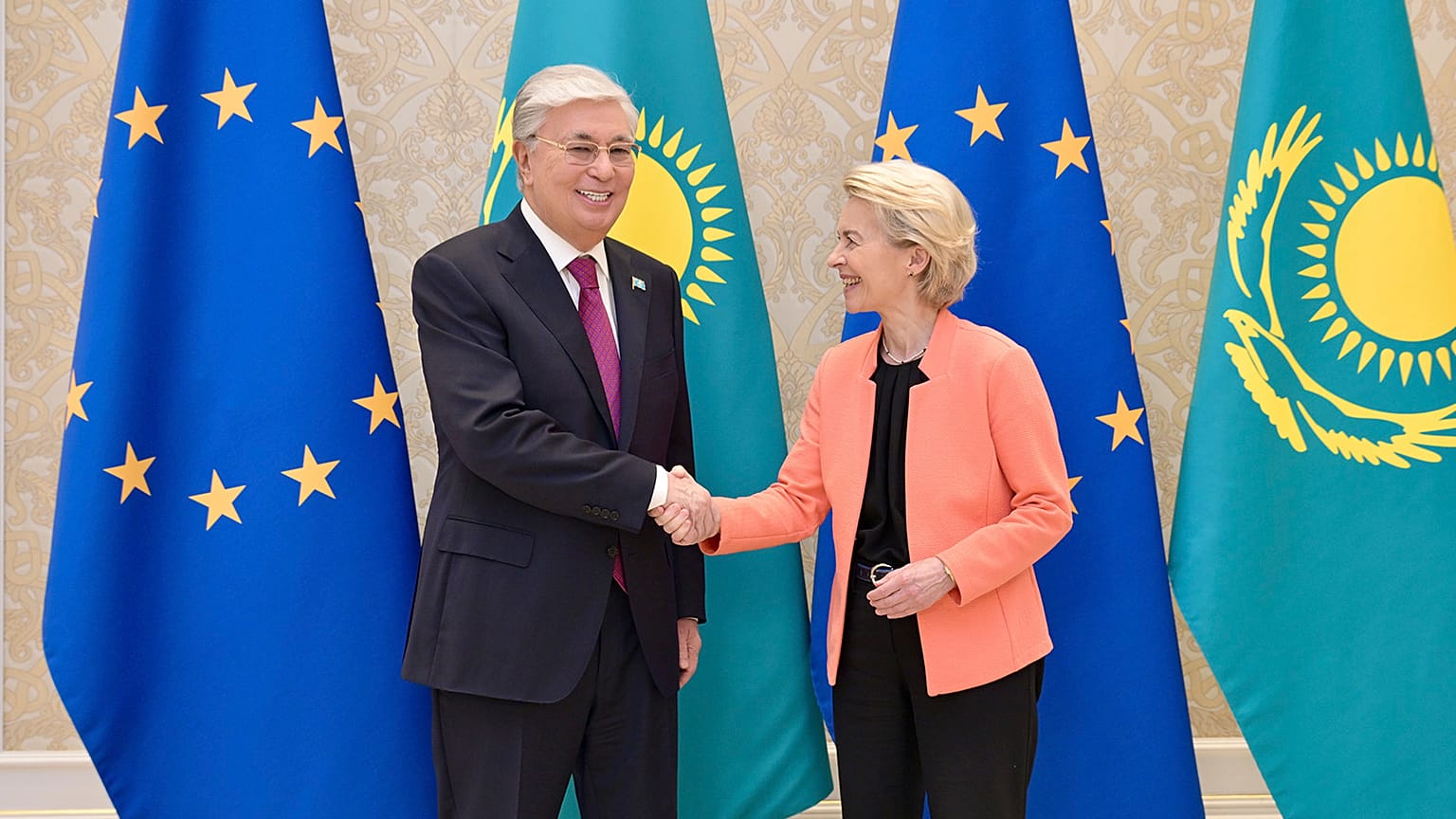













The EU and Kazakhstan are celebrating the 10th anniversary of the signing of the Enhanced Cooperation Agreement, with connectivity and critical raw materials as key areas of cooperation.
Kazakhstan has called on the European Union to accelerate infrastructure projects in Central Asia that were proposed two years ago, warning that delays could see opportunities slip away.
 ADVERTISEMENT
ADVERTISEMENT
ADVERTISEMENT
Roman Vassilenko, Kazakhstan's ambassador to Belgium and head of the country's mission to the EU and NATO, said the bloc and its financial institutions must focus on implementing proposals from a 2023 European Bank for Reconstruction and Development report.
"We would like to call on the EU, its member states as well as financial institutions to move faster and focus on practical implementations of the 2023 EBRD report findings on both hard and soft infrastructures in Central Asia," Vassilenko told the Brussels Europe Press Club.
The EBRD study, submitted in June 2023, recommended seven soft connectivity measures and 33 hard infrastructure investments across the region. Based on the report, the EU and EU-supported financial institutions pledged €10 billion for Central Asian infrastructure development.
So far, the EBRD has signed loan agreements with Kazakhstan worth $800 million (€691 million), while the European Investment Bank signed a €200 million loan agreement with the Development Bank of Kazakhstan in March.
"We can't say that we haven't moved, but we have just started moving forward. The market demand is there, we need to build up these capacities now," Vassilenko said.
He warned the moment could be lost if red tape and feasibility studies take too long.
Decade of enhanced partnership
This December marks the 10th anniversary of the Enhanced Cooperation and Partnership Agreement between the EU and Kazakhstan, which covers 29 areas including trade, connectivity, critical raw materials, energy, climate change and regional security.
"It was signed 10 years ago, and it has been valid for five years. So, it's a very important milestone," said Aleška Simkić, EU ambassador to Kazakhstan.
The partnership dates to 1993, shortly after Kazakhstan gained independence. The first partnership agreement was signed in 1995 but had exhausted its potential by 2010-2015, according to Valeriy Sitenko, senior expert at the Foreign Policy Research Institute under Kazakhstan's Foreign Ministry.
The enhanced agreement signed in December 2015 was the first of its kind in Central Asia. Kyrgyzstan signed a similar agreement last year and Uzbekistan signed one in October. Tajikistan is preparing to follow suit.
The first EU-Central Asia Summit was held in April in Uzbekistan's city of Samarkand.
EU's largest trade partner
Kazakhstan is the EU's largest partner in Central Asia, accounting for 90% of trade with the region. For Kazakhstan, the EU is its largest trading and investment partner.
Trade turnover between the two exceeded €40 billion in 2024. EU investments over nearly 35 years have reached €173 billion, representing half of all foreign direct investment into Kazakhstan.
Kazakhstan provides 13% of the EU's oil imports and 16% of its uranium imports.
"In this regard, we reaffirm our commitment to ensuring the continued, secure, and uninterrupted supply of Kazakh oil to the EU market," Vassilenko said.
The country can provide 21 of the 34 critical raw materials the EU has identified, which officials say will support Europe's industrial resilience while enabling Kazakhstan to modernise its economy.
Transport corridor expansion
Some 85% of land transit between Europe and Asia passes through Kazakhstan, including the Middle Corridor, which is expected to handle 5.2 million tonnes of cargo this year.
The route's capacity currently stands at 6 million tonnes per year and is planned to expand to 10 million by 2028.
"As we can see, the Middle Corridor is evolving beyond a mere transport route. It is becoming a strategic partnership platform that connects economies, technologies, and people," Vassilenko said.
Kazakhstan has invested €30 billion in transport sector modernisation and plans to invest another €13 billion, aiming to reach Pakistan's market through Afghanistan.
The two sides are also working on easing visa application processes to strengthen business and cultural ties.
"This decision represents a significant step toward bringing our peoples even closer, enabling greater mobility, more opportunities for students and professionals, and deeper mutual understanding," Vassilenko said.