

















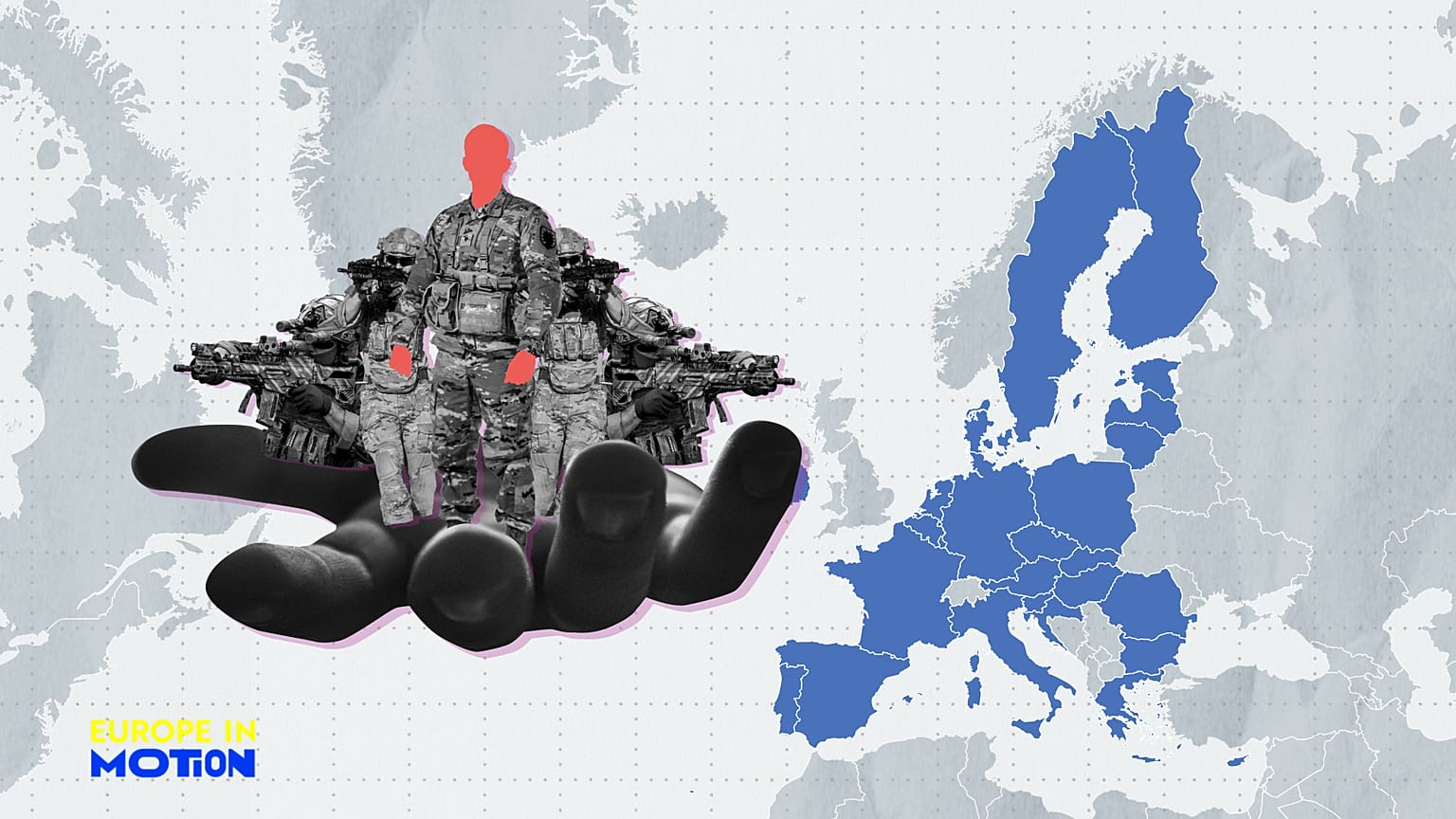














In an increasingly volatile world, citizens across the EU differ on how much they believe Brussels should be spending on its own defence and security.
With transatlantic relations at an all-time low, Europe is desperately seeking to reclaim, strengthen and take ownership of its own defence capabilities.
 ADVERTISEMENT
ADVERTISEMENT
ADVERTISEMENT
Yet despite recent continent-wide attempts to ramp up security, the majority of Europeans appear to doubt their governments' abilities to protect them, according to the latest data from Eurobarometer.
Specifically, it said that more than two-thirds of Europeans believe their country is under threat: France (79%), the Netherlands (77%), and Denmark (76%) registered the highest number of respondents who think so, while Slovenia (50%), Croatia (52%), and the Czech Republic (52%) recorded the lowest.
At the same time, EU citizens draw a clear distinction between threats to their country and to themselves, as the majority (51%) disagree that their personal safety is at risk.
Driven by Russia's war in Ukraine, the EU has tried to take accelerated steps in recent years to bolster its defence capabilities, focusing on joint procurement and industrial expansion.
Among these measures are its ReArm Europe plan, which was designed to boost defence spending, and the Security Action for Europe (SAFE) loan instrument, which lets member states borrow money to fund joint procurement and strengthen Europe's defence industry.
The initiatives appear to have gone down well with the public, with many expressing belief in Brussels' capacity to enhance defence: according to Eurobarometer, most Europeans trust the EU to strengthen security and defence (52%), especially in countries such as Luxembourg (76%), Portugal (74%), Cyprus (73%) and Lithuania (71%).
Younger EU respondents aged 15 to 24 trust the EU on security and defence more than other age groups, especially those aged 55 and older.
Nevertheless, a significant number of Europeans are unhappy with the amount that Brussels is pumping into its military capabilities.
Almost one-third of citizens believe that the EU does not invest enough in defence and security, while 14% think it invests too much, according to the study.
Demand for increased EU investment rises with age: 27% of 15 to 24-year-old respondents say they want more, rising to 35% of those aged 55 and older.
Space: the future of defence and security?
Europeans tend not to just consider the continent's terrestrial capabilities either — many are looking towards the stars.
Some 53% of respondents told Eurobarometer that security and defence should be a priority for the EU's space policy programmes, followed by other areas such as the environment and climate change, and growing European industry.
Among the EU's recent space initiatives is IRIS² — a secure, multi-orbital connectivity constellation to strengthen cyber-resilience and strategic, high-speed communication between EU governments and citizens, reducing reliance on foreign providers.
It is due to go fully operational between 2027 and 2030, a few years after the EU Space Strategy for Security and Defence was launched to protect the bloc's space assets from threats such as anti-satellite strikes.