















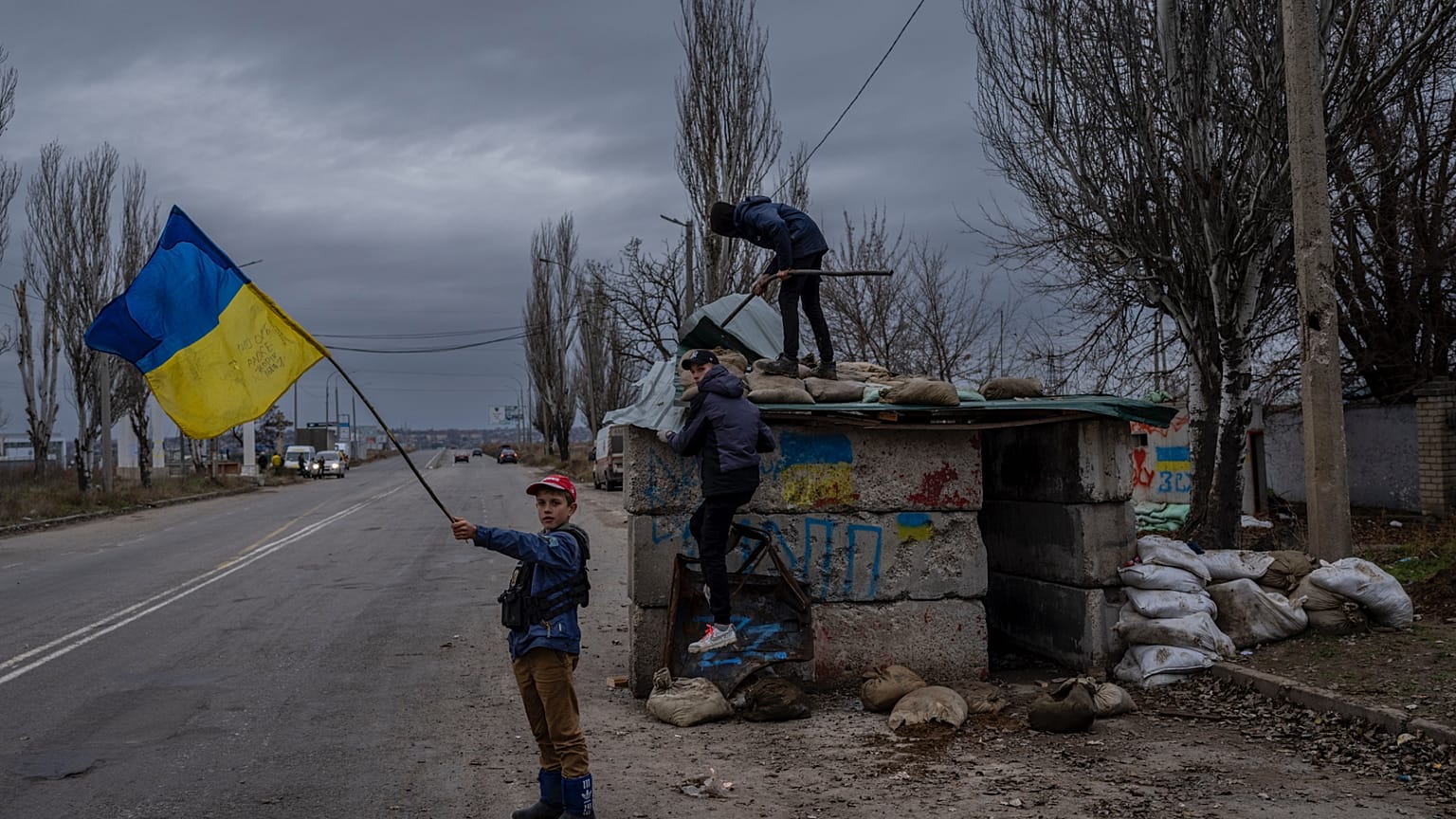













Russia has forcefully deported at least 20,000 Ukrainian children since the beginning of its full-scale invasion. Kyiv managed to bring back 2,000 minors. In some cases, returns took years.
Vlad Buriak was 16 years old when he tried to evacuate from Melitopol, a town in the Zaporizhzhia region, which Russian forces occupied in the first weeks of Moscow’s full-out war it embarked on four years ago.
 ADVERTISEMENT
ADVERTISEMENT
ADVERTISEMENT
On 8 April 2022, the car he was in was stopped by Russian troops in Vasylivka, at the last checkpoint before Ukraine’s controlled territory. As the Moscow troops checked the car's passengers, Vlad, seated in the back, was holding the phone.
He told Euronews that Russian soldiers first accused him of filming them and forced him out of the car.
Vlad said the soldiers were furious and after checking his papers and age, they pointed a gun at him, asking Vlad, “Should I kill you right now?”
“I was really scared”, Vlad told Euronews, “I really have no idea what one can do in a situation like this”.
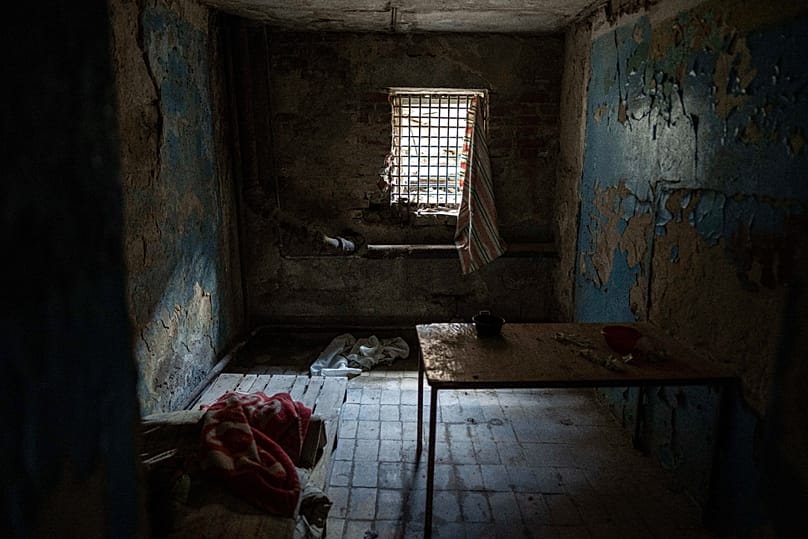
He was taken first to a “filtration camp” — a system of interrogation, detention and forced deportation for civilians in areas of Ukraine it occupies — then to a prison at the police office and then back to Melitopol, where he was placed in a former hotel turned into a prison.
Vlad told Euronews the horrifying details of his stay there.
“One of my jobs was cleaning the torture chamber. After torturing, in this special room there was lots of blood, lots of medicine bandages and everything, and after torturing most of the time I cleaned the torture room, just mop the floor, take some rubbish from this room,” Vlad recalled.
He says Russian troops there “mostly” tortured Ukrainian civilians and soldiers, who were defending Vasylivka when Russia started its all-out war.
“I also washed the floors on the hall of this police station, helped in the kitchen, gave food from the kitchen to the prisoners. I also did cleaning and some other types of job as well. But the most difficult was to clean a torture cell.”
After Vlad was captured, Russian forces also falsified a criminal record against him, accusing him of selling drugs.
Vlad admits that he managed to get out and return to Ukraine after 90 days in Russian captivity largely thanks to a massive effort by his family, society and Ukrainian officials.
Bringing a child back to Ukraine can take years
Until now, Ukraine managed to bring back 2000 children out of 20,000 forcefully deported by Russia.
This number is a “milestone” in itself, says the head of projects at Bring Kids Back UA, an initiative by Ukrainian President Volodymyr Zelenskyy.
Maksym Maksymov told Euronews it can take years to return one child from Russia after abduction, from the beginning of the identification of a child until the return happens.
“I think 2000 cases is a significant milestone,“ Maksymov stated, pointing out the “context of the situation we're operating with”.
“There is no legal mechanism with established rules, international monitoring”.
He admitted that he cannot go “too much into operational details of how returns are happening”, but “it takes heroic effort from multiple teams across various sectors to return a single child”.
“The number of 2,000 is a good testament to the extremely courageous and difficult work that is being implemented.”
Yale’s Humanitarian Research Lab placed the number of deported Ukrainian children closer to 35,000. Moscow claimed the number could reach 700,000.
The US-based Institute for the Study of War think tank (ISW) insists that the true number of deported children is near-impossible to verify, "but the implication remains the same — Russia has stolen tens, potentially hundreds of thousands of Ukrainian children with the explicit intent of eradicating their Ukrainian identities and turning them into Russians."
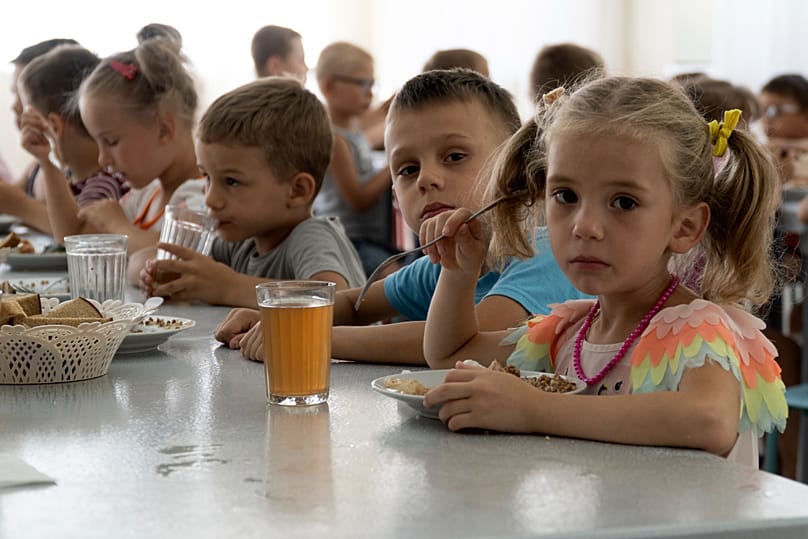
'Eradicating Ukrainian identity'
Vlad Buriak said he was subject to psychological abuse and pressure during his 90 days in Russian captivity.
Russian soldiers and special forces “who tortured people” were telling him that Ukraine “no longer existed”.
“They were saying that the Ukrainian army had already fallen and our president already escaped and lots of this sort of brainwashing propaganda," Vlad said.
Maksymov explained that these are the standard actions on Russian authorities towards the forcefully deported Ukrainian children and not “isolated incidents”.
“They are part of a deliberate strategy, a state policy of demographic engineering and identity erasure," he said.
Child abductions and “industrial scale re-education” are being weaponised to reshape entire communities and redirect children's loyalty, "essentially pushing a generation away from home”, he said, adding that Russia executes this strategy methodically.
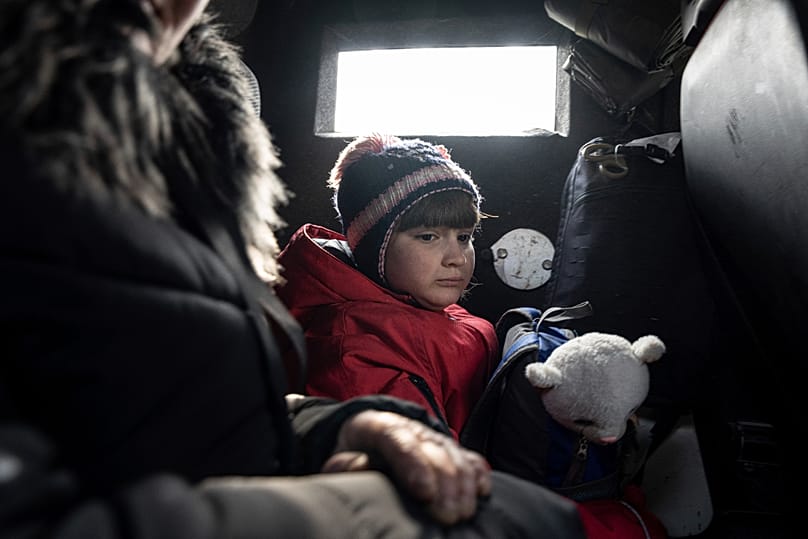
The ISW says that abducting the children was one of Russian President Vladimir Putin’s priorities, referring to the revelations of Ukrainian human rights activists.
They uncovered Kremlin documents dated 18 February 2022, which laid out plans to remove Ukrainian children from orphanages in occupied eastern Luhansk and Donetsk regions and bring them to Russia under the guise of “humanitarian evacuations”.
These documents revealed that Russia planned to target vulnerable Ukrainian children, especially those without parental care, before the full-scale invasion had even begun.
Some 1.6 million Ukrainian children still remain in the temporarily occupied territories at this time.
Russia’s strategic methodology: ‘Isolate, reprogram, deploy’
Maksymov explained that there is a well-established strategy for the abducted children.
First they are being isolated.
“Families, teachers and friends are cut off, leaving a child disoriented and without familiar support structures," Maksymov said.
Then, as the second step, “Russia dismantles their identity”.
“Being Ukrainian becomes something to hide, new documents, new guardians and at 14 imposed Russian citizenship are all designed to severe the legal and emotional path back," he explained.
And then finally, when identity is weakened, militarisation begins.
“Children enter state-run programmes where they train with drones, practice assault drills, and generally absorb wartime ideology.”
This way, Maksymov said, by the age of 18, the imposed Russian citizenship becomes the basis for conscription to send Ukrainian children to fight “the country they were taken from”.
“This is the arc of Russia's design: isolate, reprogram, deploy.”
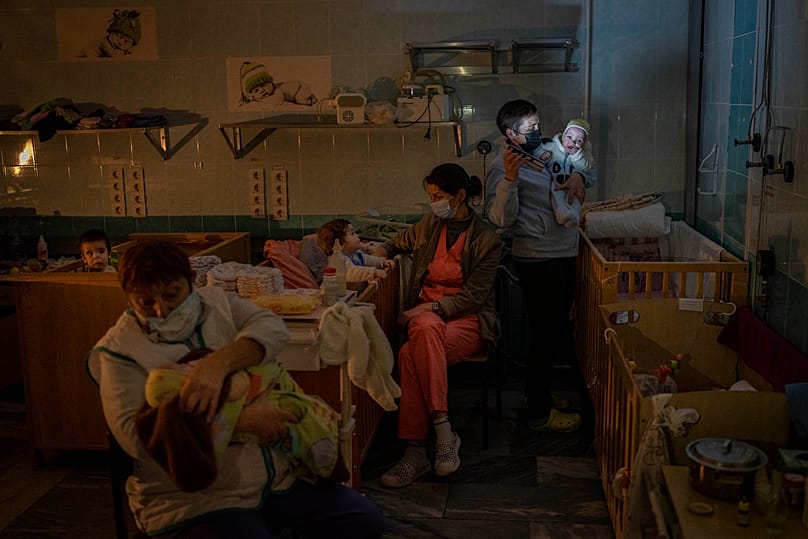
Vlad Buriak escaped the second and the third steps. He says after isolation in Vasylivka, he was “lucky” not to be transferred to Russia, and after 48 days of solitary confinement in a prison cell in Vasylivka, he was transferred back to Melitopol to a prison where he cleaned the torture chambers.
“I did not go to Russia. So it mostly about my luck as well," Vlad said.
Euronews spoke to Vlad on the eve of the fourth anniversary of Russia’s full-scale invasion. Now 20 years old, he repeatedly pointed out that his father, who was in Zaporizhzhia, was fighting to bring his son back.
Smaller children, who have been abducted by Russia, are much more difficult to return to Ukraine.
The younger the child is, the harder it is
Vlad was 16 years old when Russian forces abducted him.
Maksymov explains that at this age a person already “identifies as a Ukrainian”.
“He knows he or she knows who their his parents are, what school he or she went to, what the world is, what Ukraine is and what Russia is? They have this understanding of the context and they can clearly assess what has been happening to them," Maksymov said.
But when it comes to the youngest children, they do not have all of that. They're even before the formative years, so they do not have any self-perception.
“Another element of complication to this process is that it's easier to establish guardianship or forced adoption of a child that is younger because as a rule the younger the child is - the easier it is for adoptive parents to move forward.”
Ukrainian authorities recorded a significant number of cases when younger children, including those from children's homes, were put either on websites for adoption in Russia or have already been placed into Russian families inside Russia.
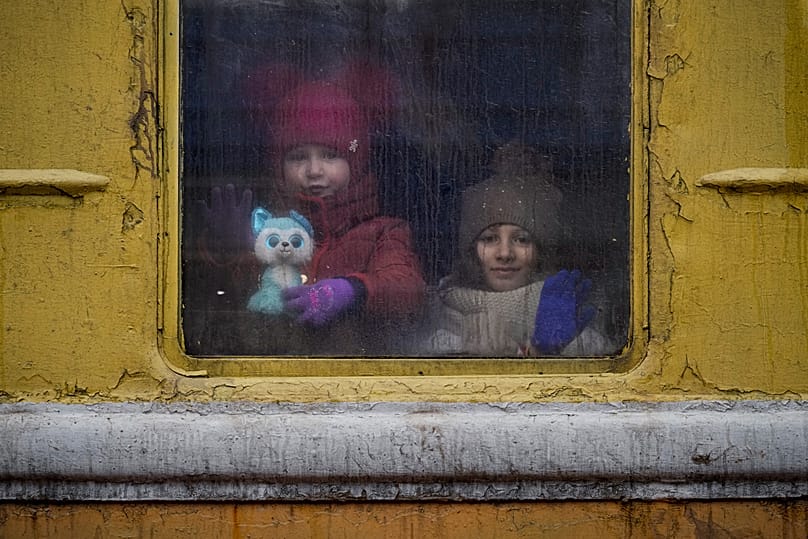
Euronews reported in summer 2025 that Russia-installed occupation authorities in Ukraine’s Luhansk region created an online “catalogue” of Ukrainian children, offering them for coerced “adoption” through the education department.
The database included 294 Ukrainian children, who were sorted and categorised so users could “filter” them by age, gender, and physical traits such as eye and hair colour.
The children were advertised for their character traits, with some described as "obedient" or "calm".
In numerous cases, the children were described as “polite and respectful towards the adults”, “disciplined” and “not conflictive” or “can be relied on to execute tasks”.
“One of the challenges with the youngest children is that they do not have yet self-perception or an identity, one may say.”
Reintegration and rehabilitation of Ukrainian children
Bringing back abducted Ukrainian children might start with identification, but it is not over when a child is crossing Ukrainian border, Maksymov said, insisting that reintegration and rehabilitation are ”the core pillar of the policy of the government of Ukraine”.
“If we do not ensure proper long-term recovery of a child or a young person who has been through a lot to say the least, then we are not able to restore the childhood and we're not able to restore the normal life for that person.”
The Ukrainian government established a framework for this process, he explained to Euronews.
For every person returned, whether a child under 18 or a young person aged 18 to 23 who was a child at the moment of the full-scale invasion, when they come back to Ukraine, the first thing that happens is that their needs are assessed.
“Do does this person need to be enrolled in education? Does this person need to have catch-up classes? What are the psychological needs? Does he or she need a therapist? Are there any medical needs? Do documents need to restored," Maksymov mentioned some of the concerns.
"Where would this person live? What is the family situation? Is this person an orphan or is there a family member waiting in Ukraine? All these needs are being assessed and what we call an individual protection plan is being designed.”
An individual protection plan is a document that outlines the needs of the returned child and how to meet them.
Maksymov explains that a case manager is assigned to every person who guides that person through the implementation of an individual production plan.
On top of that a team of specialists is being formed.
“Let's say if we speak about education, then there would be someone from the Ministry of Education. If there are medical needs, then there will be someone from the Ministry of health. If we're speaking about psychological rehabilitation, a psychologist would be involved etc etc etc.”
This plan is then implemented “in three strands of time: short-term, mid-term and long-term”.
After three months, an assessment is being made of how well the reintegration and rehabilitation are progressing, and, if needed, amendments are being introduced. Then the next checkup comes in 12 months and then in 18 months.
“There is a very important process of making sure that the kid or a young person are getting the necessary support, that they have a family structure to be supported in, and that they're getting back on the feet”, Maksymov insists, adding what he called a “critical and crucial element” of this work.
A significant number of the kids that are returning as orphans, whether they were orphans at the moment of the full-scale invasion and abduction, or they became orphans as a result of the full-scale Invasion.
“We are very proud that none of the returned children are placed in orphanages or institutions. For every single child, family-based care is being arranged, whether that is their own biological family or foster family or adopting family.”
He says this aspect is of utmost importance to Ukrainian officials, as well as the return process itself.
“Look at the broader purposes of Russia's invasion into Ukraine. It is obvious that it has never been about territories, villages or cities. It has always been about subjugating Ukraine, geopolitically, politically, culturally, economically. This is what the fight is all about.”
In this context, Russia does not necessarily need to explain. “Stealing children” has a broader meaning.
“Today Russia doesn't need to physically remove the children from certain area to another to steal them, because they can do that by reprogramming them on the spot.”
Then, through the policies of passportization, indoctrination and militarisation, the consequence is that the child or a young person is “torn apart mentally from Ukraine”.
“Subjugating the country and eroding the foundations of Ukrainian society is indeed one of the core purposes of Russia’s war against Ukraine," Maksymov concluded.