


















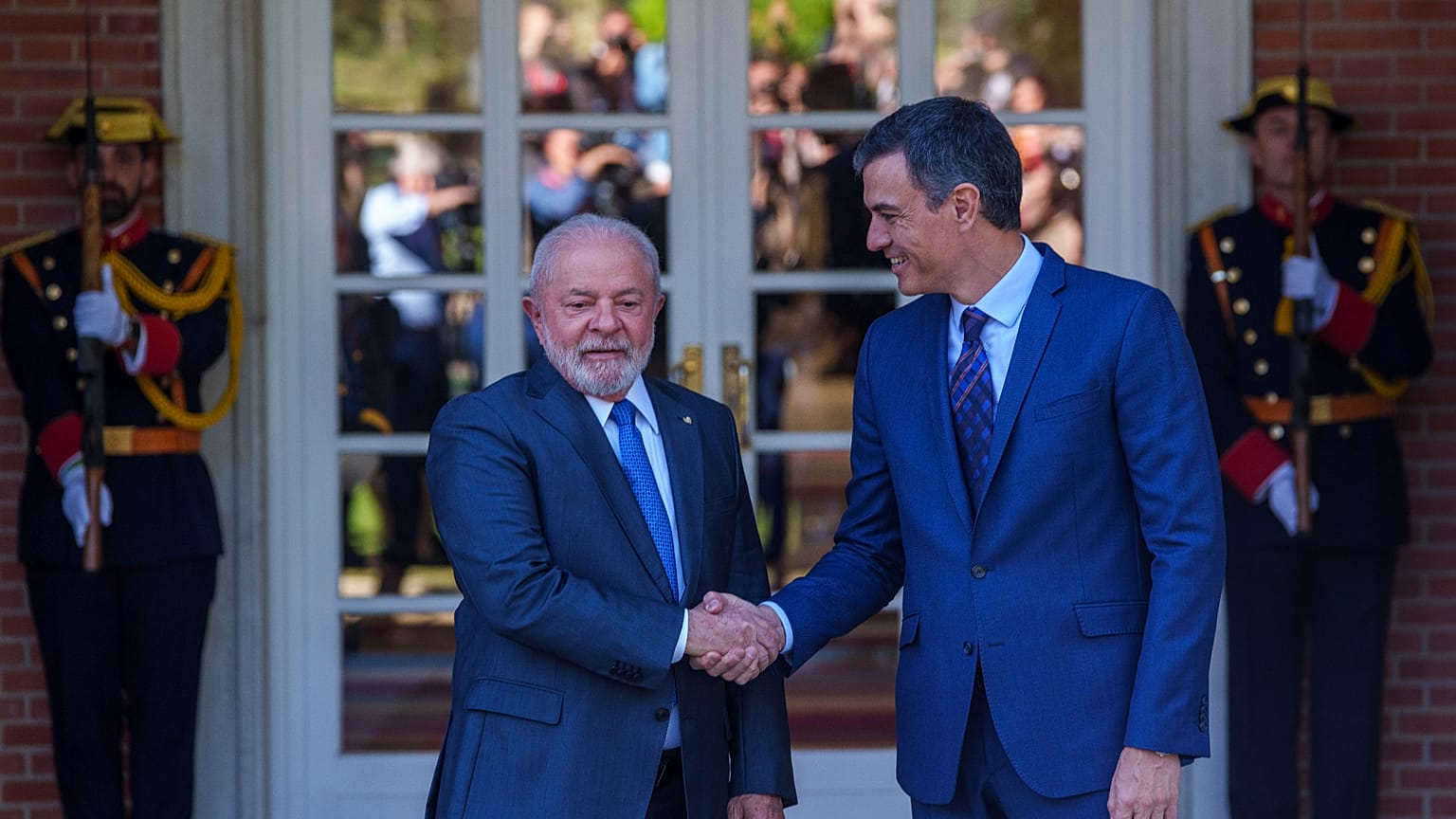














Spain, Brazil, Chile, Colombia, Mexico and Uruguay issued a joint statement rejecting 'the unilateral military operations in Venezuela' and warn against exploiting its natural resources. The signatories say the operation to oust Maduro was conducted in violation of international law.
The leaders of Spain, Brazil, Chile, Colombia, Mexico and Uruguay issued a joint statement on Sunday rejecting the US military operation that led to the ousting of strongman Nicolás Maduro and warned against the appropriation of the country's vast natural resources after the US said it would run Venezuela on the interim.
The six signatories, including Spanish Prime Minister Pedro Sánchez and Brazilian President Luiz Inácio Lula da Silva, said the US military operation had violated the "basic principles of international law, in particular the prohibition of the use of force and respect for territorial sovereignty established in the United Nations Charter."
"These actions constitute a dangerous precedent for peace, regional security and pose a risk to the civil population," the joint statement added. "We reiterate that the situation in Venezuela must be resolved exclusively through dialogue and in accordance with the will of the Venezuelan people, without interference and adhering to international law."
On Saturday, the US Delta Force captured Maduro and his wife, Cilia Flores, after a spectacular raid on his fortified compound in Caracas. Maduro is currently held at a New York prison where he faces US charges of drug trafficking, narcoterrorism, conspiracy to introduce drugs into the United States and possession of machine guns.
President Donald Trump described the operation as "brilliant" and said the US would "run Venezuela" until a transition that is "safe, proper and judicious" can take place without giving further details. Critics say the operation was conducted against international law.
The Trump administration doubled down on Sunday calling it a success.
Call for dialogue and concern for 'appropriation' of resources
In the statement, Spain and the five Latin American co-signatories also expressed their concerns about the exploitation of Venezuelan natural and strategic resources, which they also say would be incompatible with international law and sovereignty.
"We express our concern over any attempt to control, through government or administrative means, as well as the external appropriation of the natural and strategic resources (of Venezuela), which are incompatible with international law and pose a threat to the economic, political and social stability of the region," it said.
In a press conference, Trump said the US would run Venezuela on the interim, without giving a deadline or details about the practicalities on the ground, and made multiple references to the huge potential of Venezuela when it comes to oil extraction.
"We're going to rebuild the oil infrastructure, which will cost billions of dollars. It will be paid for by the oil companies directly. They will be reimbursed for what they're doing, but that's going to be paid," Trump told reporters Saturday.
Venezuela holds the world's largest oil reserves.
Chevron, the US energy major, operates within Venezuela under a special license.
Europe walks fine line as US says it 'will run Venezuela'
Meanwhile, the European Union has called for restraint and respect for the UN Charter but has been careful not to criticise openly the operation or Trump's handling of it.
German Chancellor Friedrich Merz said on Saturday that "the legal assessment of the US intervention is complex and requires consideration," while suggesting that the focus should be placed on consolidating a democratic transition in Venezuela.
French President Emmanuel Macron did not comment on the details of the operation, saying instead that the Venezuelan people "can only rejoice" after the ousting of Maduro and his "dictatorship" while signaling that Edmundo González, who ran against Maduro in an election in 2024 and was forced into exile, should play a swift role in the transition.
Spanish Prime Minister Sánchez, however, has aligned with Latin American left-leaning governments like Brazil and Mexico, saying that Madrid cannot recognise "an intervention that violates international law the same way we could not recognise the Maduro regime."
Spain has deep historical ties and business interests in Latin America.
The EU did not recognise the results of the July 2024 election which international observers say was rigged through massive electoral fraud under Maduro's instructions.
His rival, Edmundo González, had to flee Venezuela in the aftermath and María Corina Machado, the leading opposition figure who was barred from running in the election by the regime, was forced into hiding. Machado won the Nobel Peace Prize in 2025.