




























Spain hopes to become Europe's green hydrogen leader, backed by its renewable resources. What is it, what is it for and what hurdles lie ahead?
For decades, Spain has relied on oil and gas from abroad. What was once an energy disadvantage could now turn into an opportunity. Sun, wind and plenty of room to generate renewable electricity on a large scale put Spain in a privileged position for a still nascent industry: green hydrogen.
 ADVERTISEMENT
ADVERTISEMENT
ADVERTISEMENT
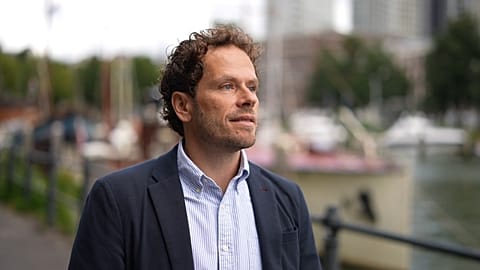
"Spain has always had the disadvantage of not having oil or gas," Maarten Wetselaar, Moeve's chief executive, tells "Euronews". "But now it is Spain's moment because it has abundant solar power, very good wind resources and space to build large renewable parks."
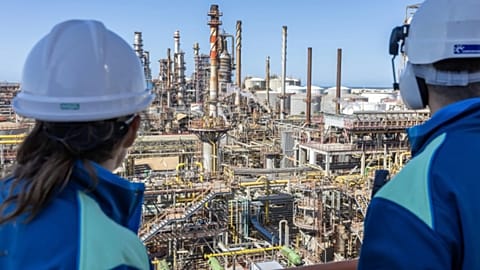
The former Cepsa wants to make the most of that combination. The company has just begun in Palos de la Frontera, Huelva, construction of Onuba, the first phase of the Andalusian Green Hydrogen Valley: more than 1 billion euros of investment in a project that will start with 300 megawatts (MW) of electrolysis capacity.
The plan goes far beyond a single plant. Spain wants to use its renewable resources to build a new industry, cut its energy dependence and, in the longer term, become an energy supplier to other European countries.
But what exactly is green hydrogen? Why does Spain believe it can produce it competitively? And what obstacles still have to be overcome before that ambition becomes reality?
What is green hydrogen?
Although it is often described as one of the energies of the future, hydrogen is not a primary energy source like the sun or the wind. It is an energy carrier: energy has to be used to produce it.
Hydrogen has been used for decades in refineries, in the chemical industry and to make products such as fertilisers. The problem is that most of it is still obtained from fossil fuels. So-called grey hydrogen is mainly produced using natural gas, a process that generates CO2 emissions.
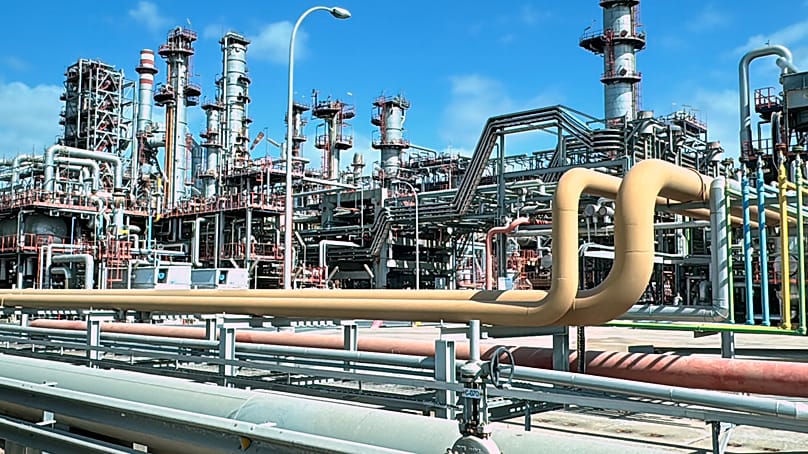
Green hydrogen changes how it is produced. Through a process known as electrolysis, an electric current splits water molecules into hydrogen and oxygen. If the electricity used comes from renewable sources such as solar or wind, we refer to renewable, or green, hydrogen.
And that is where Spain's first advantage comes in. Producing it requires vast amounts of electricity. According to Wetselaar, power accounts for roughly 70% of the cost of green hydrogen. "If you go to the place in Europe where (renewable electricity) is cheapest, which is the Iberian Peninsula, then your green hydrogen will be very, very competitive," the Moeve CEO says.
"Spain is a huge source of renewable energy and therefore can be and will be Europe's leading producer of green hydrogen," he adds. It is an ambitious forecast by the company, and there are still major hurdles before it can come true. But it helps explain why businesses and public authorities are channelling multi-billion-euro investments into this technology.
If we have renewable electricity, why do we need hydrogen?
This is one of the fundamental questions. Whenever it is possible to use renewable electricity directly, doing so is usually more efficient than using that electricity to make hydrogen and then using the hydrogen as an energy source. The aim is therefore not to replace fossil fuels with hydrogen across the board.
Its main potential lies in sectors that are hard to electrify directly. Certain processes in heavy industry, chemical production and parts of maritime and air transport need alternatives to fossil fuels that batteries cannot always provide in a practical way.
Hydrogen can also be used to produce derivatives such as ammonia or synthetic fuels.
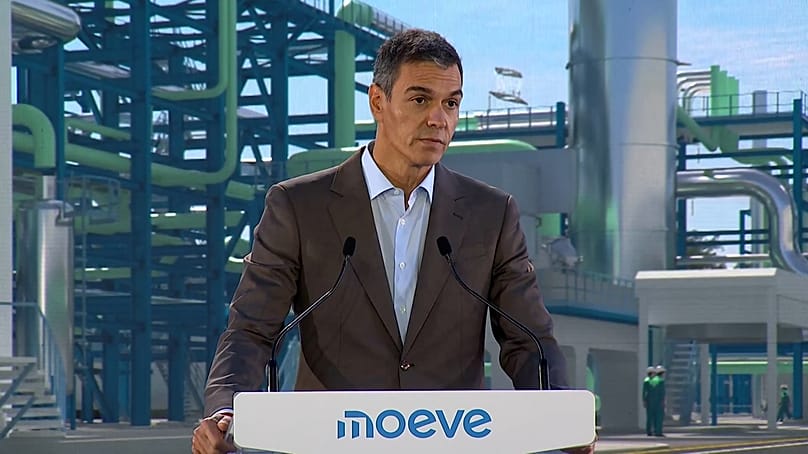
Spain's prime minister, Pedro Sánchez, argued at the Huelva project launch that this technology can help cut emissions from activities that still depend on oil and gas. But he also framed the bet in economic terms.
"This transformation is therefore not only about protecting ourselves better against crises, which is also very significant. It is also about seizing a huge industrial opportunity," he said.
Huelva, a testing ground for Spain's bet
That opportunity is beginning to take shape in places such as Palos de la Frontera. Onuba will initially have 300 MW of electrolysis capacity and can later be expanded by another 105 MW. Moeve estimates it will produce around 45,000 tonnes of renewable hydrogen a year.
The location is no accident. As well as having abundant renewable resources, Huelva has industrial activity, port infrastructure and potential consumers of that hydrogen relatively close to where it will be produced.
Moeve's ambition is subsequently to scale the entire Andalusian Green Hydrogen Valley up to 2 GW of capacity, with facilities in Huelva and Cádiz. "By connecting Huelva with other industrial areas in Europe, whether through pipelines or maritime solutions, we will be able to expand this plant from the 300 megawatts we are currently building to 2 gigawatts and beyond," Wetselaar explains.
The aim, he adds, is to "truly create a new industry in Spain".
The big unknown: can it compete on price?
This is where one of the biggest obstacles emerges. Producing green hydrogen is still generally more expensive than obtaining conventional hydrogen from fossil fuels, although the gap depends on factors such as the price of gas, the cost of electricity, taxes on emissions and the specific conditions of each project.
Wetselaar argues that the current energy context is narrowing that gap. "Green hydrogen is competitive with grey hydrogen today, partly because the price of gas is very high," he says.
His bet is that the increase in production will bring down the cost of electrolysers and of the installations, in a similar way to what has happened previously with technologies such as solar and wind.
"As the cost of producing green hydrogen falls with the scaling up of the industry, those lines will cross and green hydrogen will become not only a clean energy source, but also highly competitive for Europe," he maintains.
But that trajectory is not guaranteed. For costs to come down, large-scale projects have to be built. And for companies to invest billions in such projects, they need to know there will be enough customers willing to buy the hydrogen they produce.
Safety and the risk of leaks
The move towards large-scale production of renewable hydrogen also raises questions about the safety of the facilities and, among them, the prevention and detection of possible leaks. Hydrogen is a highly flammable gas and, because of the small size of its molecules, requires particular attention to the tightness of equipment, pipes and connections. In enclosed spaces, a leak can also create a flammable atmosphere if it reaches certain concentrations.
Moeve says its strategy is precisely built around preventing such leaks from occurring in the first place. "We understand that the development of renewable hydrogen must go hand in hand with the highest safety standards, drawing on decades of real industrial experience in handling this molecule at the La Rábida Energy Park," María Olavarría, head of the Production Department at Moeve's La Rábida Energy Park, tells "Euronews". She explains that the new facilities are designed to be leak-tight and feature several independent layers of protection aimed at preventing incidents.
The company argues that this approach prioritises prevention over a strategy based solely on reacting once a leak is detected. "Our priority is that there are no leaks, rather than relying on detecting them afterwards," Moeve says. The firm adds that, as an additional barrier, it has automatic monitoring and detection systems designed to quickly identify anomalies during operation.
The government wants to turn it into a "national project"
Spain is not leaving the development of this industry solely to the private sector. The government has made renewable hydrogen one of the pillars of its energy and industrial strategy and has raised the electrolysis capacity target for 2030 to 12 GW.
Sánchez describes it outright as "a true national project". The prime minister said in Huelva that the government has allocated more than 3 billion euros to over 120 renewable hydrogen projects. Moeve's project alone has received more than 300 million euros in public support.
The strategy is also not just about producing the molecule. "We do not only want to generate molecules (...) of green hydrogen," Sánchez explained. "We aim for it to be produced with electrolysers, valves, compressors and the rest of the equipment manufactured here in Spain."
The goal is therefore to develop a value chain around hydrogen, from the equipment needed to produce it to the infrastructure required to store and transport it.
From importing fuels to exporting energy
There is another reason behind this race: energy security. The geopolitical crises of recent years have once again exposed how vulnerable Europe is when it depends on oil and gas from other countries. "What we need in Europe is European energy that is decarbonised, that is secure and that we produce ourselves," Wetselaar tells "Euronews".
For Spain, this ambition means reversing the traditional energy flow. Instead of importing fossil fuels, the country aims to generate renewable energy, convert it into hydrogen and its derivatives, and supply both its own industry and, eventually, other European markets.
"If this country can become, for the first time in its history, an exporter of energy, its relationship with the rest of Europe changes for the better," the Moeve CEO argues. Achieving that will require building infrastructure that does not yet exist at the necessary scale.
One of the key projects is H2Med, the corridor that aims to link the hydrogen networks of Portugal and Spain with France and, from there, with Europe's major industrial centres.
Can Spain really lead Europe's green hydrogen?
Spain has some obvious advantages: abundant solar and wind resources, the capacity to keep rolling out renewables, industry, ports and a strategic geographical position. There is also a strong public and private commitment. But leadership is not guaranteed.
Renewable hydrogen still accounts for a very small share of global production. Costs remain high, new transport and storage networks are needed, and sufficient industrial demand has yet to materialise to justify many of the investments announced.
It will also be necessary to produce much more renewable electricity. Green hydrogen can only contribute to decarbonisation if the vast amount of power it requires genuinely comes from new clean sources.
The construction of Onuba shows that some of Spain's major projects are starting to move from announcements to bricks and mortar. The hardest test now begins: proving that they can produce at scale, find enough buyers and do so at a competitive price.
If Spain manages to solve that equation, its sun and wind could allow it to turn one of its historic weaknesses (dependence on imported energy) into an advantage in the new European energy landscape.