














Newsletter Newsletters Events Events Podcasts Videos Africanews
Loader
Advertisement

Staged claims and Israeli hoaxes: Debunking viral conspiracy theories about hantavirus

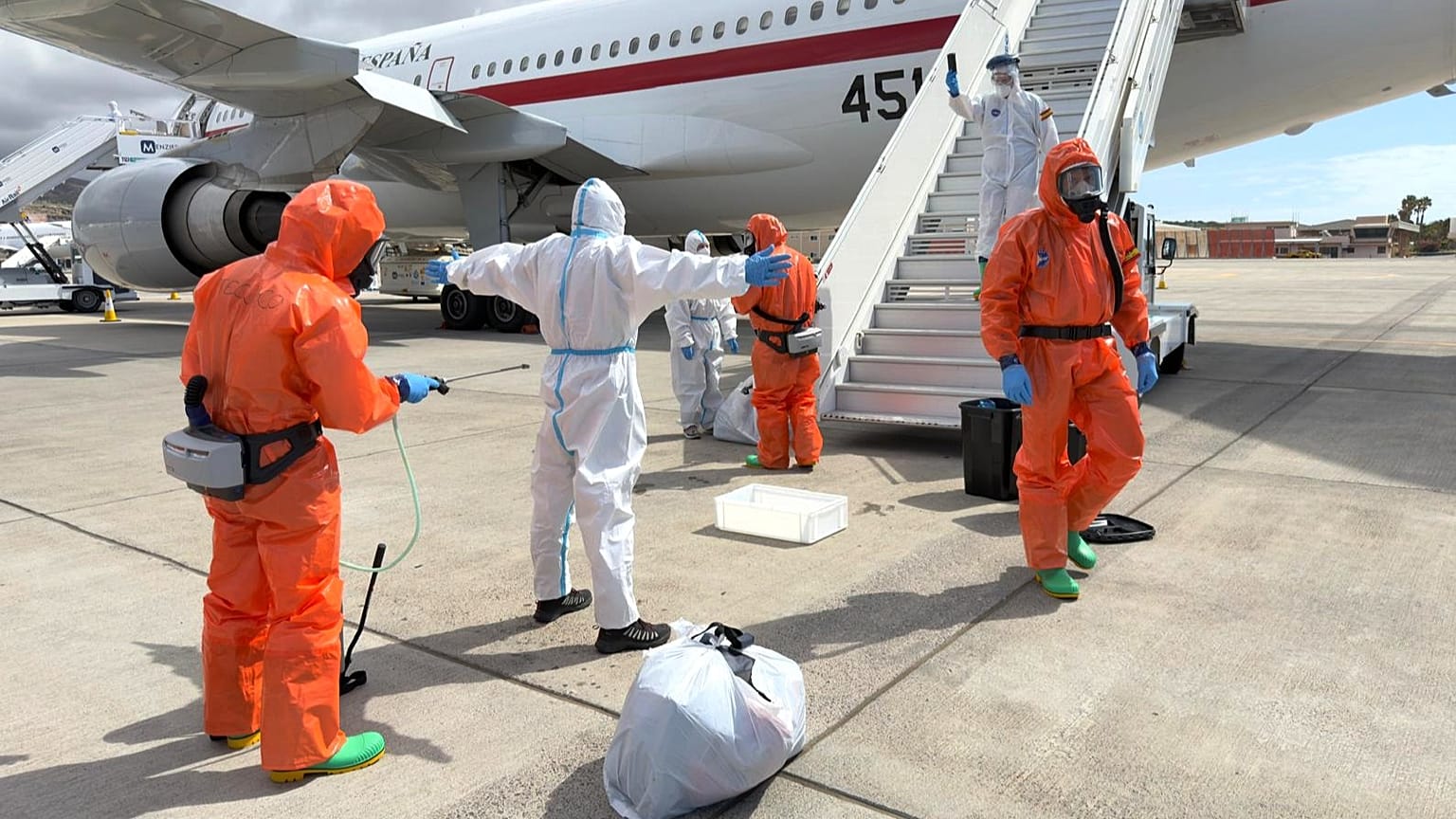
A Spanish passenger is sprayed with disinfectant by Spanish government officials before boarding a plane after disembarking from the MV Hondius, Spain, Sunday, May 10, 2026.
A Spanish passenger is sprayed with disinfectant by Spanish government officials before boarding a plane after disembarking from the MV Hondius, Spain, Sunday, May 10, 2026. Copyright  AP/Copyright 2026 The AP. All rights reserved.
Copyright AP/Copyright 2026 The AP. All rights reserved.
By Estelle Nilsson-Julien & Tamsin Paternoster
Published on Updated
Share Comments
Share Close Button

Misinformation about hantavirus has run rampant on social media, with online users reviving viral COVID-19 theories to spread fake news about the outbreak.

From conspiracy theories claiming that the term "hantavirus" is derived from Hebrew, to claims that big pharma groups created the virus to drive up vaccine profits, a slew of false claims about the pathogen have emerged on social media in recent weeks.

ADVERTISEMENT
ADVERTISEMENT

The hantavirus outbreak occurred aboard the MV Hondius ship, which set sail from Argentina on 1 April, before it docked on the island of Tenerife in the Canary Islands on 10 May.

Eleven people aboard the MV Hondius fell ill, with at least nine confirmed cases. Three passengers on the cruise died, including a Dutch couple who health officials believe were the first exposed to the virus while visiting South America.

Hantavirus contamination typically occurs when humans come into contact with rodent droppings, urine or saliva, while infections can be subsequently passed on through humans.

Antiparasitic drug ivermectin is not a cure for hantavirus

Across social media, a number of users have spread misleading statements, alleging that the antiparasitic drug ivermectin — which was also falsely touted as a cure for COVID-19 — can be used to treat hantavirus.

Figures like Marjorie Taylor Greene, a former Trump loyalist and congresswoman, who is known for spreading conspiracy theories was among those who shared such claims.

However, the use of ivermectin as a hantavirus cure is not backed by scientific evidence — as with coronavirus — as the European Medicines Agency confirmed to Euronews.

"The EMA has not seen any evidence indicating that ivermectin, which is used to treat infections caused by parasites, is effective against hantaviruses."

"In fact, there are currently no authorised treatments- antivirals or vaccines - for hantavirus, and clinical management relies on supportive care and early access to critical care facilities."

Moderna did not 'stage' the outbreak

Separately, online users have framed the fact that US pharmaceutical company Moderna has been been working on a project to develop a vaccine against hantaviruses, as suspicious.

"What is also weird is Moderna has been working on a Hantavirus for a year - as if they knew a virus was going to be rolled out", claimed one X user in a post which has garnered thousands of views.

They have framed this as evidence that the company played a part in calculating the current outbreak – echoing past conspiracy theories which emerged during the COVID pandemic.

"You’ll never guess who has been working on an mRNA hantavirus vaccine…", stated one user in a post shared on X, which has garnered more than 4 million views.

The post attached a screenshot of an article published in July 2024 about a collaboration by Moderna and a Korean university to develop a hantavirus vaccine.

However, this is not an anomaly, but instead a routine part of public health responses.

"The fact that Moderna was working on early hantavirus vaccines reflects the fact that this virus has been a well-characterised threat for decades", Amesh Adalja, senior scholar for Johns Hopkins Centre for Health Security told Euronews.

In reality, it is standard industry practice for pharmaceutical companies like Moderna to work on vaccines for pathogens like hantavirus, which have been around for decades.

As for the research collaboration between Korea University’s Vaccine Innovation Center and Moderna, it is still in the preclinical stages, meaning that human trials are not yet a realistic prospect.

Claims that the word "hantavirus" is derived from Hebrew

Social media users have been asking Grok — X's AI chatbot — to explain what the word "hanta" (or chantah) means in Hebrew. In some instances, posts asking "Hey @grok, what does ‘Hanta’ mean in Hebrew?" have racked up millions of views.

While Grok responded by claiming that "hanta" means "a scam, fraud, nonsense, lie, or something fake" in Hebrew, it later corrected itself by stating that the word social media users are referring to is in fact “khartah” (or chartah, חרטה).

This term used as slang in Hebrew is originally derived from Arabic.

These publications claiming that the word for fake in Hebrew coincides with "hanta" have been used as evidence to support conspiracy theories which blame Israel for the outbreak or to claim that the virus is a hoax.

"Draw your own conclusions whether claims that Hantavirus is a Zionist scam is Hantasemitism or not", stated one account.

Ultimately, the name of the hantavirus has nothing to do with any of this.

Instead, researchers say the term stems from an illness that first developed among UN troops during the Korean War in the 1950s, which was called the "Korean hemorrhagic fever.”

Two decades on, in the 1970s, scientists identified a virus living in field mice living near the river, giving way to the "Hantaan virus" name. As more related viruses were discovered, they were collectively called "hantaviruses."

Go to accessibility shortcuts
Share Comments

Read more

Are hantavirus cases spreading? French woman in critical condition in hospital

Hantavirus: Macron says situation is 'under control' in France and calls for European coordination

What we know about the presumed hantavirus patient zero