





























Despite rising travel costs and ongoing economic uncertainty, Europeans’ appetites for a summer getaway hasn’t curbed in the least. With these tips, the long awaited holiday season can stretch euros further when abroad – even if that means being closer to home.
The summer holidays are on the horizon and soon enough we’ll all be complaining of the hottest temperatures since records began and the noticeable scarcity of air conditioning. But alongside the heat comes another headache: the rising costs of travel.
 ADVERTISEMENT
ADVERTISEMENT
ADVERTISEMENT
With soaring jet fuel fears, thousands of flights being cut and airlines quietly passing additional costs onto passengers, many of us will not be forced to think how, and where, we’ll spend our holidays this year.
So, are Europeans abandoning travel plans altogether, or simply learning how to do so slightly differently?
The Mastercard Economics Institute (MEI)’s annual Travel Trends Report 2026 found that the continent continues to attract strong demand globally despite ongoing geopolitical and economic pressures.
Cities such as Paris, Amsterdam and Brussels ranked in the top three among 10 destinations, continuing to record year-on-year growth in the percentage of scheduled seats from international travel. Barcelona, Madrid and Frankfurt also recorded strong gains in inbound travel.
“Against a backdrop of continued geopolitical uncertainty, Europe’s travel economy has shown resilience thus far,” said Natalia Lechmanova, Chief Economist Europe at Mastercard.
Affordability, however, is a key driver in how travellers are making decisions. Rising costs for transport and accommodation, fluctuating international exchange rates and shaky income growth are impacting destination choices and how many trips people are taking in one stint.
“As travel patterns normalise, Europeans are placing greater emphasis on value, affordability and experience-led journeys,” Lechmanova added.
“Our data shows that Europe’s enduring appeal continues to anchor global travel demand, even as the geopolitical backdrop, currency shifts and wider economic conditions increasingly shape how and where people choose to travel.”
As many as 77% of Europeans remain resolute in their travel plans for this summer, according to findings from a Europ Assistance's 2026 Holiday Barometer survey of 26,000 people, conducted with Ipsos.
Countries like the UK and Portugal ranked highest among the Europeans with a desire to travel this year, with 84% and 82% of respondents having plans to do so. Even in countries where enthusiasm was on the lower end, such as in Germany and Belgium, 70% and 72% of respondents were still considering travel.
Air versus land travel
Research by Raisin, a savings and investment platform, found that travellers are paying an average of 13.1% more for airfares across nine European destinations when flying from Amsterdam Schiphol Airport.
The average cost of flights for a family of four – excluding baggage fees – has risen from €808 last year to €914 in 2026. Vienna was the only destination surveyed where prices fell, declining slightly from €987 to €968.
One solution may lie in no-frills flying. Low-cost carriers continue to promote travel at a cheaper rate but without the perks of carry-on bags, checked baggage or seat reservation. However, for an additional fee, these can all typically be added by carriers upon request.
For a carrier like EasyJet, this model seems to keep passengers happy. The British low-cost carrier told Euronews Travel: “40% of our customers travel having paid the fare only, which includes a small cabin bag for free.
“EasyJet’s options and pricing are transparent and well understood by our customers. We allow them to pay for only what they want and no more, instead of all customers having to pay for things they don’t want or need, which keeps our fares lower for everyone.”
Other travellers may choose to avoid flying altogether.
Raisin's research found that train fares from Amsterdam Central Station increased by only 2.5% from last year. Train travel was also found to be cheaper on nine out of the 10 routes surveyed, with the exception of a train trip to London costing more than by air.
Jasper Berkhout, a researcher at Raisin, advised travellers to shop around and compare rates from different providers and websites.
“On comparison sites, you can often select a box to include nearby airports in your search,” he said. “For trains, it pays to book in advance; carriers like Deutsche Bahn, for instance, offer a ‘Sparpreis’ [significantly discounted ticket] with substantial discounts.”
The UK Post Office has also advised train travel over flying – including keeping an eye out for deals via the Eurostar to cities such as Paris, Amsterdam, Brussels and Rotterdam.
Are package holidays a safer bet?
With a reported 13,000 flights being cancelled in May alone, due to the jet fuel crisis, some passengers may have delayed in booking their summer trips.
Rory Boland, editor of consumer website Which? Travel, said it is “understandable that holidaymakers are feeling apprehensive” about their summer travel plans due to the wave of cancellations. He added: “Our advice for this summer is to book a package holiday, as that is the best way to protect the full cost of your holiday should greater disruption occur.”
Home or away?
In 2024, as many as 1.19 billion personal and professional trips were made by Europeans, with a staggering 92% being intra-European voyages, according to Eurostat. The research also found that typically, holiday expenditures on foreign trips outside of the continent were 40% more expensive compared to domestic trips.
To make your money stretch further when travelling on the continent, The UK Post Office advises travellers to do plenty of digging in advance: "Although flights to some European destinations may be cheap, the city itself might be expensive on arrival."
Other key advice includes walking over hailing a taxi, dining on local street food rather than at packed touristy restaurants and cafes as well as preparing for potential unexpected expenses, such as applying for a free Global Health Insurance Card. For UK travellers, it's a gateway to lower cost emergency medical care across the EU.
Staycations and shorter distances
Data from Airbnb has shown that 25% of travellers in countries including France, Germany, Sweden, Portugal and the Netherlands will be embracing staycations in 2026. Those who are going abroad are travelling shorter distances.
In Sweden, for example, the median booking distance has dropped 26% since 2023 and is now under 500 kilometres. Another trend on the rise is splitting the cost of travel across a larger group, with bookings of four people or more up across Portugal, Spain and Sweden.
When’s the best time to book?
In its Smarter Summer Report, Skyscanner revealed the best times to book. According to the flight comparison website’s data, the key dates for your calendar are 29 June to 5 July for the cheapest week of summer travel in 2026.
“If you’ve ever muttered ‘maybe I’ll just wait and see’, this is your cue to stop waiting and start scrolling,” Skyscanner said. “Your ideal travel window might be closer (and cheaper) than you think.”
While the Post Office earmarked Tuesday as one of the cheaper days to travel, Skyscanner believes it’s a Friday, highlighting that “there’s timing a holiday – and then there’s perfectly timing a holiday”.
Skyscanner’s report also looks out for travellers on a budget. “June and September are summer’s quieter overachievers,” the site said. “You still get the sunshine, but with lower prices, shorter queues and a much easier shot at that dinner reservation. It’s the best of summer, with a bit more breathing room.”
If you're after cheap flights in June from the UK, the site recommends Poprad in Slovakia, where the average ticket will be around £55 (€63.50). Other budget-friendly options in Europe include Szczecin and Lublin in Poland, with the flights expected to cost £59 (€68.12) and £62 (€71.59) respectively.
In September, which is slightly cheaper than in June, a flight to Poprad will cost £54 (€62.35) on average. Tickets to Dortmund in Germany will be around £58 (€66.97), while Lodz and Szczecin in Poland are £65 (€75) and £69 (€79.68) respectively.
Europe’s cheapest city breaks
Eastern Europe continues to dominate Europe’s best-value city breaks for 2026, according to the latest City Costs Barometer by the UK’s Post Office Travel Money.
In its biggest comparison yet, the report analysed the cost of 12 everyday tourist items for two people across 50 European cities, including meals, drinks, attractions, airport transfers and two nights in three-star accommodation.
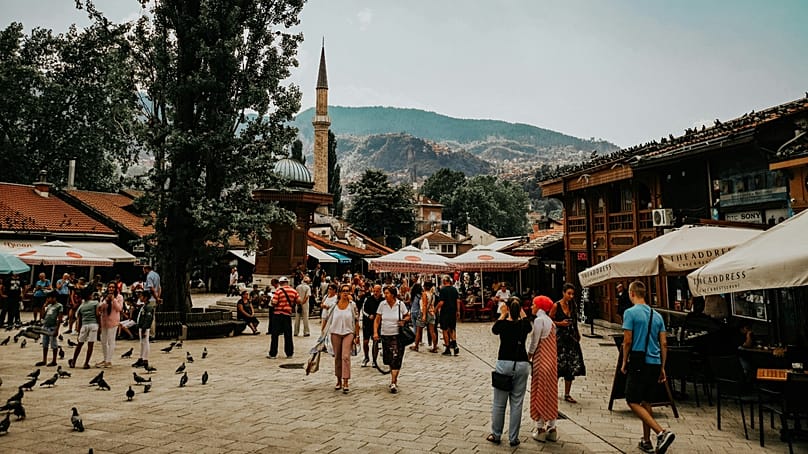
For the first time, Sarajevo topped the rankings as Europe’s cheapest city break, praised for its low-cost accommodation, affordable transport and good-value cultural attractions. Bucharest, Tirana and Belgrade also ranked highly.
Top 10 best value European city breaks
- Sarajevo, Bosnia and Herzegovina: £248/€287
- Bucharest, Romania: £258/€299
- Tirana, Albania: £263/€304.50
- Belgrade, Serbia: £265/€307
- Trenčín, Slovakia: £272/€315
- Riga, Latvia: £278//€322
- Lille, France: £289/€334
- Vilnius, Lithuania: £289/€334
- Strasbourg, France: £319/€369
- Podgorica, Montenegro: £332/€384.50