














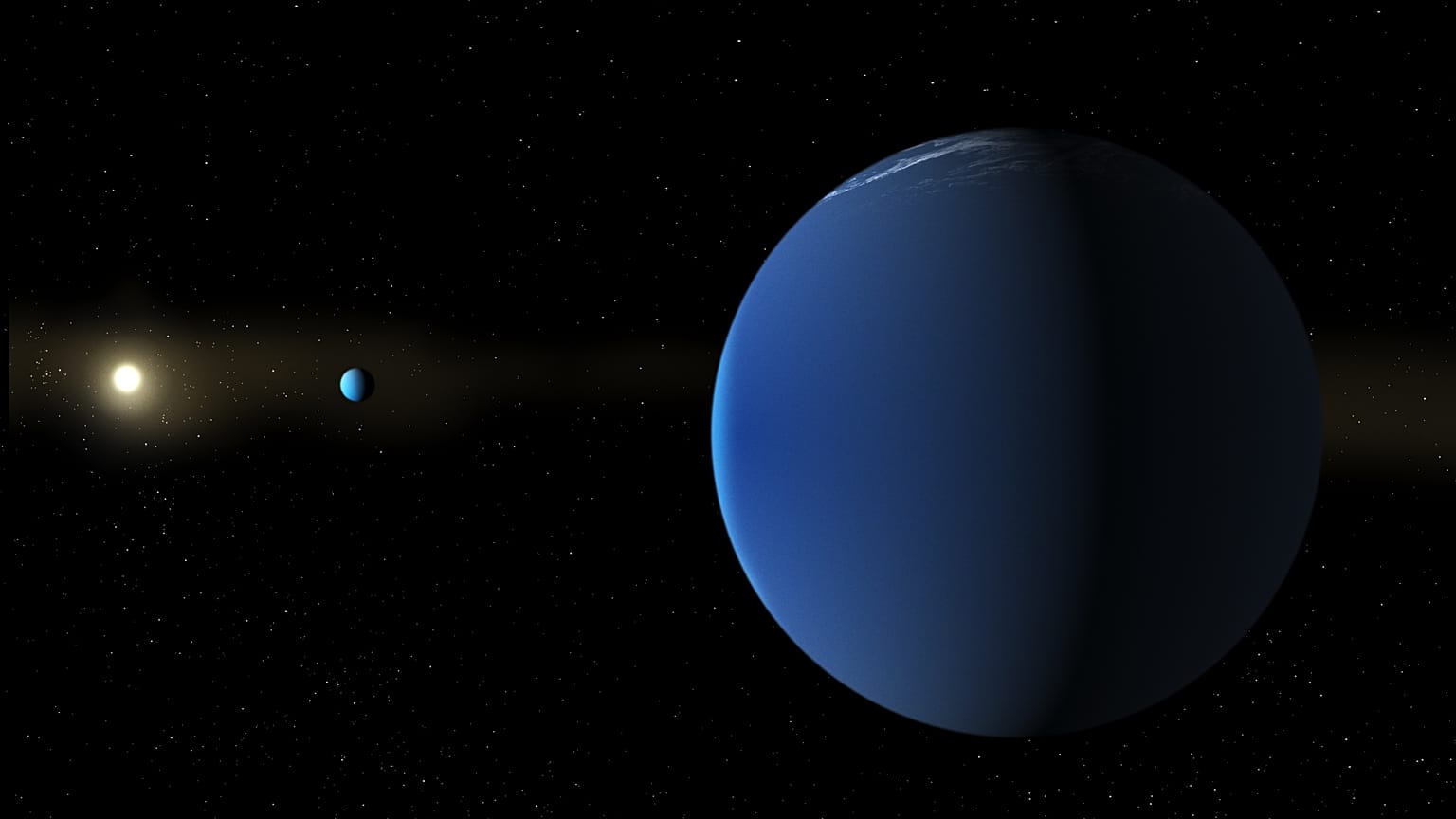













The two planets orbiting a star 1,110 light-years away are the biggest exoplanets ever found with a density lower than cotton candy, and may be mostly made of hydrogen and helium.
Astronomers have discovered a pair of giant planets lighter than cotton candy, or "super-puffs," the size of Jupiter orbiting a star more than 1,000 light-years away.
 ADVERTISEMENT
ADVERTISEMENT
ADVERTISEMENT
The featherweight duo are the biggest exoplanets ever found with such a low density, making them the lightest known planets of their size, according to George Dransfield of the University of Oxford, who led the research.
"These two planets have densities comparable to a nice blob of shaving foam, fresh from the can," Dransfield said. She and her team published their findings in Monthly Notices of the Royal Astronomical Society.
Dransfield suspects the planets are probably white or blue depending on the cloud cover — not cotton-candy pink. They are likely composed mostly of hydrogen and helium, though follow-up observations by NASA's Webb Space Telescope will be needed to confirm their chemical makeup.
Detected by NASA's TESS satellite, the two planets orbit a star in the southern constellation Volans, known as the flying fish, some 1,110 light-years away. A light-year is roughly 9.7 trillion kilometres.
Jupiter, by comparison, is up to 35 times denser than the pair.
Super-puffs are considered rare. Fewer than 40 have been confirmed among the nearly 6,300 exoplanets catalogued by NASA to date. They are thought to form in gas-rich discs around newborn stars, shedding much of their material over time.
"Ultimately, by studying exotic systems containing rare planet types, we add further pieces to the puzzle of planet formation and learn more about our place in the cosmos," Dransfield said.