

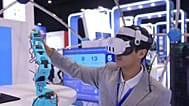






























At Hong Kong’s InnoEx fair, Chinese firms showcased humanoid robots that box, guide tours, dance on stage and promise emotional support and learning.
Chinese companies are showcasing more than 100 humanoid robots at a technology fair in Hong Kong, demonstrating machines that can box, dance and interact with visitors using synthetic skin and artificial intelligence.
 ADVERTISEMENT
ADVERTISEMENT
ADVERTISEMENT
The InnoEx tech fair opened on Sunday at the Hong Kong Convention and Exhibition Centre, running until Wednesday as part of the city's Business of Innovation and Technology Week.
Among the exhibitors are four of the world's five best-selling humanoid robot manufacturers in 2025 — AgiBot, EngineAI, UBTech and Unitree — according to technology research group Omdia.
Hangzhou-based robotics firm Unitree drew crowds with its G1 robot, which boxes with visitors wearing gloves and a full outfit.
At the Shenzhen DX Intech Technology stand, visitors reached out to touch the robots' faces, feeling their soft synthetic skin.
The company said some of its robots were already in use in museums and government venues across mainland China, guiding visitors and leading tours.
Novautek presented a more conventional, robot-like design, with a screen-based face.
The company said it envisioned a future in which robots would be programmed with distinct personalities and could provide emotional support and teaching skills.
When asked where it learned its knowledge, one robot replied, "My knowledge comes from a big omniscient brain inside me, like a comprehensive encyclopaedia”.
“I also keep learning and evolving through large model technology to answer various questions," the robot added.
Crowds cheered as Shenzhen-based EngineAI demonstrated its PM01 robot flipping, rolling and dancing on stage.
The company said it has plans to open two factories in China this year to scale up mass production.
EngineAI said that people may one day prefer interacting with robots to humans.
“(The robots will make) the human to believe 'I prefer to talk to the robot, than a salesperson,’” said Robert Chan from the company’s global strategy office.
“A salesperson is biased, the salesperson will convince me to make a decision for his advantage, will hide certain information,'" Chan added.
Heavy investment to compete with US
Chan said Beijing benefited from strengths such as low-cost engineering. He also pointed to a culture of knowledge exchange between companies, in contrast to Europe and the US, where firms tend to guard their technology more closely.
Robotics is becoming part of a wider technological rivalry between China and the United States, with growing national security implications.
Official data show that China had more than 140 humanoid robot manufacturers and over 330 models in 2025.
Accelerating the development of technologies such as humanoid robots is a priority in Beijing’s latest five-year plan, which has pledged to “target the frontiers of science and technology”.


