




























Your Gmail inbox is getting an AI-powered update. Google announced new AI features to help users write emails, summarise information, and create to-do lists.
More artificial intelligence (AI) is being implanted into Gmail, as Google tries to turn the world's most popular email service into a personal assistant that can improve writing, summarise far-flung information buried in inboxes, and deliver daily to-do lists.
 ADVERTISEMENT
ADVERTISEMENT
ADVERTISEMENT
The new AI features announced Thursday could herald a pivotal moment for Gmail, a service that transformed email when it was introduced nearly 22 years ago. Since then, Gmail has amassed more than 3 billion users to become nearly as ubiquitous as Google's search engine.
Gmail's new AI options will only be available in English within the United States for starters, but the company is promising to expand the technology to other countries and other languages later this year.
The most broadly available tool will be a “Help Me Write” option, designed to learn a user's writing style so it can personalise emails and make real-time suggestions on how to polish the message.
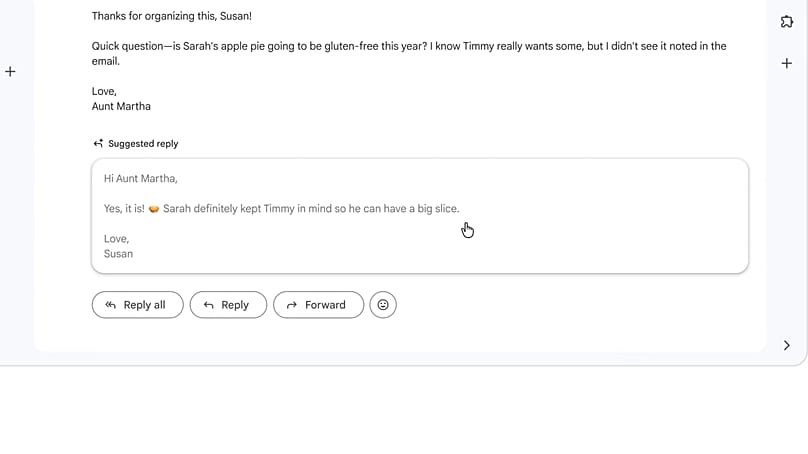
Google is also offering subscribers who pay for its Pro and Ultra services access to technology that mirrors the AI Overviews that's been built into its search engine since 2023. The expansion will enable subscribers to pose conversational questions in Gmail's search bar to get instant answers about information they are trying to retrieve from their inboxes.
In what could turn into another revolutionary step, “AI Inbox” is also being rolled out to a subset of “trusted testers” in the US. When it's turned on, the function will sift through inboxes and suggest to-do lists and topics that users might want to explore.
“This is us delivering on Gmail proactively having your back,” said Blake Barnes, a Google vice president of product.
All of the new technology is tied to the Google's latest AI model, Gemini 3, which was unleashed into its search engine late last year. The upgrade, designed to turn Google search into a “thought partner” has been so well received that it prompted OpenAI CEO Sam Altman, whose company makes the popular ChatGPT chatbot, toissue a “code red”following its release.
But thrusting more AI into Gmail poses potential risks for Google, especially if the technology malfunctions and presents misleading information or crafts emails that get users into trouble – even though people are able to proofread the messages or turn off the features at any time.
Allowing Google's AI to dig deeper into inboxes to learn more about their habits and interest also could raise privacy issues – a challenge that Gmail confronted from the get-go.
To help subsidise the free service, Google included targeted ads in Gmail that were based on information contained within a user’s inbox. That twist initially triggered a privacy backlash among lawmakers and consumer groups, but the uproar eventually died down and never led to any significant backlash against Gmail. Rivals eventually adopted similar features.
As it brings more AI into Gmail, Google promises none of the content that the technology analyses will be used to train the models that help Gemini improve.
The California-based company says it also has built an “engineering privacy” barrier to gather all the information within inboxes and protect it from prying eyes.