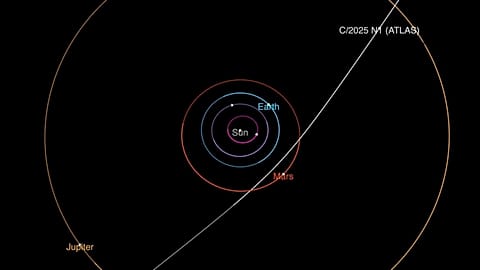













The interstellar comet 3I/ATLAS will reach its closest point to Earth on December 19, giving astronomers a closer look at the mysterious visitor before it leaves our Solar System forever.
The interstellar comet 3I/ATLAS, which has captured imaginations around the world, will make its closest approach to Earth on Friday, December 19, offering astronomers a narrow window to observe the rare visitor from a different galaxy.
 ADVERTISEMENT
ADVERTISEMENT
ADVERTISEMENT
The third confirmed interstellar object ever recorded, 3I/ATLAS will arrive no closer than 269 million kilometres from Earth – nearly twice the average distance between the Earth and the Sun, according to the European Space Agency (ESA).
Scientists say it poses no danger to Earth or any other planets as it passes through the inner Solar System.
First spotted on July 1 by the Asteroid Terrestrial-impact Last Alert System (ATLAS) telescope in Río Hurtado, Chile, the comet’s unusual characteristics and trajectory have sparked an online frenzy and given rise to a number of theories – including that it was sent by aliens.
What do astronomers hope to observe?
Interstellar comets are exceedingly rare, true outsiders to our galaxy that carry clues about how worlds form far beyond the reaches of our Solar System.
Observing one of these objects from so near a distance is an exciting opportunity for astronomers to study its coma, or the luminous halo of gas and dust released as the comet is warmed by the sun.
This can offer new insight into how comets and planets form around other stars in the Universe.
Scientists have already recorded unprecedented images of 3I/ATLAS using ground telescopes, including the ESA’s X-ray telescope XMM-Newton.
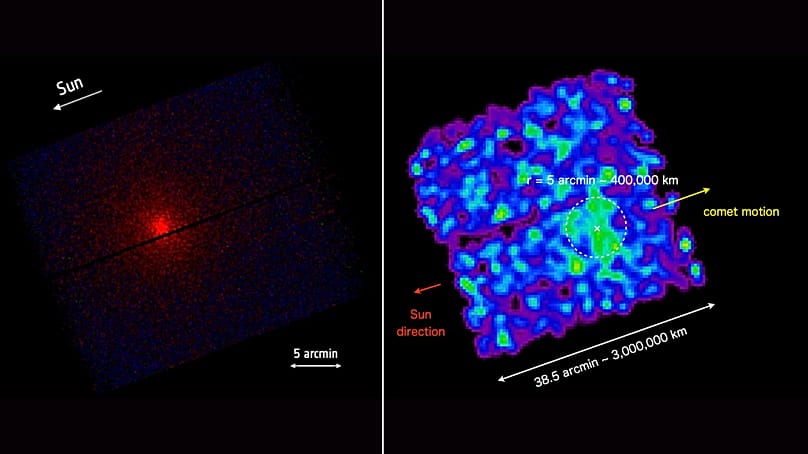
The first images of an interstellar comet observed in X-ray light revealed a diffuse X-ray glow around the comet nucleus – clearing up a long-standing mystery as to whether interstellar comets shine in X-rays like our own Solar System’s comets.
How can you track 3I/ATLAS as it passes Earth?
Unfortunately for stargazers, 3I/ATLAS’ trajectory is still too far from Earth to be seen with the naked eye.
The good news is that at its closest distance, 3I/ATLAS can be observed in the pre-dawn sky, even with a small telescope. According to NASA, it will remain observable until spring 2026, resembling a slightly brighter star.
You can see the exact location of 3I/ATLAS in real time on the ESA’s interactive map.
You can also follow 3I/ATLAS’ approach online in a free livestream hosted by the Virtual Telescope Project. If the weather holds up, the livestream will begin at 5 am CET (0400 UTC) on December 19.