






























France’s far right responded in markedly different ways to the AfD’s sweeping victory in Germany’s regional elections, with the National Rally (RN) maintaining a conspicuous silence on Monday while Éric Zemmour’s Reconquête! openly celebrated the result.
France's National Rally party reacted to the victory of Germany’s far-right Alternative für Deutschland (AfD) party with a noticeable silence on Monday, a move that reflects its complicated ties to the party.
 ADVERTISEMENT
ADVERTISEMENT
ADVERTISEMENT
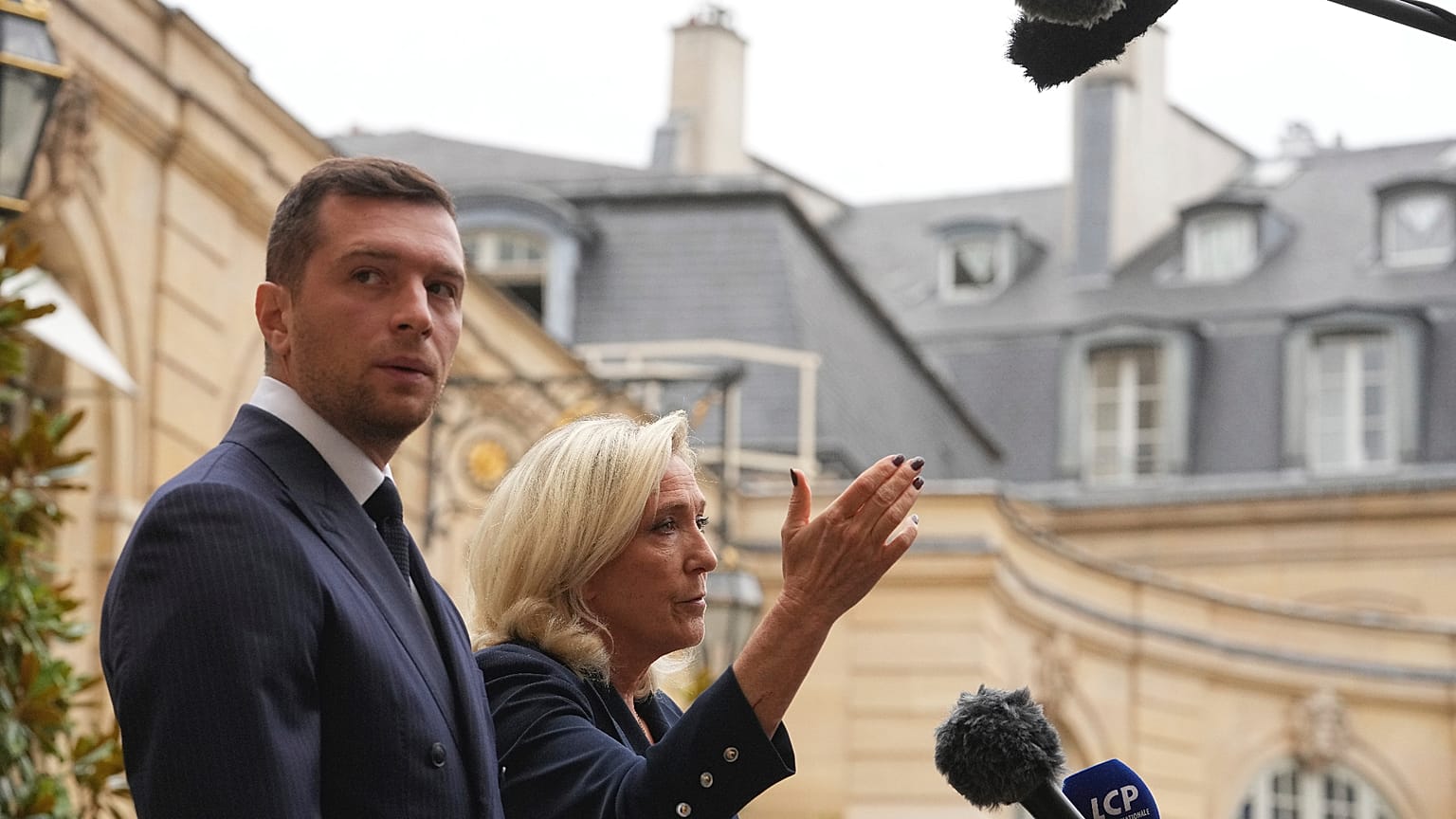
Marine Le Pen and Jordan Bardella — who are respectively campaigning to be France's next president and prime minister — made no mention of the AfD after the party took 43.8% of votes in Saxony-Anhalt’s elections, racing ahead of Christian Democratic Union, Chancellor Friedrich Merz’s party, which secured 17.2%.
Meanwhile, the Reconquête party — which is positioned further to the right than the National Rally and sits in the same group as the AfD in the European Parliament — welcomed the victory, reflecting political divergences within France's far-right.
Although the National Rally's leading figures have yet to comment publicly, other MPs from the party have weighed in. Bardella had also addressed the issue before the vote, when reporters at the Ambrosetti Forum — an annual economic and geopolitical conference held in Italy — questioned him about the prospect of the National Rally renewing ties with the AfD on Saturday.
In response, he said that this was not "planned," but underlined that "the electoral pressure exerted by the AfD in Germany has helped shift the political landscape within [Chancellor Friedrich] Merz's government, as Germany reinstated border controls a few months ago."
A campaign to recover the party's image
The silence at the top of the party is not surprising, given that Marine Le Pen has spent over a decade working to normalise the image of the National Rally (formerly known as the National Front), both at home and abroad, as part of a campaign to move away from the overt racism and antisemitism promoted by her father, Jean-Marie Le Pen, the party’s founder.
At present, her party is leading in the polls, with around 34 to 36% of respondents stating they intend to vote for her in the first round of the presidential elections scheduled for April 2027, according to a poll by IPSOS/BVA published by the French newspaper Le Parisien on Saturday.
National Rally politician and Patriots for Europe (PfE) MEP Pierre-Romain Thionnet told Euronews that the AfD's result "should not come as a surprise to anyone", arguing that its victory was vested in issues which mainstream parties have not worked to solve: "mass immigration, loss of national identity, and social and industrial decline."
According to the MEP, the result reflects "the collapse of the mainstream parties in favour of political forces that truly represent the aspirations of the European people."
Despite this, he ensured that the National Rally's decision to "no longer be an ally of the AfD" in the European Parliament would remain "unchanged."
"Several members of that political party continue to hold positions on historical and remembrance issues that we find unacceptable, and because there are very significant differences on other issues, such as foreign policy," said Thionnet.
The National Rally party and AfD were formerly part of the Identity and Democracy group, along with Italy’s League and Austria’s Freedom Party (FPÖ), among others. However, things came to a head ahead of the 2024 European Parliamentary elections, following a series of controversies involving some of the AfD's senior figures.
This included comments made by Maximilian Krah, the AfD's lead candidate in the Parliamentary elections, who stated that membership of the Nazi SS did not automatically make someone a criminal, during an interview with Italian newspaper La Repubblica.
The Identity and Democracy group voted to exclude the AfD in May 2024, just weeks before the European Parliament elections. Following the election, the AfD helped form a new far-right group, Europe of Sovereign Nations (ESN), which was formally established in July 2024.
Echoing these points, another MEP from the Patriots for Europe group told Euronews that "nothing will move before the French election," stating that "no one wants to be associated with the AfD, even though we have some points in common and cooperate on many topics."
Reconquête comes out in support of the AfD
The National Rally party may be keeping quiet, but the Reconquête! party, part of the same political group as the AfD in the European Parliament (Europe of Sovereign Nations), came out in support of the election results.
In an X post shared on Sunday evening, MEP Sarah Knafo described the results as "historic," stating that "the European peoples have shown a great deal of patience. Today, they want to take their destiny back into their own hands. An entire continent is rising up."
Meanwhile, Éric Zemmour, the leader of Reconquête, who has said he will wait until December to announce whether he will run in France's 2027 presidential election, qualified the results as "the hour of truth." In the first round of France's 2022 presidential election, Marine Le Pen took 23.15% of the votes, while the hard-right secured 7.07%.
The Reconquête! party aligns itself with the Alternative for Germany (AfD) on a number of points — notably on the concept of “remigration” — which the National Rally avoids endorsing explicitly, instead presenting its policy as favouring the systematic expulsion of illegal immigrants and foreign criminals.
According to Gilles Ivaldi, researcher and professor of politics at Sciences Po Paris, the political strategy adopted by Reconquête! is more similar to the AfD's than the National Rally's.
"The AfD expresses itself in a more radical and openly far-right manner, if I may say so, whereas the National Rally is currently trying to tone down its platform significantly in order to win the presidential election, because they know that to do this, they need to normalise their image," Ivaldi told Euronews.
"Ahead of the last presidential elections in 2022, we saw two different political strategies emerge: Le Pen continued to try to normalise her image and de-demonise her party, whereas Zemmour pursued a much more aggressive strategy of radicalisation and reclaiming certain political themes."
"I think we need to be careful not to treat the National Rally and Reconquête! as completely different, because they share many common views on migration, crime, and a whole range of issues concerning Ukraine and France's proximity to Russia."