































After Germany, Switzerland, Austria, and Finland, Sweden now also plans to return to Italy migrants who moved north after landing there. Eurostat says 109,427 transfer requests were sent to Rome between 2023 and 2025, a potential boomerang for Meloni's government.
More and more European governments are announcing their intention to transfer, or that they have already transferred, so-called Dublin transferees to Italy.
 ADVERTISEMENT
ADVERTISEMENT
ADVERTISEMENT
After Germany, Switzerland, Austria and Finland, Sweden has also confirmed to Italian news agency ANSA that it intends to "apply the rules as set out" in the new EU Pact on Asylum and Migration, which entered into force on 12 June, and that it expects "all member states to fulfil their obligations," Italy included.
Spain and France are taking the opposite line, two other countries that are key points of first entry into Europe for migrants, and have distanced themselves from sending migrants back to the country of first entry.
However, the issue of the suspension of Schengen, introduced due to the migration crisis in Ceuta and remaining in force until 31 August, is still unresolved with Madrid.
Who the Dublin transferees are and how many there are
Dublin transferees are people who have arrived in Europe to seek asylum and who, under the Dublin Regulation and the new EU Pact on Migration, are required to lodge their asylum application in the first country they enter.
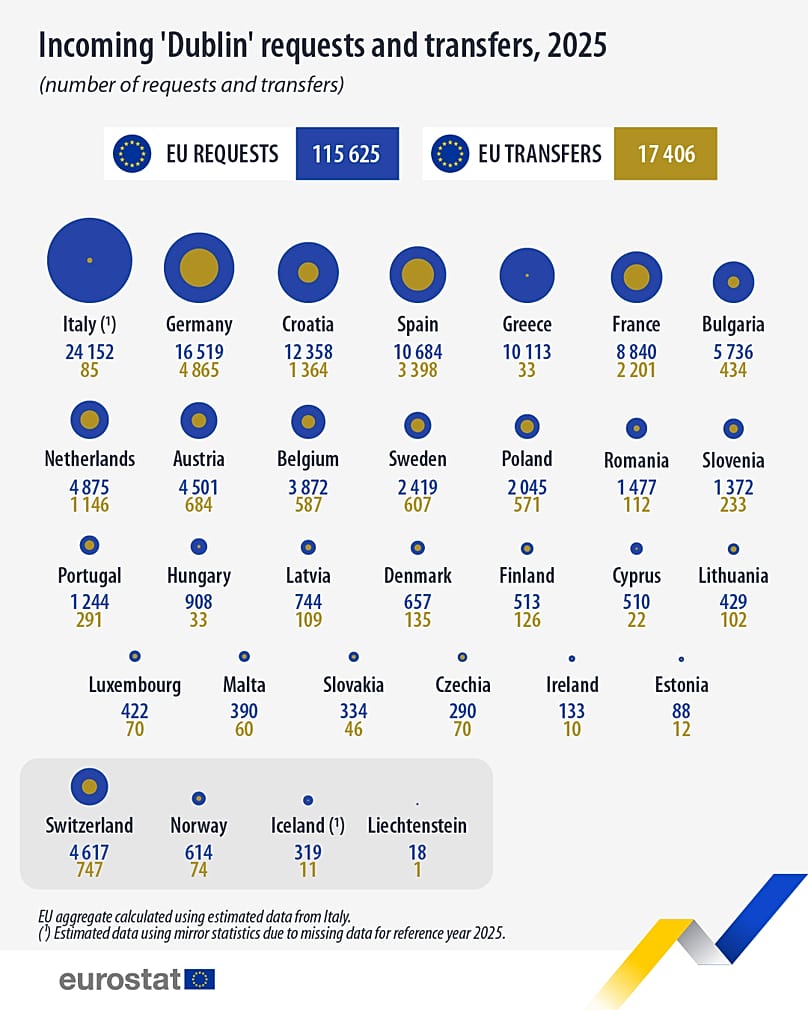
According to Eurostat, from 2023 to 2025, Rome received 109,427 transfer requests (2023 (source in Italian); 2024 (source in Italian); 2025 (source in Italian)).
Taking the 2025 data as an example, Italy is by far the country that has received the highest number of transfer requests for Dublin transferees, over 24,000, according to Eurostat.
Of these, 14,000, the largest share, come from Germany and France and would therefore be cancelled thanks to an agreement signed by Interior Minister Piantedosi (source in Italian) with the European Union's Justice and Home Affairs Council at the end of 2025.
But a further 10,000 remain pending, and the main countries of origin of these requests are precisely those now making themselves heard: Switzerland (3,612 requests), Austria (644), Finland (520), Belgium (1,531), and a few hundred more spread across other countries, starting with Sweden.
Austria, in particular, has told LaPresse that since the Pact came into force, it has already returned four Dublin transferees to Italy.
How Italy is blocking the transfer of Dublin transferees
Italy, however, unilaterally halted transfers at the end of 2022, despite a 2024 ruling (source in Italian) to the contrary, which holds that Rome cannot, in substance, evade its Dublin obligations, since it is assumed that an EU member state is capable of guaranteeing dignified reception conditions for asylum seekers.
And in an initial assessment (source in Italian) of the new EU Pact on Asylum and Migration, the Commission notes that Italy is still refusing transfers: between 12 June and 7 July, it is reported to have already rejected 12.
With specific reference to the Italian case, the text in fact states that "a receiving member state cannot refuse a transfer and (...) must propose an alternative date for the transfer".
Time limits for lodging and examining asylum applications
Under the Dublin Regulation before the new Pact, after 12 months, if the transfer to the first country of arrival has not taken place, the asylum seeker is freed from that obligation and can apply in the country where they are actually present.
It should be stressed, however, that the new European Pact on Migration extends the responsibility of the country of first arrival for the asylum application to 20 months.
Moreover, from its entry into force, the vast majority of asylum seekers should know the outcome of their application within 12 weeks.
But less than three months have passed since the new Pact entered into force and, as Piantedosi explained to the Schengen Committee last week, it is therefore still too early to draw up a balance sheet.
It is nonetheless legitimate to ask whether a country such as Italy will be able to repatriate migrants from safe countries who are denied asylum within just three months.
A first, partial answer will come with the next monitoring exercise by the European Commission, scheduled for mid-October.
Why do France and Spain choose not to join the countries sending Dublin transferees back to Italy?
Given the current state of play on migration, it is understandable that many European countries have started to raise their voices with Italy, particularly after the move to suspend Schengen with Spain and Meloni's stance, completely at odds with the solidarity required under the new Pact, on tackling irregular migration.
Unlike the Nordic countries, France has for now decided "not to join the countries" that are sending migrants back to Italy, well-informed sources in Paris told ANSA, at least "for as long as this phase of cooperation and rapprochement" with Rome continues. The two countries, the sources explain, "share the wish to work to bring down the flows departing from Tunisia and Libya".
The Spanish government is likewise "in favour" of handling the issue of the so-called Dublin transferees through the European solidarity mechanisms provided for in the European Pact on Migration and Asylum and in the European Union's recent legislation, "rather than resorting to isolated bilateral expulsions or restrictions", sources at Spain's Interior Ministry also told ANSA.
Political reactions in Italy to the Dublin transferees crisis
The affair is inevitably fuelling political controversy in Italy, which had already erupted after the Ceuta crisis and the Schengen row with Spain, and which Elly Schlein sees as "a spectacular boomerang from Giorgia Meloni's propaganda stunt".
"Because of her blind ideology, she has never pursued the most important battle to be fought in Brussels in the national interest: that for European solidarity, including on reception", said the leader of the main opposition party.
Giuseppe Conte was sarcastic about the prime minister's "masterpiece": "Repatriations are working, but against us," he wrote on social media.
"There is no link between the suspension of Schengen over the events in Ceuta and the legitimate choice by some European countries to restart the relocations of Dublin transferees," explained Carlo Fidanza, head of the Brothers of Italy delegation in the European Parliament, arguing that "the issue concerns only a small number of cases between August 2025 and 11 June 2026" and that "for those who entered after 12 June, the number of potential relocations will fall sharply".