












"A Yalta format will not bring peace," German Chancellor Friedrich Merz said at the end of a Coalition of the Willing meeting in Berlin just hours after Trump, Putin and Xi held talks in China.
European leaders have forcefully rejected any attempts to re-enact the 1945 Yalta Conference to end Russia's war on Ukraine and split the continent into spheres of influence.
 ADVERTISEMENT
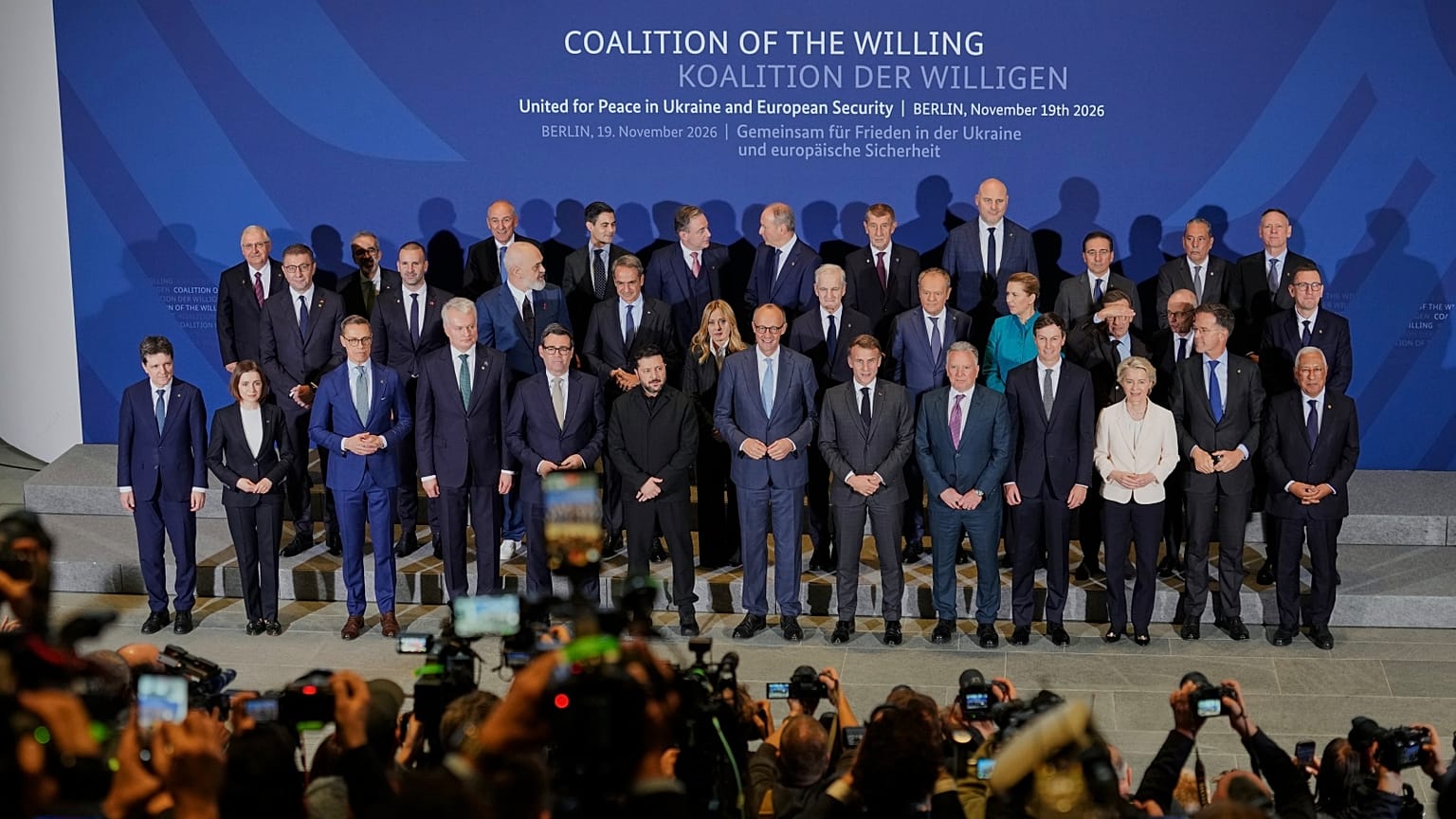
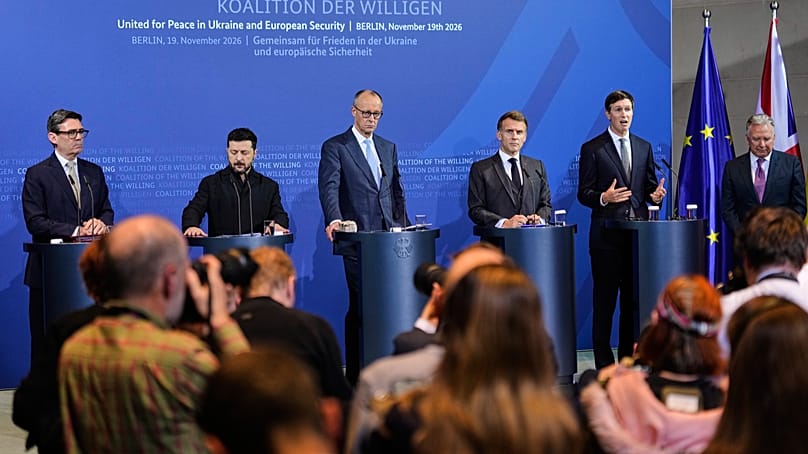
The pushback went public on Thursday at a meeting of the Coalition of the Willing, comprising Kyiv's allies, hosted by German Chancellor Friedrich Merz.
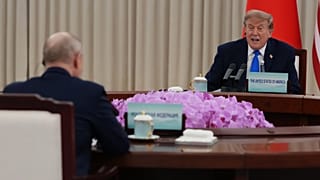
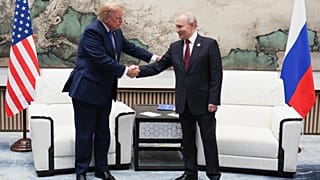
The gathering in Berlin took place just hours after Russian President Vladimir Putin, US President Donald Trump and Chinese President Xi Jinping held a historic trilateral meeting in Shenzhen, China, dubbed "Yalta 2.0" by media commentators.
Trump, Putin and Xi discussed Ukraine, but their joint statement, titled "Declaration Toward Peace", did not mention the country.
"A Yalta format will not bring peace," Merz said, flanked by other leaders.
"At Yalta, Europe was divided up. It was parcelled up. And we won't allow anything like that to happen again."
Merz gifted the over 40 delegations that took part in the talks a piece of the Berlin Wall, which, he said, is "what Yalta represented".
By his side, French President Emmanuel Macron said the four-point statement issued by Trump, Putin and Xi in Shenzhen did not replicate the outcome of the 1945 conference, which set the stage for the four-decade-long Cold War.
"I don't think that it amounts to a reorganisation of the world," he said.
"If there is one critical element for the reorganisation of Europe and its security, it is the meeting that took place (today) in Berlin."
Macron stressed that negotiations to end the war would need to involve Ukraine, Europe, the US and Russia seated at the same table.
"Europeans have taken decisions. They have decided to determine their own fate," the French president said. "Europe is not a subject on a menu of discussions, but a series of powers who want to build their own future".
British Prime Minister Andy Burnham echoed Macron's message, saying "there is no decision about Ukraine without Ukraine in the room (and) there's no decision about European security without Europe represented in the room".
Ukrainian President Volodymyr Zelenskyy said the meeting in Berlin bore "testament" to Russia's failure to sow division among European allies.
The four leaders agreed that the time has come for Europe to engage in face-to-face negotiations with Russia, marking a step that has yet to take place in the negotiation process.
Europe has appointed a joint team of seven representatives from France, the UK, Germany, Poland, Italy, the EU institutions and NATO for the next round of talks.
US special envoys Steve Witkoff and Jared Kushner, who flew to Berlin to attend the meeting, also called on Russia to allow European participation.
"We do believe that having Europe at the table will be essential to ending this war in a just and long-term, durable way," Kushner said at the closing press conference.
"And the Russians are willing to trust that instinct on our behalf."
Moscow, though, has not committed to a multilateral format.
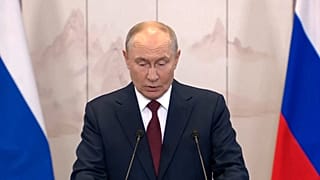
Speaking in Shenzhen, Putin said he had suggested "via diplomatic channels that the Europeans come to Moscow to define their positions," and, after that, the Kremlin would "decide on continuing the dialogue with Ukraine".
Putin also said that it "would be strange to discuss Europe's security without Europe itself", referring to the demands that Moscow has tabled to restructure the continent's security architecture, which Macron slammed as "maximalist".
Merz said the debate on European security would happen only after peace has been established in Ukraine. The future security guarantees to the war-weary country will inherently have "repercussions" for the transatlantic alliance, he said.
Among the guarantees in the works is a clause emulating NATO's Article 5 of collective defence should Russia attack Ukraine again. Another guarantee would be a Europe-led peacekeeping force, which Putin says he would not allow in any scenario.
"From America's perspective, giving an Article 5-like security guarantee is a really, really big deal," Kushner said. "And I think that that's something that President Trump is open to, but obviously it has to be in America's interest to do that."
During the closed-door discussions in Berlin, Trump phoned in from his plane and addressed the room, Kushner confirmed. Media reports suggest that Trump expressed scepticism about Europe's military support for Ukraine.
Leaders seemed unmoved and agreed that assistance will continue unabatedto put Ukraine in a strong position at the negotiating table.
"I hope that message is heard very clearly in Moscow," Burnham said.
"For as long as it takes, we will be there at the side of Ukraine, and we will not falter. Our support will be unwavering. And that's the biggest weapon we have together."