

















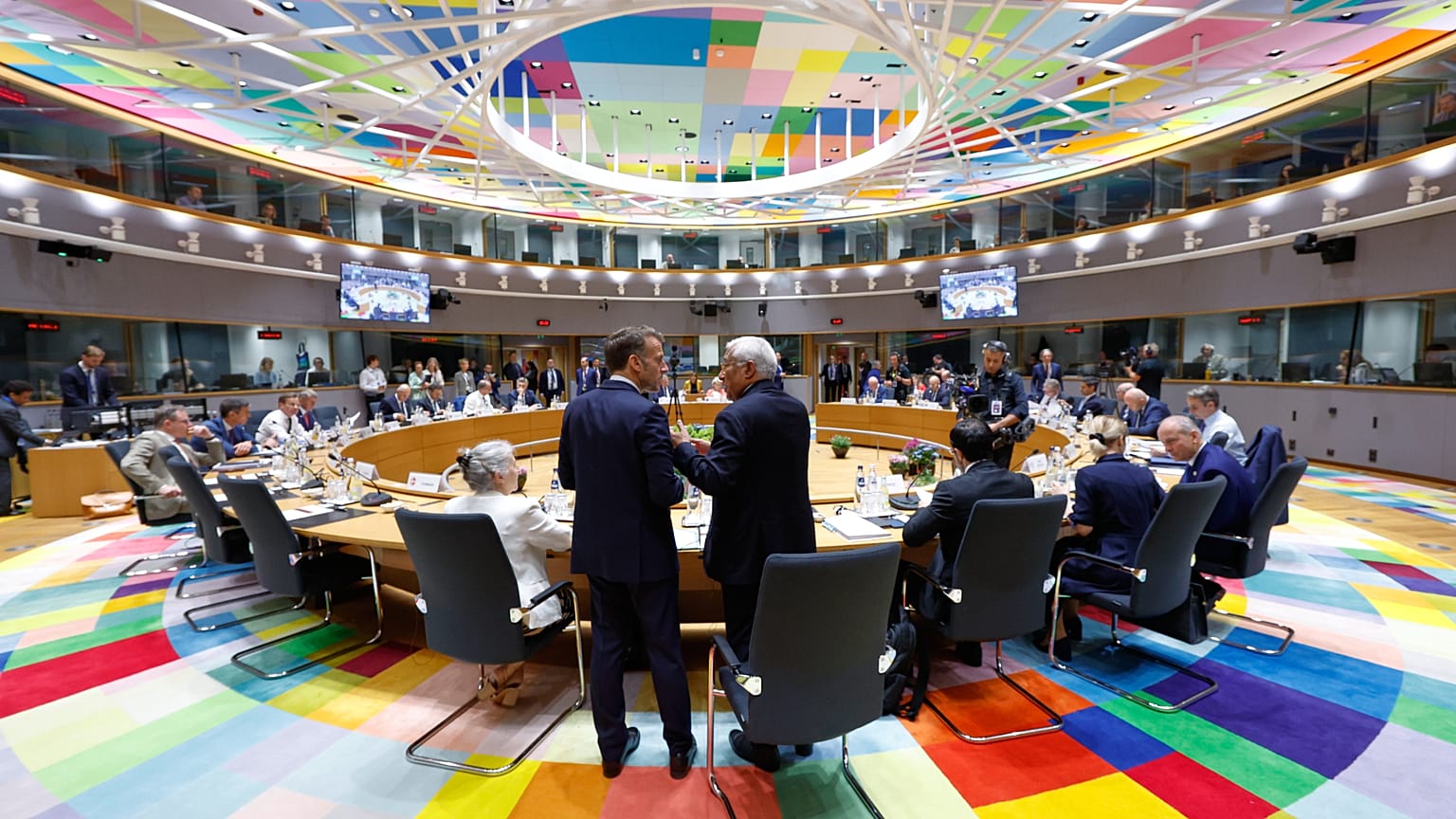













Battle lines are being drawn between member states on EU spending, with southern and eastern states seeking more for agriculture and regional funding while hawkish governments push back.
EU leaders meeting in Brussels have agreed to produce a preliminary deal on the €2 trillion EU long-term budget for 2028–2034 by October, according to a draft statement published on Friday.
 ADVERTISEMENT
ADVERTISEMENT
ADVERTISEMENT
In a gathering on Thursday and Friday, the bloc entered a sensitive phase of the negotiations, trying to reach a common understanding on expenditure and revenues to fund the priorities of the next seven years.
There is a delicate balancing act to be struck among EU member states. While a group of net payers led by Germany and The Netherlands pushing to slash the bloc's total spend, southern and eastern European member states are concerned that funding for sectors such as agriculture will be sacrificed in favour of more defence spending.
In a press conference on Friday, European Commission President Ursula von der Leyen and European Council President António Costa called on the bloc to reach an agreement, particularly on the financing aspect, by the end of the year.
The budget was proposed by the European Commission in July 2025. EU leaders have now asked the incoming Irish presidency, which will chair the discussions among member states from 1 July, to propose a new negotiating text in October, an EU official said – referring to a document covering expenditure and revenues, known as "own resources".
"An ambitious and balanced package on new own resources by the October European Council" is also expected, another EU official said.
The two main camps
Despite negotiations being complex and dynamic, there are mainly two groups of countries putting forward proposals: the "Friends of Cohesion" and the "Frugals".
In late May, the Friends of Cohesion signed a document calling for an increase in agricultural and regional funding. The signatories were Bulgaria, Croatia, Estonia, Greece, Italy, Latvia, Lithuania, Malta, Poland, Portugal, the Czech Republic, Romania, Slovenia, Slovakia, Spain and Hungary.
The "frugal" countries – Germany, the Netherlands, Denmark, Sweden, Finland and Austria – said any increase in spending would be a no-go.
In a revised text presented last week, the Cypriot authorities, currently chairing the talks among the member states, pitched a cut of €32.8 billion to the overall €2 trillion budget, describing it as a compromise between the two camps.
The European Parliament, a co-legislator which will have to approve the budget alongside leaders, has rejected the Cypriot proposal, describing it as insufficient, particularly with regard to agriculture and regional funding.
Budget revenues and rolling debt
The debate over how the budget will be financed remains unresolved, and a draft agreement is expected by October.
In its initial proposal, the European Commission included revenue streams from the Emissions Trading System, the Carbon Border Adjustment Mechanism, non-collected e-waste, tobacco excise duties and a corporate tax.
During the negotiations, the European Parliament proposed additional sources of revenue. According to several EU diplomats who spoke to Euronews on condition of anonymity, the proposals that have attracted the greatest interest among leaders include a gambling tax, a digital levy and a tax on crypto assets.
The frugal countries remain hesitant about the proposed revenue measures, particularly Sweden, which is against any kind of own resources. They argue that a move in that direction would oblige the EU's wealthiest member states to shoulder a disproportionate financial burden.
Countries including Italy, France and Greece have proposed repaying NextGenerationEU recovery funds through the reissuance of debt, a mechanism known as "rolling debt". The proposal is strongly opposed by Germany, the Netherlands and others, who reject any form of new common borrowing.
According to two EU diplomats familiar with the negotiations, the debate on rolling debt will depend on the kind of agreement leaders reach on own resources.
The bloc is aiming to reach an agreement on the budget by the end of 2026. The co-legislators are keen to avoid extending negotiations into 2027, a major election year in several key European countries, including France, Italy and Poland.
Any agreement on the budget will require unanimous support from all 27 member states, as well as the consent of the European Parliament.