




























Russia's war on Ukraine and unfair Chinese competition were the two main topics at the first day of the EU summit.
The first day of the EU summit concluded with the 27 leaders giving Ursula von der Leyen a mandate to develop new tools to contain the increasingly devastating effects of the glut of low-cost, heavily subsidised goods coming from China.
 ADVERTISEMENT
ADVERTISEMENT
ADVERTISEMENT
However, it remains to be seen if, when push comes to shove, unity will prevail. Beijing has already threatened to retaliate if Brussels goes down the assertive road.
Meanwhile, the 27 EU leaders unanimously agreed to extend economic sanctions on Russia for one year. The bloc has traditionally prolonged sanctions every six months, creating opportunities for individual vetoes.
The European Council also adopted joint conclusions on Ukraine backed by the 27 leaders. This is the first time it has happened since March 2025, when Hungarian Prime Minister Viktor Orbán shocked his peers by refusing to sign up.
This is how the day unfolded.

 ${title}
Live ended
The EU summit has come to an end
The first day of the EU summit has ended.
Our live blog will be back tomorrow for the second day.
In the meantime, we leave you with our top story: Costa defends surprise decision to open diplomatic channel with Russia.
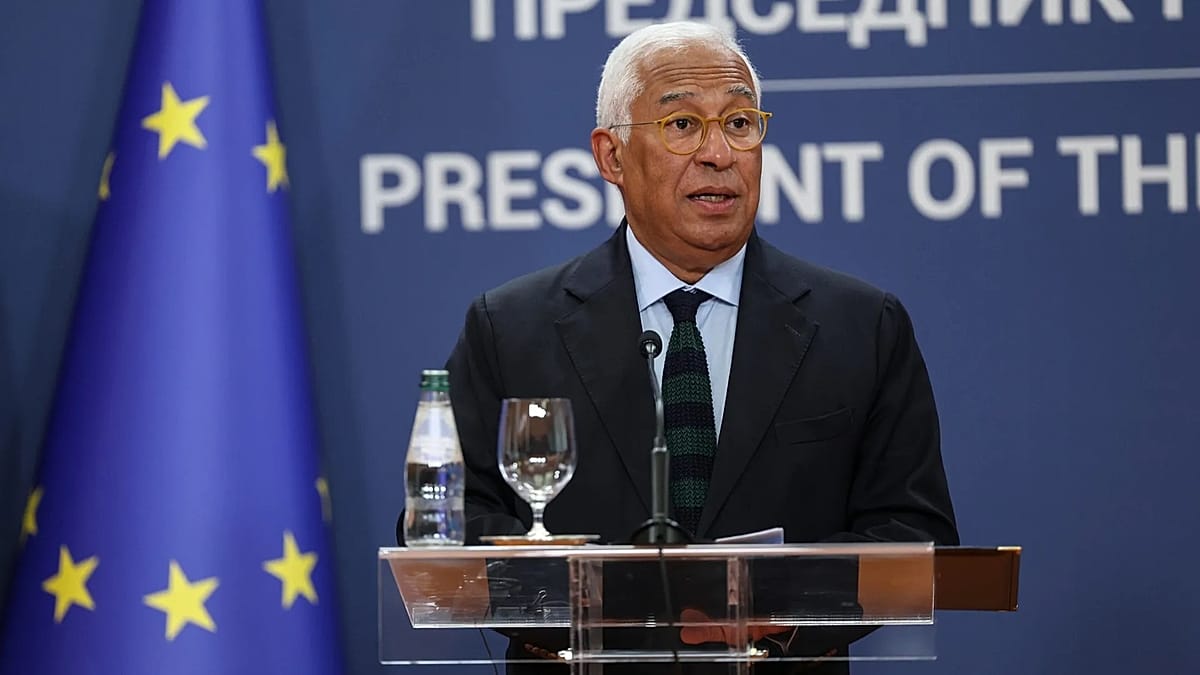
Costa defends surprise decision to open diplomatic channel with Russia
António Costa’s surprise decision to open a diplomatic channel with Russia dominated discussions at Thursday’s summit, as several leaders expressed concern tha…
Ursula von der Leyen gets mandate to develop new tools against China
The 27 leaders have concluded their dinner on economic imbalances by giving Ursula von der Leyen a mandate to develop new tools to contain the increasingly devastating effects of the glut of low-cost, heavily subsidised goods from China.
"Leaders agreed that the current global macroeconomic imbalances require a European response based on two pillars: European unity and dialogue with our main economic partners," an EU official said at the end of the talks.
"That is why Leaders asked the Commission to work on two tasks: 1) to continue engaging in a constructive dialogue with our main economic partners, to defend our economic and security interests, that dialogue needs to provide results; and 2) to develop and eventually complement the toolbox in the area of trade defence and industrial policy – to make sure that the European Union has all the instruments it needs to defend its interests and derisk."
This means the European Commission now has the go-ahead to beef up its trade arsenal and even design new measures to take on China. However, it remains to be seen if, when push comes to shove, the 27 will rally behind the Commission. Beijing has already threatened to retaliate if Brussels goes down a harder road.
Read the conclusions on Ukraine
You can now read the joint conclusions on Ukraine, endorsed by the 27 leaders for the first time since March 2025.
In the text, the European Council "looks forward" to Ukraine opening the remaining accession clusters and says it is ready to "step up" its engagement in the peace process, which is currently stalled. It also calls on Russia to "show genuine willingness regarding peace" and "agree to a full, unconditional and immediate ceasefire".

European Council conclusions on Ukraine and on European defence and security
On 18 June, the European Council adopted conclusions on Ukraine and on European defence and security.
‘We’ve survived Orbán,’ Zelenskyy said after the summit
After the changes in Hungary, “there is clearly a new opportunity to strengthen relations both within the EU and between the EU and Ukraine,” Zelenskyy told the EU leaders with Péter Magyar present in the room for his first summit since the April elections.
In a voice message in the presidential WhatsApp chat after the meeting in Brussels, Zelenskyy said Ukraine has not “compromised dignity” under the pressure of Viktor Orbán’s vetoes.
“We have survived Orbán.”
Addressing the room, he also thanked Ukraine’s neighbouring countries, specifically Hungary, Poland, Romania and Slovakia, assuring them that “Ukraine is committed to mutual respect.”
In a clear reference to the sensitive issue of Hungarian minorities in Ukraine, Zelenskyy insisted that for Kyiv, “being a good neighbour has never been just words.”
“And now we are ready to work as closely as possible, and with mutual respect, with every one of our EU neighbours.”
Zelenskyy still has not held a separate bilateral meeting with Péter Magyar, but the meeting with Slovak Prime Minister Robert Fico took place in Brussels.
With Prime Minister of Slovakia @RobertFicoSVK, we discussed European integration, mutually beneficial energy cooperation, and the results of the G7 Évian Summ…
Europe’s security rests on Ukraine’s army, Zelenskyy told EU leaders
“There is no army without funding,” Zelenskyy said, insisting that when Europe talks about its own security, “its foundation is the Ukrainian army”.
Addressing the EU leaders, he pointed out Ukraine’s hard‑won experience of modern warfare and its success in holding back Russian aggression as evidence that the country’s armed forces now form a central pillar of Europe’s security architecture.
“We need to provide long-term security guarantees for Europe, and that means long-term financial guarantees for the Ukrainian army.”
Ukraine deserves the full EU membership ‘more than any other European country’
“Ukraine believes that every democratic nation in Europe deserves to be a full member of the EU,” Zelenskyy said, addressing the European Council on Thursday.
“Ukraine merits it because it has paid more than any other European country for its right to be free, independent, and European.”
He insisted that right is “not only for Ukraine.”
“It is also the right of other nations to be independent from Russia,” he went on.
Ukraine’s president insisted that the future of Europe "is being decided in our defence”, and this shows how “unique” Ukraine’s situation is. “The most important such step could be a fast-track path for Ukraine to join the EU.”
Ukraine believes that every democratic nation in Europe deserves to be a full member of the EU. And we are working as actively as possible to achieve this. Ple…
Leaders begin dinner on China
After a long discussion on Ukraine, the 27 leaders have begun their dinner focused on economic imbalances.
In other words: China.
European Commission President Ursula von der Leyen hopes to leave the summit with enough backing for a more assertive policy to contain the glut of low-cost, heavily subsidised goods from China that threaten to wipe out European industry.
Costa defends outreach to the Kremlin
During a discussion on Ukraine, European Council President António Costa defended his decision to open a diplomatic channel with Russia to test whether conditions for negotiations exist.
"The President explained that he had asked his office to open a diplomatic channel with Russia. The goal was to be ready, when the right moment comes, to defend the EU’s interests. What we talk about are brief contacts with no exchange on substance and no negotiation - diplomats doing diplomatic work," an EU official said. "The most important point is that Europeans remain coordinated on how to engage with Russia and on what the EU’s position should be. And the President’s role is to support the EU’s unity."
According to the official, a "number of leaders" signalled that Costa would be the "natural representative" of the bloc's interests, suggesting some support for eventually appointing him special envoy for direct talks with Russia.
Costa's decision, however, was not well received by Poland, the Baltics and the Nordics, Euronews understands.
The European Council President did not consult broadly with capitals before giving the green light to his chief of cabinet to pick up the phone.
Spain welcomes US-Iran deal and commits to help stabilise Strait of Hormuz
Spanish Prime Minister Pedro Sánchez told journalists on Thursday that his government welcomes the peace agreement between the US and Iran, saying it will bring relief to millions of people directly affected by the war, but also to Europeans facing a risk of rapid inflation.
"The Government of Spain joined 16 other European countries precisely to be able to commit ourselves to the stabilisation and consolidation of this peace, especially in the Strait of Hormuz," Sánchez said, referring to a joint naval mission that has attracted international backing.
Sánchez said that formal meetings between the EU and Gulf countries this summer and autumn will be crucial "to reinforce cooperation in the Middle East", warning that the world still faces "a really difficult and complex scenario where there are overlapping crises".
The 12-month sanctions rewal doesn't affect individual sanctions
The 12-month renewal of the sanctions against Russia agreed by EU leaders on Thursday evening does not affect the blacklist of individuals and entities accused of supporting and promoting the full-scale invasion of Ukraine.
The individual sanctions will therefore remain subject to the traditional six-month roll-over, a process that tends to entail the removal of some names considered legally weak. It also involves the deletion of individuals who have passed away.
EU leaders agree to extend economic sanctions on Russia for 12 months
The 27 EU leaders have unanimously agreed to extend sanctions on Russia for one year. The bloc has traditionally prolonged sanctions every six months, creating opportunities for individual vetoes to extract concessions.
The 12-month renewal creates greater predictability at a time when Ukraine enjoys fresh momentum on the battlefield, and Washington signals new determination to tighten restrictions.
EU adopts joint conclusions on Ukraine at 27 for the first time since March 2025
The European Council has adopted joint conclusions on Ukraine backed by the 27 leaders.
This is the first time it has happened since March 2025, when Hungarian Prime Minister Viktor Orbán shocked his peers by refusing to sign up. Since then, EU summits have adopted the text on Ukraine as an "extract" with either 26 or 25 leaders, depending on the mood of Slovakia's Robert Fico. But Orbán was ousted in April after 16 years in office, paving the way for a renewed consensus on the matter.
"Today, all 27 leaders stand together, united and committed to supporting Ukraine," European Council President António Costa wrote on social media.
"We are moving forward on accession talks, strengthening Ukraine’s defence through our support loan, and increasing pressure on Russia with new sanctions. Our strategy is working. Together, we are turning the tide."
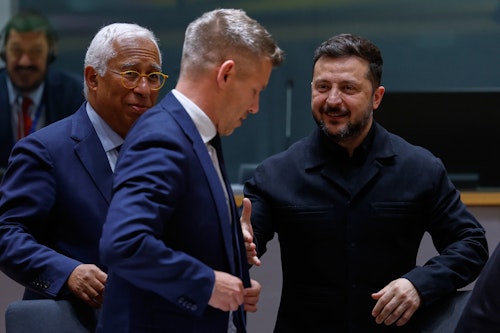
Credit: Associated Press
Ukraine debate drags on, China dinner on hold
The discussion on Ukraine among the 27 EU leaders continues. It's running longer than expected.
The highly anticipated dinner focused on China is yet to take place.
Metsola urges EU leaders to make progress on long-term budget revenues
European Parliament President Roberta Metsola has called on leaders to make progress on the issue of "new own resources" as part of discussions on the EU's long-term budget of 2028–2034.
The “own resources” are the budget’s potential revenues, i.e. the way the EU will finance some of its priorities for the next seven years.
"My appeal to the leaders is to make progress on new own resources, because this will ease the pressure on national budgets today while ensuring that we don't pass that burden to generations tomorrow," Metsola said during a press conference on the margins of the European Council.
The European Commission presented its proposal on the EU long-term budget in July 2025. It's now under scrutiny by member states, with EU leaders expecting to begin the first of many discussions on the matter Friday.
The Commission put forward its proposal in July last year, but no formal compromise has been reached by the member states on the own resources issue.
Zelenskyy left the building
Ukraine’s president just left the summit after over an hour and a half exchange with the EU leaders.
Zelenskyy did not hold a press conference and there was no statement after the meeting.
Slovenia backs direct talks with Russia
At his first EU summit since his political comeback, Slovenian Prime Minister Janez Janša has backed European Council President António Costa's initiative to open diplomatic channels with Russia to lay the groundwork for peace negotiations.
“Any steps that can lead to a cessation of hostilities and negotiations should be welcomed. As long as weapons are speaking, diplomacy has limited power. Both sides must be won over to a peaceful solution,” Janša said, according to his office.
He also "stressed that efforts to open dialogue between Ukraine and Russia are essential for creating the conditions for a negotiated path toward peace", his office added.
Yesterday, during the G7 summit, it was confirmed that Costa's office had made brief contacts with Russia, but without substance. The outreach wasn't broadly consulted with member states beforehand, several diplomats told Euronews.
Metsola: 'Costa can perform in talks with Russia'
European Council's President António Costa "can perform in any task that he's given", said EU Parliament's President Roberta Metsola when asked about Costa's possible involvement in peace talks with Russia.
Costa is considered one of the candidates for the role of EU envoy in talks with Russia, after his cabinet initiated a diplomatic outreach with Russia to test whether a channel of communication could be established.
During a press conference after she addressed EU leaders, Metsola underlined that any talks with Russia should respect the principle "nothing on Ukraine without Ukraine", meaning that Kyiv should be involved in the negotiations.
Italian Prime Minister Giorgia Meloni said on Wednesday that an EU envoy from a small-sized country would probably have a better chance of being accepted by Russia, fueling speculations that Metsola could also be one of the possible candidates. Metsola told reporters she has been involved in talks.
Zelenskyy holds bilateral meeting with Bulgarian prime minister
Volodymyr Zelenskyy has held a bilateral meeting with the new prime minister of Bulgaria, Rumen Radev, Euronews can confirm.
Earlier today, Radev confirmed his opposition to sanctioning Russia's Patriarch Kirill, who has described Russia's invasion of Ukraine as a "Holy War". Radev also raised concerns about certain energy sanctions.
Zelenskyy also held a bilateral meeting with Slovakia's Robert Fico, who has used his veto on several occasions to delay sanctions on Russia. The meeting touched upon Ukraine's accession, energy cooperation and the results of the G7 summit, Zelenskyy said on social media.
Zelenskyy leaves the room, discussion on Ukraine continues among 27 leaders
Volodymyr Zelenskyy has left the room after an extensive discussion with the EU leaders.
Now, the debate on Ukraine will continue among the 27.
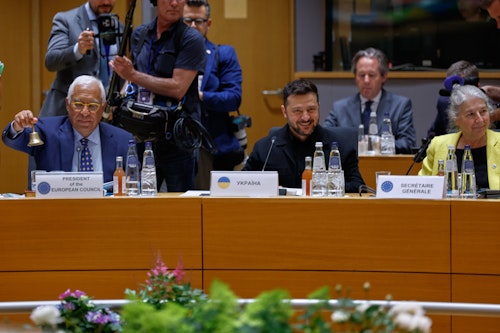
Credit: Associated Press
Emmanuel Macron has arrived
French President Emmanuel Macron has just arrived at the EU summit.
He's fresh from his G7 summit in Évian, widely considered a diplomatic success.
Ireland 'open minded' about potential sanctions on alumina, Martin says
Irish Prime Minister Micheál Martin has cautiously opened the door to sanctioning exports of alumina, the raw material used to manufacture aluminium, to Russia.
Ireland has been battling damaging headlines since a media investigation exposed the business ties between Aughinish Alumina, Europe's largest alumina refinery, and the Russian economy. According to the findings, the sprawling plant, based in western Ireland, sells alumina to Russian smelters owned by its parent company, United Company Rusal, which in turn sells the metal to a Moscow-based trader that supplies aluminium to sanctioned defence manufacturers.
The Irish government has launched a probe into the matter.
"We need to find out the full facts," Martin said at the summit. "We also need to understand the implications Europe-wide of any action in respect of Aughinish. And then we need to engage with the European Commission on all of that and potentially in a range of scenarios."
"We have an open mind in terms of how we approach this," he added. "We don't want to obviously have material going to support Russia, but we supported every sanctions package so far. The EU has never proposed that alumina would be subject to sanctions. There's a reason for that."
The timing of the revelations is particularly sensitive for Dublin, which is about to assume the EU Council's six-month presidency.
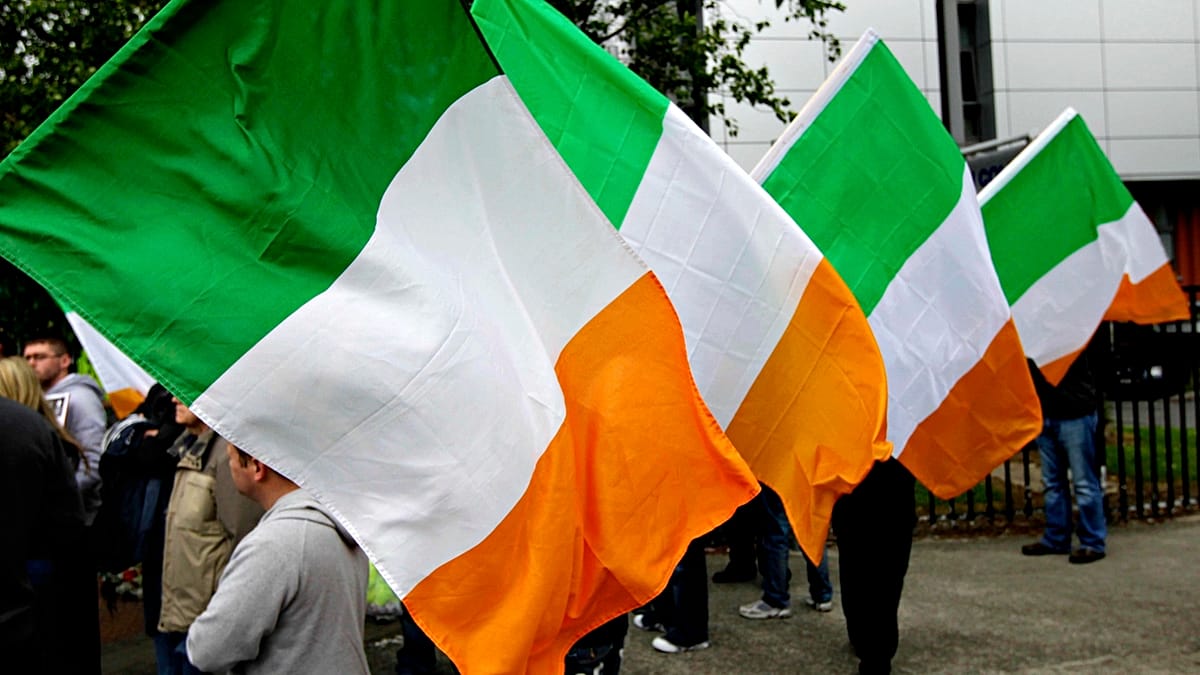
Why Ireland is under fire over its alumina exports to Russia
Though legal, Ireland’s alumina exports to Russia have prompted outrage just as the country prepares to assume the EU Council’s presidency. #EuropeNews
US-Iran deal can bring back global attention to Ukraine, Swedish minister says
The memorandum of understanding between the United States and Iran can help bring more attention to Ukraine, Jessica Rosencrantz, Sweden's minister for European affairs, told Euronews.
"The Ukrainians are doing well on the battlefield. We see that Russia is having a lot of losses. The Russian economy is hurting. So in many ways, I see there's a good position for Ukraine now," Rosencrantz said. "We need to work together, Europe and the US, to support Ukraine."
Rosencrantz said European support for Ukraine was a "moral obligation" and called for the fast opening of all remaining clusters of negotiations. Earlier this week, Ukraine and Moldova opened the first cluster after almost two years under Hungary's veto.
"Our support to Ukraine is existential. It's a moral obligation, but it is also an investment in European security. And this also comes down to enlargement. And Ukraine belongs in the European family," she said.
"We see advancements from the Ukrainian side. They are doing real reforms back home, which is impressive during an ongoing war. And when a candidate country delivers so much, (then) we must continue with these negotiations. And I hear a completely new tone from the new Hungarian government, which makes me very happy. "
EU budgets needs to 'come down substantially', Swedish minister tells Euronews
During the interview with Euronews, Jessica Rosencrantz, Sweden's minister for European affairs, also discussed the next long-term EU budget, which is under negotiation and will be discussed tomorrow. Leaders aim to get a deal by the end of the year.
The Cyprus presidency has tabled a compromise that envisions a moderate 2% cut to the European Commission's original proposal, which was worth almost €2 trillion.
Rosencrantz was unambiguous: the budget is still "way too high" and "needs to come down substantially".
"Fom the Swedish point of view, we want to budget around 1% of GNI. So that's a substantial decrease," she explained. "But a lot of member states are doing tough priorities back home. The EU needs to do the same kind of tough priorities, and it's about taking responsibility for taxpayers' money."
Asked by Maria if Sweden wanted to cut more in the traditional envelopes (cohesion and agriculture funds), Rosencrantz said the draft needed "cuts across the board"
"Of course, it makes sense to look at the really big parts of the budget," she said. "There will have to be cuts across the board. But we want to maintain the focus on competitiveness and on security, because those are our main challenges in today's world."
'The tide is turning for Ukraine', von der Leyen says
"The tide is turning. Ukraine is holding the line," Ursula von der Leyen said ahead of an EU summit in Brussels.
— euronews (@euronews) June 18, 2026
She also denounced Russia for imposing a "digital iron curtain on its own people". pic.twitter.com/pC4w7SMUQy
Ukraine and EU are discussing a drone deal
Another topic on the agenda for the EU summit on Thursday is a drone deal with Kyiv, which could strengthen the European air defence and also position Ukraine as a provider of military aid for the EU and not just a receiver.
Earlier this month, Ukraine signed a drone agreement with Latvia and a defence cooperation declaration with Estonia, reinforcing security and defence ties with the Baltic states, which have reported multiple drone incursions in recent weeks.
Kyiv’s drone agreements with Gulf states, signed amid the US-Israel war with Iran, include a comprehensive air defence package featuring maritime drones, electronic warfare, and interception technologies, as well as the deployment of Ukrainian drone specialists on the ground.
EU leaders begin debate on Ukraine alongside Zelenskyy
EU leaders have begun their discussion on Russia's war on Ukraine. The topics on the agenda include accession, military support, sanctions and peace negotiations.
President Zelenskyy is in the room and will deliver an address.
Stay tuned for updates.
Seventeen EU countries push for more cohesions funds
The leaders of the “Friends of Cohesion” group, comprising 17 member states, held an informal meeting ahead of the EU summit to advocate for increased funding for cohesion policy, agriculture, and fisheries in the next EU multiannual budget, one of the key issues on the summit agenda.
They reaffirmed their belief that the future EU budget must allow the Union to address emerging strategic challenges without weakening existing policies, according to a statement from the Italian government.
They are determined to maintain a united stance throughout negotiations, which are expected to continue into next year, as so-called “frugal” countries push for cuts to the EU budget, particularly for cohesion policy and the Common Agricultural Policy (CAP).
The "Friends of Cohesion" are Bulgaria, Croatia, Cyprus (whose leader did not take part in today's meeting), Czech Republic, Estonia, Greece, Hungary, Italy, Latvia, Lithuania, Malta, Poland, Portugal, Romania, Slovakia, Slovenia, and Spain.
EU trade with China has to be 'fair game', Swedish minister tells Euronews
Trade between the European Union and China has to be "fair game", Jessica Rosencrantz, Sweden's minister for European affairs, told Euronews' Maria Tadeo during our special report.
"The Swedish government is often saying that we are probably (one of) the most pro-free trade governments in the world, but it is also about a level playing field," she said. "When China plays according to different rules than the rest of us, then we must also reconsider our options because China has a lot of subsidies over production that they want to dump on the European market. And that makes it necessary for Europe to look at further tools in the toolbox."
Asked by Maria about what she would like to see in the bloc’s policy toolbox, Rosencrantz said that would be for leaders to discuss later that evening over dinner, but stressed that action was urgently needed.
"What I think and hope is that we go from words to action because we have seen for a long time that China has an aim of global economic domination. And that can potentially, and we already see it, hurt European businesses," the minister said.
"We have to rethink if China wants (or) doesn't want to work with the EU on a level playing field. Then we have to reconsider our options when it comes to trade, and we have to make sure that we have European businesses' backs. It doesn't mean that we don't want free trade. We want to continue to work with China. But it needs to be a fair game."
Magyar pledges new EU approach, but flags reservations on Ukraine's accession
Hungarian Prime Minister Péter Magyar signalled a shift in Hungary’s approach to the EU on Thursday. His predecessor, Viktor Orbán, had often obstructed initiatives at the European level.
"We will represent Hungary with a different method. We will certainly not agree on everything. I can promise one thing: that I will only and exclusively represent the interests of Hungary and the Hungarian people. We will not agree or veto here for domestic political or party political reasons," Magyar told reporters upon arriving at the summit.
Magyar expressed hope that agreement would be reached on all points discussed that evening and that the summit's conclusions would be signed by all member states.
Under his predecessor Viktor Orbán, Hungary repeatedly refused to endorse statements supporting Ukraine.
However, Magyar made clear that Budapest still has reservations about the pace of Ukraine’s EU accession talks, even as negotiations are now formally underway.
"We have reservations about opening all the other negotiating chapters after the first cluster has been opened. And we are not alone in this — there are other member states who say the same thing. We stand for a merit-based, performance-based accession process."
In early June, Hungary lifted its veto on the opening of the first negotiating chapter — covering fundamental rights — in Ukraine's accession process, following an agreement on the rights of the Hungarian minority in Ukraine.
Luxembourg's PM calls for 'exact EU position' ahead of potential talks with Russia
Luxembourg’s Prime Minister Luc Frieden said Europe cannot rely solely on the United States to mediate any future peace efforts between Ukraine and Russia, warning that doing so could leave the EU sidelined.
"But before we talk, we need to identify what our exact position in such potential negotiations is, and then of course also make sure that there is the appropriate representation of Europe to lead these talks," Luc said.
The Luxembourgish PM said the bloc stands with Ukraine and defends fundamental principles of international law and the United Nations, which Russia has "obviously" violated.
"But I believe that, at some point, yes, we need to sit at the table. We should not wait for others to organise the table and then ask to be invited," he added.
'China is a cooperation partner and a systemic rival," Austrian Chancellor says
Austria's Chancellor Christian Stocker said that where interests overlap, cooperation can also take place, as he talked about the complicated trade relations between China and the EU.
"China is a cooperation partner but it is also a systemic rival, because we also have to put our interests against China. It needs a strategic approach. The European Union should develop it together and jointly," Stocker said, adding that relations with Beijing are not broken, and they should not be.
"We also need to use all available channels of communication, because without conversations, we will not reach any reasonable solutions," the Chancellor added.
'This proposal goes in the trash," Dutch PM says on new budgetary proposal
Dutch Prime Minister Rob Jetten said the revised proposal for the EU’s next long-term budget, put forward by the Cypriot presidency earlier this month, is not sufficient for the Netherlands, adding that he intends to negotiate “vigorously” in the coming months.
The Netherlands is part of the so-called “frugal” group of countries advocating significant cuts to the EU budget proposal and a reorientation away from traditional funding towards emerging priorities. By comparison, the Cypriot proposal foresees just a 2% reduction, with the most substantial cuts affecting competitiveness and defence.
"If you want Europe to take care of our security, of an economy that also makes us all more prosperous, then you also have to make a budget that fits that," he said.
Portuguese PM suggests 'Portuguese personalities' as potential envoy to Russia
Portugal’s Prime Minister Luís Montenegro said it was “positive” and “necessary” to open communication channels with Russia, following confirmation that European Council President António Costa had established diplomatic contact with Moscow.
"Russia could somehow initiate a negotiation process with Ukraine, with our participation and eventual mediation, so that we can reach a good port," said Montenegro, noting that such developments "need to happen".
"I'm not going to take part in a contest to choose or propose names for this process. What I can say, and I have no problem in saying it, is that there are some Portuguese personalities who would do this role very well. It's my conviction," Montenegro said.
Too early to say who EU negotiator with Russia could be – Jetten
Dutch Prime Minister Rob Jetten has said it is too early to determine who should be the person who will represent the EU during the peace negotiations with Russia, noting that Moscow has not shown a willingness to engage in serious negotiations yet.
"The Russians are losing in huge numbers of wounded and dead," he said. "Russia's economy is in bad shape, so the more support for Ukraine, the stronger (Ukraine) will be able to appear at the negotiating table."
Asked whether the right person for the job might be European Council President António Costa, who earlier this week initiated contacts with the Kremlin, Jetten said that was not the question at hand.
"Both Ukraine and Europe have always been very clear that ultimately you will need negotiations to reach a lasting peace deal. But as long as the Russians are not willing to do that, we must help Ukraine to get the upper hand on the battlefield," he said.
Watch Euronews special report on the EU summit, live with Maria Tadeo
High-stakes diplomacy moves from Evian to Brussels as European leaders gather for a crucial summit. With Ukraine, China trade, and difficult EU budget talks at the top of the agenda, Special Report is back with Maria Tadeo and our correspondents in Brussels, at NATO, and in Geneva. Watch live across Euronews platforms from 7pm CET.
Europe shouldn't be 'naïve' about China's retaliations, Jetten says
Dutch Prime Minister Rob Jetten warned that European leaders should not be naïve about the risk that China might retaliate against trade defence policies, given the international situation where different blocs are more than willing to take trade measures against each other.
"At the end of the day, Europe and China also need each other in a lot of areas. And that also requires a collaboration that we can maintain with each other in the coming years," he said.
Jetten added that, in several sectors, Europe is dependent on one or a few countries, meaning it needs to diversify its economy. Still, he conceded that there are reasons for "being critical of the imbalance that is now in the global economy with unfair competition that is occasionally driven by China".
Europe 'entering the next phase of the war', Lithuanian President says
In a post on social media, Lithuania's President Gitanas Nausėda has said that the recent events in Moscow -- where an oil refinery was struck today in the biggest Ukrainian attack on the city since the start of the war -- is a "game changer".
"We see that Ukraine is prevailing. Europe is entering the next stage of the war," Nausėda wrote.
What is happening in Moscow right now is a game changer. We see that Ukraine is prevailing. Europe is entering the next stage of the war.
Leaders of sixteen EU countries meet ahead of European Council to align on long-term budget
Italian Prime Minister Giorgia Meloni co-chaired an informal meeting with Romanian President Nicușor Dan with the "friends of cohesion", a group of 16 EU countries pushing to increase agricultural and regional funds on the next EU long-term budget 2028-2034.
The meeting was attended by Bulgaria, Croatia, Estonia, Greece, Italy, Latvia, Lithuania, Malta, Poland, Portugal, the Czech Republic, Romania, Slovenia, Slovakia, Spain, and Hungary.
The talks took place ahead of a key Brussels summit on the upcoming budget, where leaders are expected to decide on spending priorities and hold important discussions on revenue sources.
The sixteen countries, which identify themselves as "Friends of Cohesion" signed a joint statement in late May asking for an increase in funds for agriculture and regional funds, known as "cohesion funds".
While agriculture and regional funds remain the largest spending line in the proposed budget, they represent a significant relative decline, dropping from around 60% of the current budget to 44% in the Commission's proposed framework for 2028-2034.
Last week, the Cypriot presidency, currently chairing the negotiations in the Council among member states, proposed a revised text with an overall cut of €32.8 billion across all spending lines. The Cypriot government said that the text is a result of a compromise between the "Friends of Cohesion" and the so-called "Frugal" countries, including Germany, the Netherlands, Denmark, Sweden, Finland and Austria, that want further cuts.
EU summit begins
The EU summit has officially begun.
The first item on the agenda is an exchange of views with Roberta Metsola, the president of the European Parliament, and progress on deepening the single market. Metsola will then leave the room and give a press conference.
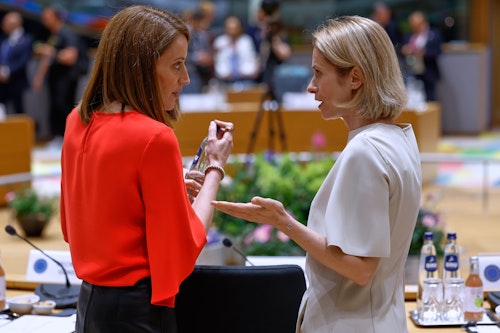
Credit: Associated Press
'Every peace begins with talks', Austrian Chancellor says about Russia
Austria's Chancellor Christian Stocker said that he stands for "conversations and channels" that can lead to peace, referring to possible talks with Russia to reach an end of the war in Ukraine.
However, the Austrian leader said he has not yet received a "corresponding answer from the Russian side".
"I do not have the impression that Russia, especially President Putin, wants to come to negotiate a peace resolution. I think it's too early to consider easing sanctions, because we have to see how this agreement is implemented in practice. But it is definitely a reason to be careful and optimistic, because it is an improvement on the situation before," Stocker said.
Commenting on the recent US–Iran peace agreement, Stocker said developments in oil prices were a positive signal, but added that there was “still a lot to be done” to reach a sustainable solution.
Leaders begin gathering in the room
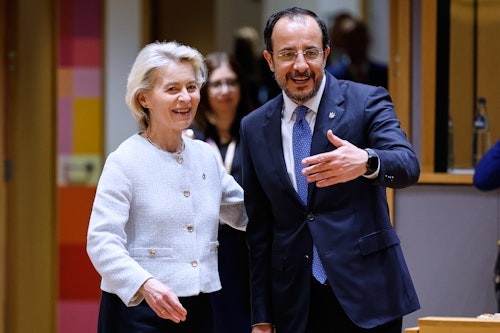
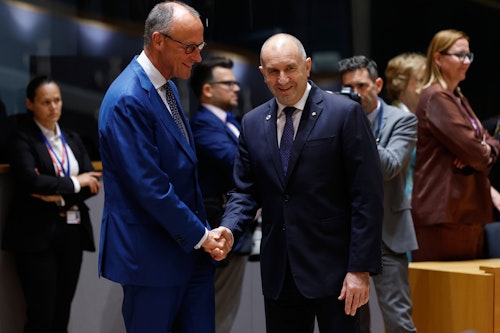
Credit: Associated Press
Plenković expects 'constructive approach' from Magyar
Croatian Prime Minister Andrej Plenković says he expects a "constructive approach" from the new Hungarian prime minister, Péter Magyar. Both of them belong to the centre-right EPP.
"That's democracy, we have Péter Magyar now," the Croat said about the April elections in Hungary that ousted Viktor Orbán after 16 years. "We respect the will of the Hungarian people."
Asked about what he expects from Magyar's new executive, he said: "When it comes to Europe, a constructive approach. When it comes to bilateral relations with Croatia, I think a new phase for improving our relations. We are ready for that."
Finland's Orpo: 'Turning point in the war in Ukraine'
Finnish Prime Minister Petteri Orpo said he sees a clear “turning point” in the war in Ukraine.
"Ukraine is getting stronger, and Russia is weakening. And that's why my message here is that this strategy needs to be continued. Support Ukraine militarily, economically, politically and at the same time continue to exert heavy pressure on Russia," he told reporters upon arriving at the EU summit in Brussels.
On Ukraine's accession, Orpo said he would encourage the EU to open all the clusters of negotiations during the summer.
He also addressed the EU’s critical dependencies, saying he would present fellow leaders with a roadmap to assess the level of criticality of each and identify appropriate solutions.
On the EU's multi-year budget, Finland considers the total amount proposed by Cypriot Presidency as too high. "We need to prioritize defence, security, competitiveness and important issues for Finland, such as support for the sparsely populated northern region," Orpo said.
'The Chinese do whatever they can to undermine our businesses,' Danish PM says
The EU is in a different situation than the last time it negotiated a budget, Denmark's Prime Minister Mette Friedrikesen said, warning that the bloc is losing its competitive advantage vis-à-vis China and the US.
"Unfortunately, there is uncertainty in the world trade area, also from the Americans' side. The Chinese do whatever they can to undermine our businesses. And we have lost part of the technological competition," Friedrikesen.
"When you put everything together, Europe is in an extremely difficult situation. And we need more muscle. But they have to be muscles for the right thing. We need to spend more money on defence, on technology, on energy. But not on the old land use regulations."
Migration rules 'a great victory for Denmark' – Frederiksen
Denmark's Prime Minister Mette Frederiksen has hailed the new migration rules backed by the EU co-legislators and said EU leaders now have to focus on the next steps to implement them.
"We can now begin to establish both reception and travel centres outside the EU when it comes to foreign countries," Frederiksen said. "It is a great victory for Denmark. We have worked with this for many years."
The Danish PM added is that Europe cannot solve foreign problems on its own territory, but can liaise with third countries that will help manage the arrivals of migrants.
EU not ready to discuss lifting sanctions on Iran – Kallas
The conditions are not yet right to discuss lifting sanctions on Tehran, EU chief diplomat Kaja Kallas said ahead of the European Council meeting.
The recently announced US-Iran framework deal would see Tehran give up on future attempts to acquire nuclear weapons in exchange for the lifting of international sanctions.
"We have different sanctions on Iran. Those that are related to nuclear, of course, if there is a nuclear deal, then I think the member states will discuss this. Then there are also sanctions on human rights violations, and we see the human rights situation is actually more difficult than it has ever been," Kallas said.
She also mentioned that some of the sanctions related to Iran's interference with freedom of navigation, which might be reviewed once the Strait of Hormuz is reopened.
Spain's Sánchez backs efforts to revive Ukraine-Russia peace talks
Speaking to reporters, Spain's Prime Minister Pedro Sánchez has said he is open to supporting efforts to reach a peace deal for Ukraine.
"You know that in the past hours we've learned about the EU institutions' readiness to try to open a channel of dialogue with the Russian authorities to start a diplomatic channel," Sánchez said.
"I wanted to say that, besides the fact that we clearly continue to support Ukraine (...) we are open to support any efforts to find peace and end the war in Ukraine."
The prospect of reviving peace efforts and the EU's role in any prospective peace talks is expected to be debated at the summit. Some leaders, notably Italy's Giorgia Meloni and France's Emmanuel Macron, had been urging the EU to demand a seat at the negotiating table, but the calls were met by resistance by some more sceptical member states.
The question is now back on the table, with European Council President Antonio Costa beginning to lay down the groundwork to open communication channels with Moscow.
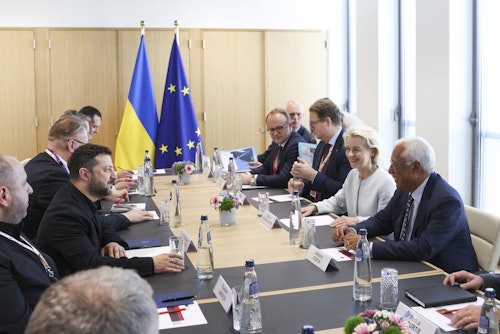
Zelenskyy meets with von der Leyen and Costa
Ahead of the EU summit, Volodymyr Zelenskyy held a meeting with Ursula von der Leyen and António Costa. Both hailed the strong momentum that Ukraine is enjoying on the battefield.
EU position on Russia updated after foreign ministers' talks – Kallas
The EU's position on how to negotiate with Russia during the peace process for the war in Ukraine has been updated after the latest discussions among the bloc's foreign ministers, EU chief diplomat Kaja Kallas said.
"After the last meeting, I also updated the [position] paper where we have listed different core interests. And I think this is important that these asks are also made to Russia," she said.
Kallas reiterated that Brussels cannot be a neutral mediator in negotiations with Moscow since it is clearly on Kyiv's side, and since it has its own security interests to consider.
EU, Franco-UK naval missions can work together in Hormuz, Kallas says
EU foreign policy chief Kaja Kallas said that the bloc's mission in the Red Sea, Operation Aspides, and the coalition of the willing led by France and the UK could work together to secure the Strait of Hormuz.
"These two can work hand in hand and with operational speed. We are ready to work, and the coalition of the willing is also quite far," she said.
Kallas previously proposed the expansion of the scope of the Operation Aspides to the Persian Gulf. The naval missions would be tasked with reinstating the freedom of navigation in the Strait of Hormuz following the achievement of a final peace agreement between the US and Iran, including by removing sea mines.
'We usually support Israel in standing up for their own interests,' Estonian PM says
Estonia Prime Minister Kristen Michal said that "hopefully" Israel will understand that the rules-based world in Europe is "probably its best friend".
"As everybody knows, we usually support Israel in standing up for their own interests, but hopefully this will be resolved among friends," Michal said in relation to EU Foreign Affairs Representative Kaja Kallas' comments about Israel, which have triggered a wave of ire against the former Estonian leader.
"Kallas has also publicly said that she is representing the European Union's position, and that should be accepted," Michal said.
Romanian president welcomes EU focus on drone threat at Brussels summit
Romanian President Nicușor Dan welcomed the decision to place aerial drones high on the agenda of the Brussels summit, telling journalists on Thursday that the issue deserved significant attention.
On 29 May, a drone crashed into an apartment building in eastern Romania during an attack on Ukraine. A NATO spokesperson told Reuters that the drone was of Russian origin, despite Russia denying any wrongdoing.
“As a result of the work of our colleagues in Brussels, the conclusions of the Council will include the issue of drones and aerial drones that we have had on our territory and, consequently, a strengthening of the Eastern Flank Watch,” Dan said, referring to the final document that will be produced at the end of the summit, the so-called "conclusions" and the NATO’s patrolling mission.
EU leaders meet in Brussels today and tomorrow to discuss key geopolitical topics, including defence, the war in Ukraine, the EU's long-term budget, as well as the Middle East.
'We don't always see eye to eye with the Israelis' – Kallas
Kaja Kallas, the EU's top diplomat, said she has been representing the EU position in talks with the Israeli government, admitting that "we don't always see eye to eye with the Israelis".
She cited in particular the often violent expansion of illegal settlements in the West Bank.
After Kallas allegedly compared the Israeli occupation of the Palestinian territory to South Africa's apartheid system, Israel's Foreign Minister Gideon Sa'ar threatened to cut all communications with her. Asked for her thoughts, Kallas said talks have to be open.
"I've had very good, open and frank and sometimes very difficult discussions with Minister Sa'ar that I found very constructive. We are willing to continue with this, but we can't deny the criticism."
‘Russia is once again raising an iron curtain,’ says Commission president
“The tide is turning,” Ursula von der Leyen said, referring to Ukraine’s recent gains on the battlefield.
The European Commission president said Ukrainian forces are holding their ground and making gradual territorial gains, while reaffirming the EU’s commitment to stand by Kyiv for as long as necessary.
Von der Leyen praised the €90 billion loan facility, the first tranche of which is expected to be discussed by EU leaders during the summit.
By contrast, she said, Russia’s economy is now “suffering”.
“The fact that Russia has shut down the internet and closed down platforms such as Telegram speaks for itself, because Russia is once again "raising an iron curtain,” von der Leyen said.
Ukraine brought Moscow’s war back to Russian territory – Nausėda
“Ukraine is prevailing in this war”, Lithuanian President Gitanas Nausėda declared as he arrived at the EU summit.
“We see more and more evidence that the war in coming closer to the Russian population,” he said, referring to the Ukrainian drone attack on a Moscow refinery early this morning.
He stressed that Kyiv’s strike campaign will make Russians see that the war is ”not about watching it on TV," but having it come to them.
The Lithuanian president said he supports the idea of having "one European voice" in any possible talks with Russia, but insisted that so far, Moscow has shown no willingness to talk to Ukraine or Europe.
Zelenskyy pushes to open all EU accession clusters this summer
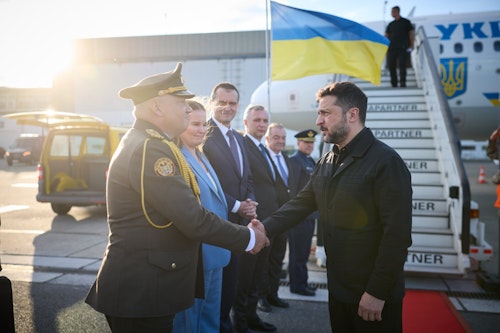
Arriving at the EU summit alongside European Council President António Costa and European Commission President Ursula von der Leyen, Volodymyr Zelenskyy said he intended to discuss the opening of all EU accession negotiation clusters for Ukraine.
He reaffirmed Kyiv’s push for a faster path to membership, despite concerns from several member states that such an approach could place Ukraine ahead of other candidate countries.
Both Costa and von der Leyen refrained from specifying which accession clusters might be opened next, instead expressing gratitude to EU leaders for their unanimous decision earlier this week to begin negotiations on the “fundamentals” cluster with Ukraine and Moldova.
Nonetheless, von der Leyen praised Ukraine’s progress, arguing that as Kyiv continues to fulfill its commitments, the EU must also uphold its obligations and deliver on its promises.
Zelenskyy is clearly seeking to capitalise on the momentum from his G7 gains to keep pushing for faster movement on accession.
EU budget should not 'contribute to further economic disparities' – Greek PM
Greek Prime Minister Kyriakos Mitsotakis has warned that the EU's next long-term budget should not increase disparities among the bloc's member states.
"Let’s discuss the new Competitiveness Fund, which is intended to support European businesses in the face of global competition. It must be distributed fairly, so that it does not contribute to further economic disparities between the strong and the weaker economies," he said in remarks earlier.
Mitsotakis added that Greece is, with other countries, backing the EU's traditional funding instruments for cohesion policy and common agricultural policy.
"I have said many times that the ambitious goals we have set require equally ambitious financing tools."
Reopening of Strait of Hormuz must lead to lower energy prices – Mitsotakis
Welcoming the US-Iran framework to finalise a peace deal, Greek Prime Minister Kyriakos Mitsotakis said that the top priority should be the full restoration of freedom of navigation in the Strait of Hormuz.
"Of course, we are monitoring oil and natural gas prices very closely," he said. "We have already seen an initial significant easing, and it is the Greek government’s duty to ensure that the drop in crude oil prices is immediately reflected in lower prices for diesel and gasoline at the pump, thereby benefiting all Greek consumers."
'There cannot be any new European debt,' Merz says
German Chancellor Friedrich Merz rejected the idea of joint borrowing as he told reporters that today and tomorrow EU leaders and heads of state will discuss topics of "great importance" for the future of the bloc.
"I do not want to hide the fact that we also have a very difficult topic, namely the question of the future financial framework of the European Union," Merz said.
The German leader said these discussions must be "intense" over the course of the year, and confirmed that tomorrow, leaders will hold an orientation debate to assess "where we stand and where we want to go".
Merz wants to get rid of more red tape
At the start of the EU summit in Brussels, German Chancellor Friedrich Merz called for further efforts to reduce bureaucracy in order to strengthen European competitiveness.
“We want to gradually roll back European bureaucracy. It’s a very slow process, but it’s possible,” Merz said upon his arrival at the Council building.
He noted that this was one of the summit’s most important topics. He expressed his gratitude to European Commission President Ursula von der Leyen for the initiatives taken so far.
Existing global economic inequalities must also be discussed further, according to Merz.
On Iran, Merz reiterated Germany’s willingness to provide military support for the framework agreement negotiated between Washington and Tehran regarding the opening of the Strait of Hormuz, for example through mine-sweeping vessels from the German Navy.
However, he noted that this would require a clear legal basis, above all a corresponding resolution by the German Bundestag. Berlin would deliberate on this “at its leisure.”
When asked about Kaja Kallas’s comparison of Israel to apartheid, Merz said he did not share that characterization at all.
Péter Magyar “happy to represent Hungary” as he meets EPP leaders and Metsola ahead of first EU summit
Hungarian Prime Minister Péter Magyar arrived in Brussels on Thursday to participate in his first European Council summit since taking office in April. During his visit, he met with European Parliament President Roberta Metsola and attended the European People's Party's meeting ahead of the summit.
"I am very happy that I represent Hungary as Prime Minister here in Brussels. I am especially happy that today we have the strongest political mandate in the EU, thanks to the Hungarian people," Magyar told Euronews on the sidelines of the EPP meeting.
He added that enlargement, the EU budget, and competitiveness would be the summit's key topics.
After meeting with fellow EPP leaders, Magyar held bilateral talks with Slovak Prime Minister Robert Fico. The discussions were later broadened to include representatives from the Visegrád Four countries.
Magyar also participated in a meeting of the "Friends of Cohesion" group — a bloc of 16 member states which seek to preserve agricultural and cohesion funding — before joining the full session of the 27 EU leaders.
In a social media video posted from Brussels, Magyar said Hungary could sign the summit's conclusions, and indicated that negotiations were under way to accommodate Budapest's requests regarding the final text.
The comments reflect a shift in Hungary’s approach to EU summits. During the tenure of former Prime Minister Viktor Orbán, Budapest frequently refused to endorse common positions, forcing the remaining member states to issue joint statements on behalf of 26 countries.
Rob Jetten: 'We should not be naive with Putin'
Dutch Prime Minister Rob Jetten warned Europe against being "naive" about Russian President Vladimir Putin, as European Council President António Costa considers establishing diplomatic outreach with Moscow to help bring the war in Ukraine to an end.
"Russians are losing this war both on the battlefield and economically. So I think the best thing that we can do is support Ukraine, make sure that they can continue their counter-attacks," he told reporters before attending the Renew Europe group's meeting ahead of the EU summit in Brussels.
There is no "clear indication that Putin is actually willing to have serious negotiations," he added.
Jetten also firmly rejected the Cypriot presidency’s proposal for the EU’s next long-term budget. The issue is expected to be one of the key topics on the agenda as EU leaders convene for the summit.
"It is not a proposal that we can take very seriously. I think we are very far from any agreement," he said, advocating for a budget "that invests in our security and a strong economy."
The Netherlands, like other "frugal" countries, is pushing to cut EU funds meant to finance the cohesion policy and the agriculture sector. "I think we can divert some of the budget from the funds that we've had over the past few decades more towards the big challenges that we face," he said.
Russian dissident assassination might be 'state terrorism' – Tusk
Polish PM Donald Tusk said that the murder of Russian artist Semyon Skrepetsky might be "a politically ordered murder by a foreign state."
On Thursday, the Lublin police and the Internal Security Agency arrested a suspect in the murder of the Russian dissident, who was shot dead in Poland on Monday.
"I don't need to convince anyone that we fear there is the possibility of state terrorism," Tusk said, adding that while such assassinations have already occurred across Europe, it would be a first for Poland.
"These are hypotheses for now, but we have to take them very seriously."
Tusk 'optimistic' about permanent American base in Poland
Polish Premier Donald Tusk welcomed a US government letter expressing interest in Poland's offer for a potential permanent American base on its territory.
"I'm optimistic, but I didn't expect such a quick and positive reaction," the Polish PM told reporters ahead of the European Council in Brussels. He added that further arrangements were needed, but he felt the proposal was on a "very good path."
For the Polish leader, a permanent US military base would radically change the country's sense of security.
'Very special moment': Tusk hails Visegrad revival ahead of EU summit
"We are launching the first Visegrad Group meeting in years here in Brussels," Polish Prime Minister Donald Tusk said as he arrived at the European Council summit.
The Visegrad Group, or V4, is a semi-formal bloc comprising Czechia, Slovakia, Hungary and Poland. It lapsed into obsolescence after the full-scale invasion of Ukraine in 2022 as Warsaw and Budapest did not see eye to eye on how to approach Russia.
But a revival is now on the cards since Péter Magyar ousted Viktor Orbán from government in a landslide electoral victory in April, leading to a rapprochement with Poland.
"This is a very special moment, because I’m keen to get this group moving again, as we have a few common issues to address in Europe," Tusk said.
New Latvian Prime Minister says Ukraine has "earned" its place in the EU
Presenting himself as the "new guy in town", Latvia's recently-appointed Prime Minister Andris Kulbergs has just told reporters that Ukraine is "the one fighting for peace in Europe", and that the country has definitely earned its place in the EU and NATO".
He also weighed in on the ongoing debate on appointing an EU envoy to peace talks between Ukraine and Russia. "First of all there has to be someone on the other side wanting peace," he explained, adding: "Nobody wants peace unfortunately from that side. So there is no point of contact."
Kulbergs' government was recently elected after the previous coalition collapsed over a disagreement related to stray drones that have been increasingly crossing into the Baltic state's airspace. He said that he would be "very vocal" on the issue of the threats facing Europe's eastern flank, citing the toll that the war in Ukraine is taking on his Baltic nation's economy.
US-Iran deal must be implemented, Cyprus president says
Nikos Christodoulides, the president of Cyprus, has welcomed the memorandum of understanding between the US and Iran. As you might remember, in the early days of the war, a drone hit the British military base in Cyprus, briefly raising fears of a military spillover.
"For sure, the situation is much better than it used to be," Christodoulides said upon arrival at the summit.
"What we need to do now is (ensure) that whatever is signed will be implemented," he added. "It's important to have an agreement and have the implementation of the agreement."
Cyprus currently holds the rotating presidency of the EU Council.
Ukraine wants to open all clusters ‘in the coming weeks’ – Zelenskyy
Volodymyr Zelenskyy said one of his priorities at the EU summit on Thursday is to fast-track Ukraine's EU accession process, an idea many in the bloc reject as unfair to other candidate countries.
Speaking with reporters in a presidential WhatsApp chat on Thursday morning, Zelenskyy said Kyiv is “grateful to all the countries of the European Union for opening the first cluster”, calling it a "significant step forward”.
“We are not stopping there. Our aim is that in the coming weeks and months – preferably within weeks – we will be able to open the other five clusters, so that all six clusters are operational and pave the way for our future EU membership."
Four freshly-elected faces join EU summit
Today’s meeting of EU leaders will feature four brand new prime ministers.
Hungarian Prime Minister Péter Magyar makes his EU summit debut, after ousting Viktor Orbán in the election in April. He has vowed to open a new chapter in the relationship between Brussels and Budapest, lifting some of the previous government’s long-standing vetoes on crucial foreign policy decisions and unlocking billions of euros in EU funds frozen under Orbán’s rule.
Bulgaria’s Prime Minister Rumen Radev (who has attended previous summits in his capacity as Bulgaria's President) attends his first summit since winning the April election. He has repeatedly opposed sending military aid to Ukraine, but is not expected to disrupt EU decisions to the same extent as Orbán.
After piecing together a government in the aftermath of inconclusive elections in March, Slovenia’s Janez Janša is back in Brussels in what is his fourth term in power. Janša, a veteran nationalist politician, is a Trump admirer; whereas the previous Slovenian leader, Robert Golob, was a staunch supporter of Palestine, Janša is expected to oppose any efforts to sanction Israel.
And joining for the first time is Latvia’s recently-elected Prime Minister Andris Kulbergs, who formed a centre-right government three weeks ago after the previous coalition collapsed amid a row over a stray drone.
From G7 to EU: what’s on Zelenskyy’s agenda in Brussels?
Volodymyr Zelenskyy began his visit to Brussels with a meeting with Mark Rutte on Wednesday evening. Ukraine’s president said the two discussed the measures agreed by the G7, in particular those aimed at strengthening Ukrainian air defences.
On Thursday, his one‑day programme in Brussels is divided between NATO and the European Council summit:
11:15 – Meeting with Belgian prime minister Bart De Wever.
13:00 – Audience with King Philippe of the Belgians.
14:40 – Meeting between Zelenskyy, NATO’s Rutte and the defence ministers of Ukraine, the UK and Germany.
15:00 – Meeting of the Contact Group on Ukraine’s Defence in the “Ramstein” format.
16:55 – Arrival at the European Council for the summit.
Zelenskyy is also expected to hold a series of bilateral meetings with EU leaders before joining the European Council meeting at 18:45.
Bulgarian prime minister opposes EU sanctions on Russia's Patriarch Kirill
Bulgaria's new prime minister, Rumen Radev, says he opposes EU sanctions on Russia's Patriarch Kirill. The name has been included in the 21st package of sanctions presented last week.
"The era of Crusades is over," Radev said on Thursday before flying to his first-ever summit in Brussels.
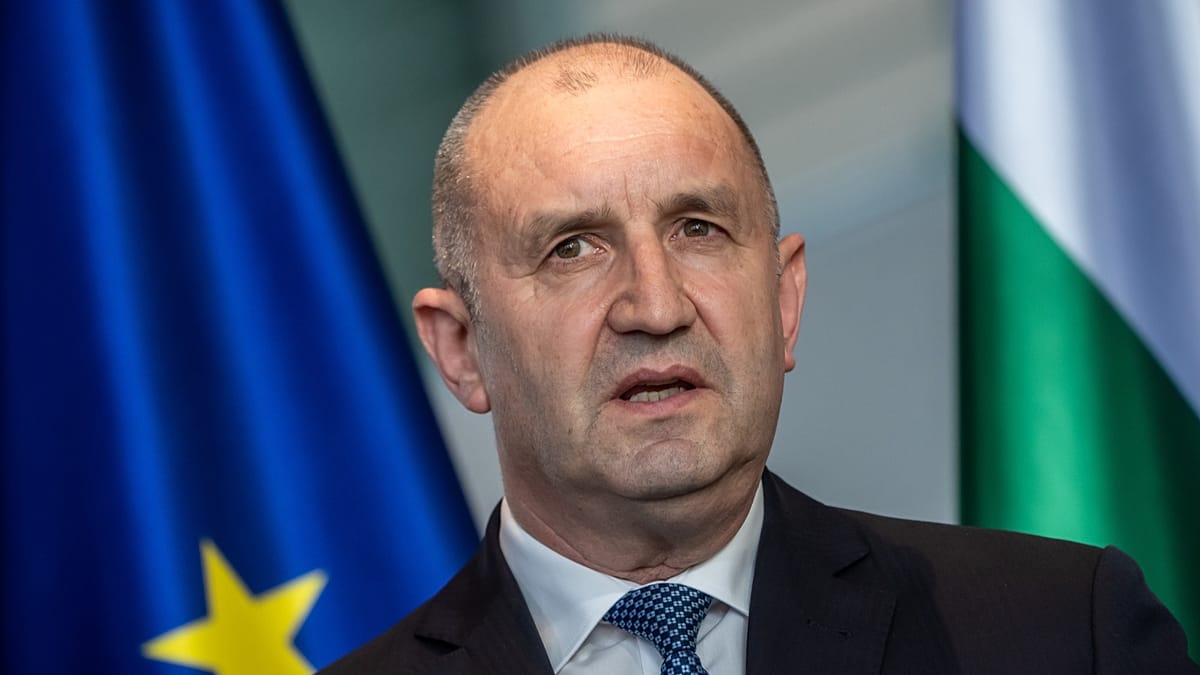
Bulgarian PM opposes EU sanctions on Russia’s Patriarch Kirill
“The era of the Crusades is over,” the Bulgarian prime minister said on Thursday as he confirmed his opposition to the proposal. #EuropeNews
What to expect from this EU summit
Welcome to our live blog!
We will keep you updated today and tomorrow on everything that happens at the EU summit in Brussels.
First, here's what's on the agenda.
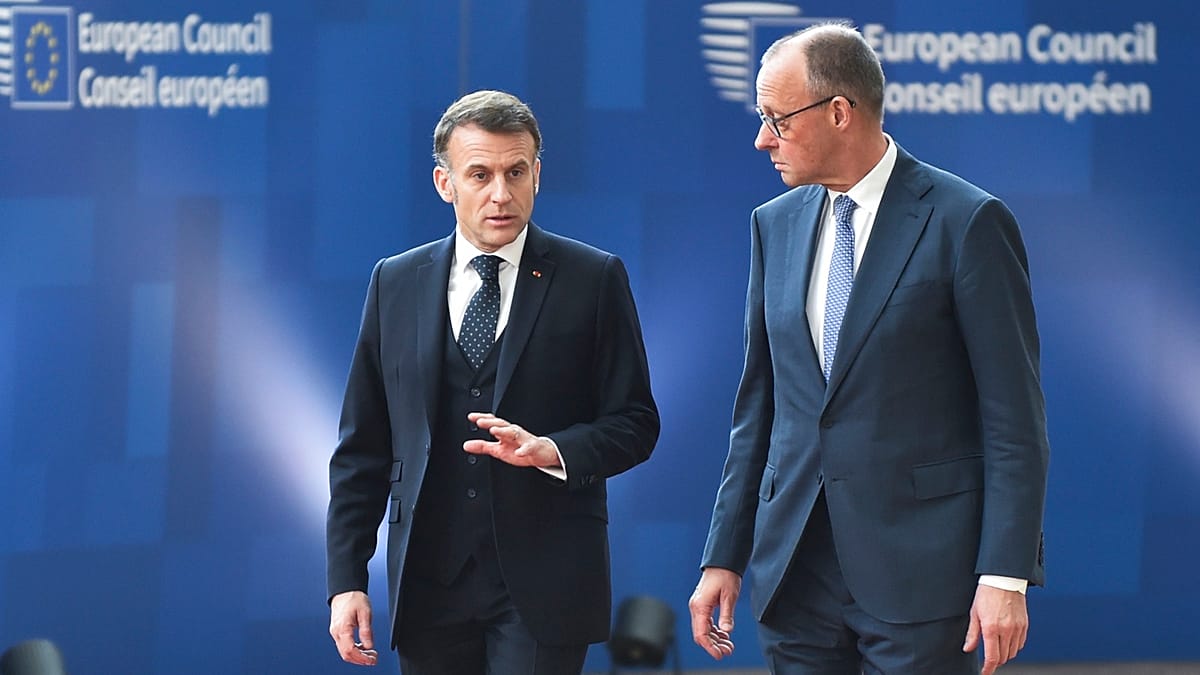
EU leaders meet to discuss Ukraine, China shock and €2 trillion budget
Russia’s war on Ukraine, unfair Chinese competition and the next long-term budget top the agenda of the EU summit. #EuropeNews