




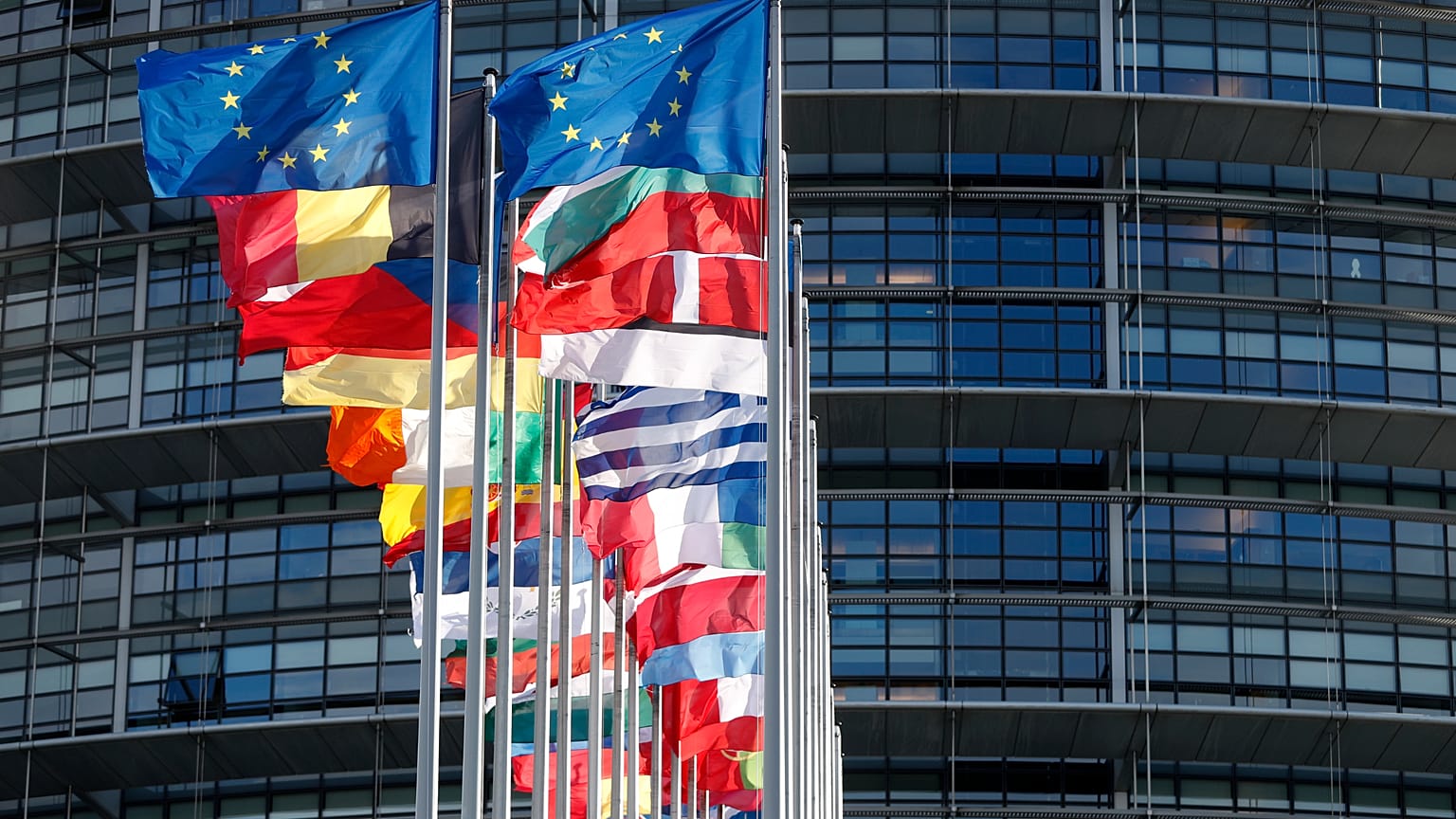













Dozens of European leaders and heads of state from the six Western Balkan countries will be in Montenegro on Friday for talks about how to grow the European Union. Also in the newsletter: how Europe balances trade with the US and China.
Good morning, Brussels. Angela Skujins hereon newsletter duty, helping you ride out the last day of the week. EU enlargement is on the minds of everyone in the Belgian capital — as well as the tiny Montenegrin town of Tivat.
 ADVERTISEMENT
ADVERTISEMENT
ADVERTISEMENT
Western Balkans bundle. EU institutional figureheads and up to 30 European heads of state will today meet six Western Balkan leaders for a bi-annual summit aimed at accelerating the countries’ bid to join the 27-member club. Euronews’ Europe Editor Maria Tadeo sat down exclusively with the European Council President António Costa on Montenegro’s sun-soaked coast to speak about the event and the symbolism it brings to the Balkan region.
“I'm very optimistic about the summit, first of all, because the landscape is very inspiring,” he said in comments on Euronews’ flagship morning news programme Europe Today. Costa, flanked by yachts and the Adriatic Sea, speaks on Thursday from Montenegro, a country widely considered a clear frontrunner, alongside Albania, for joining the EU.
“Montenegro shows that effectively it's possible to move forward on this enlargement, that the member states want this enlargement and the candidate states want to and can effectively make the necessary reforms to enter in the European Union,” he said. Watch.
Over the last five days, Costa has visited the six Western Balkan partners: Bosnia and Herzegovina; Albania; North Macedonia; Kosovo; Serbia; and finally, Montenegro — the country billing itself as the EU’s 28th member state by 2028.
But not all candidate countries are perfect. Albanian Prime Minister Edi Rama has attracted fierce controversy in recent days for approving a Trump family-linked resort on a fragile stretch of coast.
In recent weeks, Serbian President Aleksandar Vučić has repeatedly defended his relationship with Beijing while castigating Brussels — treading a fine line between what is acceptable from the EU’s security framework perspective, and what is not.
Belgrade has also been under fire for concerns including pressure on the judiciary, restrictions on media freedom, and a crackdown on protests.
The EU-Western Balkan Summit comes at a fortuitous time. In Brussels, 1,800 kilometres away, a seismic shift occurred. On Wednesday, Hungary lifted its veto on Ukraine’s accession process. “Prime Minister (Péter) Magyar announced that he believes that in three weeks they are in (a) condition to release the veto and we can move forward,” Costa said about what is only being described as a breakthrough.
“Fortunately, we didn't lose time during this period because the Commission and Ukrainian authorities started last year, these negotiations,” he said.
Ukraine lodged its EU accession bid in 2022, the year that Russia launched its full-scale invasion. Kyiv sees its EU membership as a sure-fire way to bolster its defences against the continued war, but the opening of negotiations has been repeatedly stalled due to protestations by the former Hungarian Prime Minister, Viktor Orbán.
The new government, led by Magyar, has made significant inroads in Kyiv-Budapest relations, most recently by announcing a deal on Hungarian minority rights in Ukraine. "We have reached a comprehensive agreement with Ukraine on the expansion of the linguistic, educational, cultural and political rights of the 100,000-strong Hungarian minority," Magyar said on Wednesday on a Facebook video.
This deal paved the way for Hungary to drop its veto. In a must-read exclusive story, my colleagues Jorge Liboreiro, Sasha Vakulina, Sándor Zsiros and Luca Bertuzzi take you inside the room and in the minds of the pivotal figures to explain how the tides finally shifted. "All Brussels was waiting for this," a diplomat said. "It's unbelievable. It's good news."
A different kind of negotiation. The EU’s trade chief Maroš Šefčovič occupies one of the hardest jobs in Brussels, balancing the interests of the bloc with trade relations with Beijing and Washington.
The European Commissioner for Trade will speak at an event sponsored by Euronews, the Brussels Economic Security Forum, on Friday in the Belgian capital. The speech comes a day after he met with the US Trade Representative, Ambassador Greer, at the OECD conference in the French capital. Following the meeting, Šefčovič trotted out his usual stump speech: that the EU and the US had reaffirmed their “shared” commitment to “keep moving forward in good faith”.
It came after a surprise announcement from US President Donald Trump on Tuesday that threatened to, once again, rupture relations between the transatlantic allies. The Trump administration proposed imposing additional tariffs of 10% or 12.5% on imports from 60 economies, including the EU. The announcement was denounced by the Commission.
Šefčovič’s highly-anticipated speech, focussing on mobilising strength for Europe’s security, also comes a day after he met with his Chinese counterpart, Chinese trade envoy Li Chenggang. Following the bilateral, also in Paris, the EU’s trade boss told reporters he will continue trying to speak to the Chinese to resolve what is becoming an “unsustainable” trade deficit.
The EU’s trade deficit with China is ballooning and shows no signs of abating. In the first quarter of 2026, the Commission puts this figure at €98 billion — the highest gap since the previous record was set in 2022 at €107 billion.
On Thursday, in comments to Euronews’ Shona Murray, Lithuania’s Foreign Minister Kęstutis Budrys highlighted that while Russia has forced Europe to rearm, China is exacerbating Europe’s defensive challenges by its chokehold on key minerals needed for European weapons. “China's dominance of critical raw material supply chains and its willingness to weaponise them already restricts our defence industry,” Budrys said.
Speaking of Moscow. My colleague Vincenzo Genovese has reported that as Russian President Vladimir Putin and Ukrainian President Volodymyr Zelenskyy inch closer to a possible meeting to end the war, the European Union is considering tightening the screws on Ukrainians’ access to temporary protection.
Countries including Poland and Germany are pushing to exclude military-age men from the status, which grants the right to reside and work in the EU until March 2027. At a meeting of EU interior ministers in Luxembourg on Thursday, several options for narrowing the scheme were discussed.
But the proposal gaining the most steam excludes Ukrainian men aged 23 to 60, who are eligible for military service, from receiving the temporary protection. The move would also please Kyiv.
EU sources have told Euronews that the Commission should propose something concrete soon.
'It's not happening': EU loses hope in maritime services ban for Russian tankers
Officials and diplomats in Brussels are growing increasingly pessimistic about the chances of enforcing a full ban on maritime services for Russian tankers, as both internal and external factors weigh against the ambitious proposal.
"It's not happening," a diplomat bluntly said, according to reporting by Jorge Liboreiro.
The ban was approved in late April as part of the 20th package of sanctions to cripple Moscow's war economy. It is designed to prohibit all maritime-related services, including banking, shipping, flagging and insurance, for tankers carrying Russian oil. Crucially, the far-reaching measure was left on hold sine die.
The official reason for the pause was a desire to reach an agreement at the G7 level following the example of the price cap, which was adopted in conjunction with allies.
"This was the best way to send a signal that we were ready," another diplomat said. "It was a deliberate choice."
However, other G7 members have shown little to no enthusiasm in following suit. The United States has moved in the opposite direction by issuing three successive sanctions waivers on Russian oil to cope with the turmoil unleashed by the Strait of Hormuz. Recent moves from the United Kingdom have also raised eyebrows in Brussels.
Although the EU has flat-out refused to ease sanctions, it has delayed a long-awaited proposal to phase out imports of Russian oil. G7 leaders will meet in Evian, France, in mid-June. Ukrainian President Volodymyr Zelenskyy, who has called for stronger sanctions on Russia, is expected to attend.
Publicly, the European Commission, the Baltics and the Nordics continue to push for the services ban to be enforced and raise the material costs for Russia's energy sector.
But officials and diplomats admit that turmoil in energy markets, coupled with persistently high oil prices, is a powerful deterrent to activating the untested measure, which was unveiled just weeks before the US and Israel launched strikes against Iran.
More from our newsrooms
Greenland is part of Denmark 'for now,' US Secretary of State Marco Rubio says
US Secretary of State Marco Rubio has reignited the flame over the US's continued pursuit of Greenland. While testifying before the House Foreign Affairs Committee on Wednesday, he was asked by congresswoman Sarah McBride whether he was "aware that Greenland is indeed part of Denmark". "For now," Rubio replied. Nathan Rennolds has more on the story.
'No more shopping weekends': 11 European countries seek tougher Russian visa rules
Eleven European countries are pressing for tougher visa restrictions on Russian tourists, arguing that holiday travel while the war in Ukraine continues undermines EU solidarity, weakens pressure on Moscow and creates potential security risks. Luca Bertuzzi, Jorge Liboreiro and Vincenzo Genovese have more.
Be less polite: How to cut your AI impact as UN report reveals data centre energy use rivals nations
The environmental footprint of data centres already rivals some of the world's largest countries, according to a United Nations University report released on 3 June. AI users can reduce the climate impact of their queries for artificial intelligence bots by being less polite and more concise in their queries, one of the report's authors advises. Angela Barnes looks at the data.
We're also keeping an eye on
- EU ministers responsible for cohesion will meet for an informal gathering in Lefkosia, Cyprus.
- EU ministers responsible for justice and home affairs will meet in Luxembourg for a second day of talks, focussing on justice.
- European Commissioner for Defence Andrius Kubilius will visit the facilities of defence companies Thales and FN in Wallonia, Belgium.
That’s it for today. Jorge Liboreiro and Vincenzo Genovese contributed to this newsletter.