

















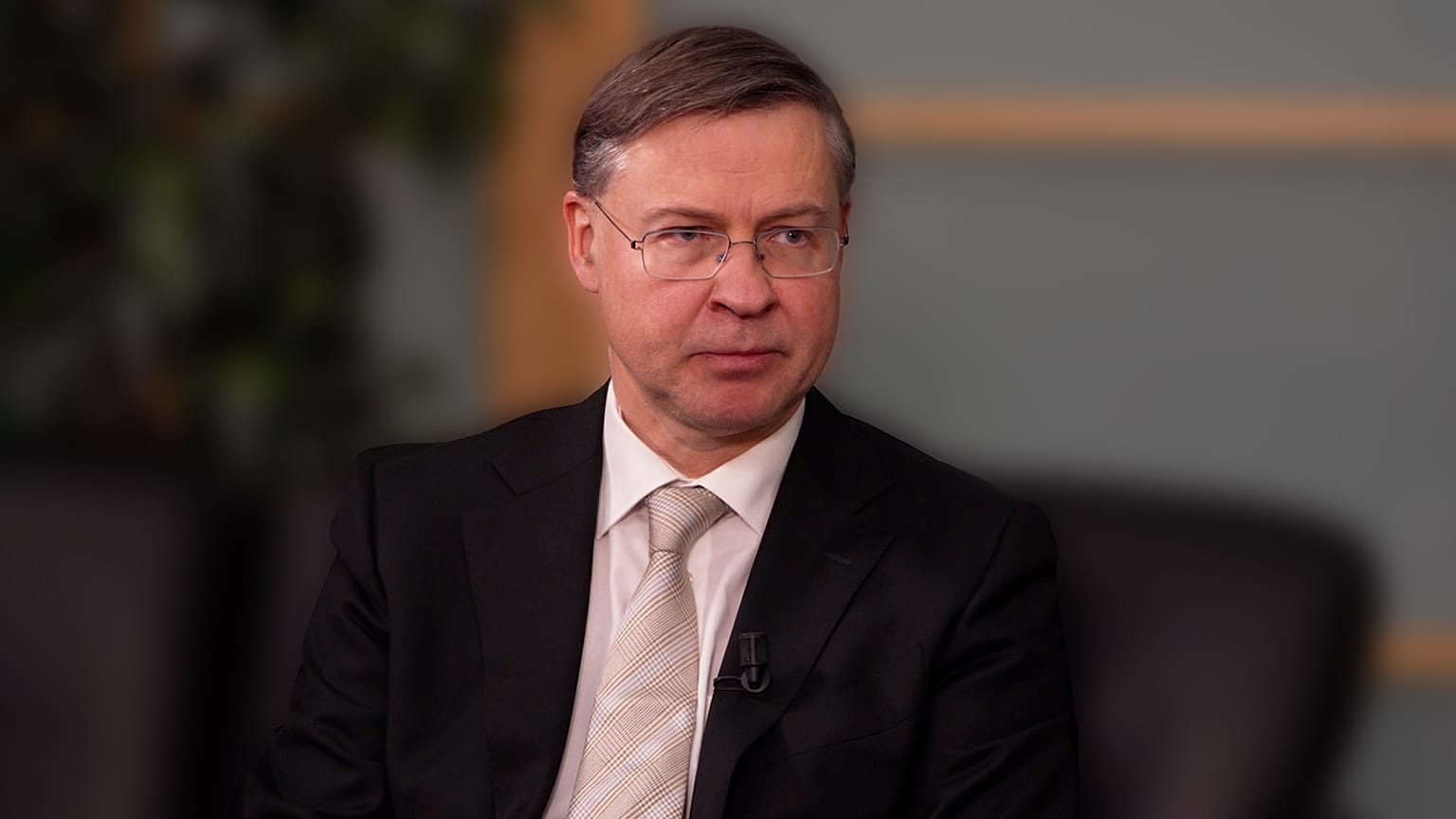














Exclusive: European Commissioner for the Economy Valdis Dombrovskis said Russia is milking the crisis in the Middle East for energy profits – and the EU will not ease on its sanction regime for cheaper oil or gas flows.
European Commissioner for the Economy Valdis Dombrovskis has said in exclusive comments to Euronews that the EU “should not” look to cheap Russian fossil fuels and gas for relief as the energy crisis persists.
 ADVERTISEMENT
ADVERTISEMENT
ADVERTISEMENT
“If anything, we need to strengthen sanctions against Russia, not ease, because actually Russia is a country benefiting from this conflict in the Middle East and those higher energy prices, getting substantial windfall profits, so we should not facilitate it further,” Dombrovskis told Euronews’ Europe Today programme.
On Tuesday the UK government published an open-ended licence allowing the import of diesel and jet fuel made from Russian crude oil in other countries, such as Turkey and India, where the oil is purchased at discounted prices.
A separate licence enables the provision of short-term service contracts with Russia's Sakhalin-2 and Yamal LNG projects until January 2027.
As Ukraine and its allies were left blindsided by the announcement – an unusual move from London as Prime Minister Keir Starmer has remained one of Ukraine’s staunchest supporters – number 10 Downing Street downplayed the incident as poor communication.
Asked whether the EU would walk back some of its sanctions targeting Russian oil and gas to support households faced with mammoth energy bills, Dombrovskis ruled out the possibility and said there is a “strategic decision” to continue moving away from Moscow.
“We already saw back in 2022 that Russia tried to use its fossil fuel supplies as a tool for blackmail and manipulation, and we paid a quite dear economic price for having this dependency from Russia, so therefore there's no point of going back to this,” he said.
Europe’s economy is projected to weaken this year as the war in Iran and ongoing tensions in the Middle East have sparked the second biggest energy crisis in the past five years following Russia’s invasion of Ukraine.
Dombrovskis said there was no risk of Europe being plunged into blackouts, a concern that had emerged during the 2022 energy crisis.
EU lawmakers have pushed to formally ban all remaining Russian gas flows by 2027 and permanently phase out oil imports earlier than expected.
The Rome conundrum
On Monday Italian Prime Minister Giorgia Meloni urged the EU to treat the energy crisis like the defence emergency – and for the bloc to relax fiscal rules considering increased energy costs.
In a letter sent on Monday to Commission President Ursula von der Leyen and seen by Euronews, Meloni said the EU should show the same “political courage” on energy as it has on defence.
“If we rightly consider defence to be such a strategic priority as to justify the activation of the National Escape Clause, then we must have the political courage to recognise that today energy security is also a European strategic priority,” the letter reads.
Dombrovskis said that the EU is “looking at policy options” in support of Rome – but that support must be “temporary and targeted”.
“We certainly are listening to the concerns of member states and looking at appropriate policy response,” he said.
Watch the full interview in the player above.