






























As European officials attempt to grapple with how to force Russian President Vladimir Putin to the negotiating table, and who from Europe should do the talking, the means and methods of supporting Ukraine on the frontlines is also at the fore of Tuesday's discussions.
Good morning.
 ADVERTISEMENT
ADVERTISEMENT
ADVERTISEMENT
Defence – be it military, political or strategic – sits at the heart of Tuesday’s conversations in Brussels. Angela Skujins in the trenches for you, ready to lay out the war plans for today’s newsletter.
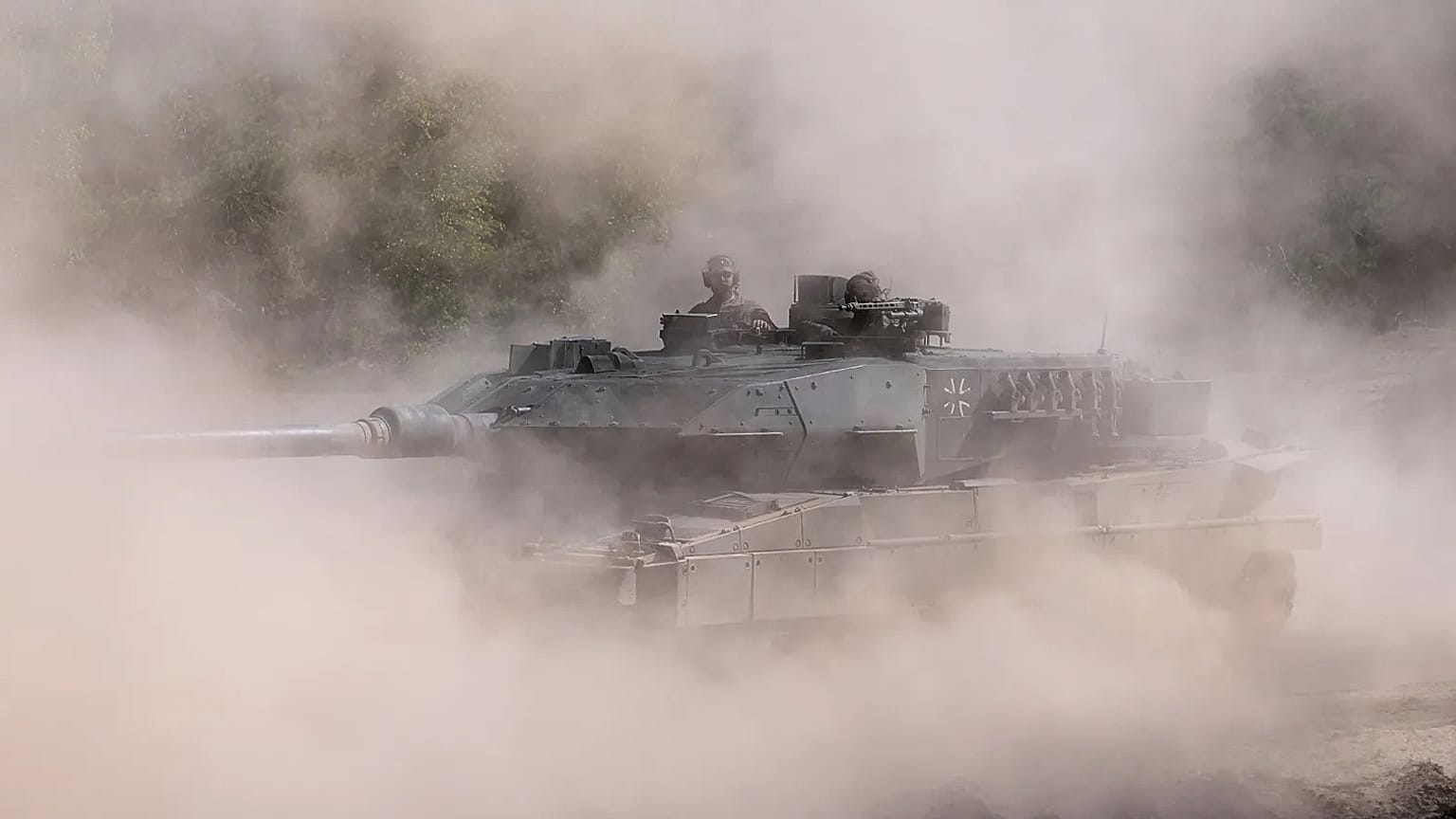
Like a loaded gun: EU defence ministers are meeting for high-level talks focussing on security across three major areas, spanning Russia’s invasion of Ukraine, the conflict in the Middle East and its ongoing implications, and European defence readiness.
Ukrainian Defence Minister Mykhailo Fedorov will connect via videolink to provide an on-the-ground update to his counterparts of how Russia’s invasion, grinding into its fifth year, is faring. He will also outline what Kyiv needs from its allies to repel Russian forces. The conversation is likely to specifically focus on what weapons, ammunition and defence capabilities it requires.
“The principle that we always underline is that Ukraine is in the driving seat,” a senior EU source said in the run-up to the meeting. “It's very important that Ukraine decides what the needs are, what is being purchased, and it gives Ukraine predictability.”
The comments are in reference to the first tranche of the EU’s €90 billion loan, valued to be €9.1 billion, to be dispersed "as soon as possible" during the second quarter of 2026, the European Commission confirmed on Monday. The big question here is how much of the defence allocation – a total of €60 billion – will be spent on European arms, and which ones.
Second, ministers will discuss the Iran war, with the EU’s top diplomat Kaja Kallas expected to emphasise more money needs to be given to the Lebanese Armed Forces to help disarm Hezbollah and restore state control in Lebanon.
There will also be chatter around shoring up security in the Strait of Hormuz when and if the blockade by the Iranians ends, as well as exploring the “willingness” of member states to ensure the freedom of navigation, a senior EU source said.
This is expected to come off the back of discussions between more than 50 countries in a plan led by Britain and France to re-open and facilitate passage through the Strait of Hormuz once the war is over.
The agenda’s final point is shoring-up the bloc’s own security. Micael Johansson, the President of the Aerospace, Security and Defence Industries Association of Europe, will speak about defence production: what the gaps are, and how they can be plugged. It will help inform the Commission's strategy to respond to crises, should they materialise.
“What is essential is that we have the capacity to act,” a senior EU source said, stating the dialogue should follow-on from theoretical wargames among ambassadors weeks ago.
This is what sits at the core of the talks. But there are other issues, notably whether the EU should directly engage with Russia, that preoccupy much of the watercooler chat and commentary on the red carpet. This topic, of whether to thaw EU-Russia relations amid the ongoing invasion, is not a new ministerial discussion point.
This time, however, something’s different: Ukrainian President Volodymyr Zelenskyy has grown exasperated by the White House’s diplomacy and has publicly called on Europeans to have “one common voice”.
And yet, the topic continues to sharply divide member states, as it became obvious during yesterday’s meeting of foreign ministers. Some stressed the need to have a seat at the table and a negotiating team, while others insisted on approving further sanctions to weaken Moscow’s negotiating hand.
At the end of the meeting, Kallas admitted the hot-button topic isn’t mature yet and requires further discussions to arrive at a common position.
“The EU has always supported attempts to achieve a just and lasting peace,” Kallas told reporters. “For Europe to take a more active role, we must agree amongst ourselves what we want to talk to Russia about and what our red lines are.”
Our reporter Jorge Liboreiro breaks down the state of play.
Evading justice: Wanted former Polish minister confirms he fled Hungary to US
Poland's former justice minister Zbigniew Ziobro has confirmed he fled Hungary to the United States following local media reports.
As reported by Lukasz Aftanski and Gavin Blackburn, Ziobro received asylum by the government of right-wing ally Viktor Orbán's last year, and faces up to 25 years in prison in Poland if convicted of the charges laid against him.
These includes abuse of power, leading an organised criminal enterprise and using funds meant for crime victims to buy Israeli Pegasus spyware, allegedly to monitor political opponents.
After Orbán's party was ousted from power in an election in April, Hungary's new Prime Minister Péter Magyar – sworn in on Saturday – said that Hungary would no longer protect people wanted elsewhere.
"Hungary will no longer be a dumping ground for internationally wanted criminals," he told journalists the day after his victory, naming as examples Ziobro and his former deputy, Marcin Romanowski, suspected of embezzling nearly €40 million.
EU approves sanctions on Israeli settlers after Hungarian backing
The EU agreed on Monday to sanction Israeli settlers over their violence against Palestinians in the West Bank, a move enabled by backing from Hungary’s incoming government.
As reported by Maïa de la Baume, the EU’s top diplomat Kaja Kallas trumpeted the news to journalists following a meeting in Brussels on Monday, stating: “Today, we reached a political agreement to sanction Israeli extremists settlers and entities.”
“We move from political deadlock that was there for a long time. Violence and extremism carry consequences.”
Kallas added in a post on X earlier on Monday that the measures – including asset freezes and travel bans – will also target members of Hamas, which the EU designates as a terrorist organisation. This is a condition required by some countries in order to support the sanctions.
The sanctions come amid what UN Human Rights spokesperson Thameen Al-Kheetan recently described as Israel’s “unlawful settlement expansion” and the “annexation of large parts of the occupied West Bank.” They also follow two months of ongoing violence against Palestinians in the territory.
More from our newsrooms
Which EU capitals have rents higher than minimum wages?
Euronews Business takes a look at gross minimum wages and average rent costs across EU countries and their capital cities. In many capitals, even the gross minimum wage is not enough to cover rent. Servet Yanatma digests the data.
Has Amsterdam banned meat adverts to avoid offending Muslims?
The Dutch capital recently banned adverts depicting meat products, with European far-right figures claiming the reason behind the move is to appease Muslims. The Cube’s James Thomas uncovers the truth.
We're also keeping an eye on
- European Commission President Ursula von der Leyen visits Copenhagen, Denmark for the European Summit on Artificial Intelligence and Children.
- European Commission Executive Vice-President for Social Rights and Skills, Quality Jobs and Preparedness Roxana Mînzatu will meet Ukrainian Minister of Education and Science Oksen Lisovyi in Brussels, Belgium.
That’s it for today. Jorge Liboreiro contributed to this newsletter.